Q1 2026 FX quarterly outlook – Majors and key crosses


Macro backdrop: Setting the scene for Q1 2026
As we move into Q1 2026, the FX market is increasingly defined by policy divergence narrowing, rather than widening. The dominant macro theme through 2025 — US exceptionalism — has begun to soften. The Federal Reserve is now firmly in an easing cycle, while several major central banks are either holding steady or only cautiously adjusting policy.
In plain terms, the US dollar no longer enjoys the same structural advantage it once did. Rate differentials are compressing, global growth has stabilised rather than deteriorated, and risk appetite remains constructive. This does not imply a collapse in the dollar, but it does suggest that USD strength is more vulnerable to corrections than in previous years.
Europe’s growth outlook remains modest, but stability — rather than deterioration — is proving supportive for the euro. The ECB appears comfortable maintaining policy at current levels while monitoring inflation persistence. In contrast, Japan is slowly transitioning away from ultra-loose policy. While this shift is gradual, it introduces an asymmetric risk: any acceleration in Japanese inflation or wage growth could prompt sharper yen moves.
Commodity-linked currencies such as the Australian and New Zealand dollars are benefitting from a steadier China outlook and improved global risk sentiment, though upside remains measured. Meanwhile, safe-haven currencies like the Swiss franc continue to trade more as risk proxies than pure yield instruments.
Against this backdrop, Q1 2026 looks set to be a quarter where technicals dominate execution, with macro acting as a validating — rather than leading — force.
Major currency pairs – Technical outlook with macro context
EUR/USD
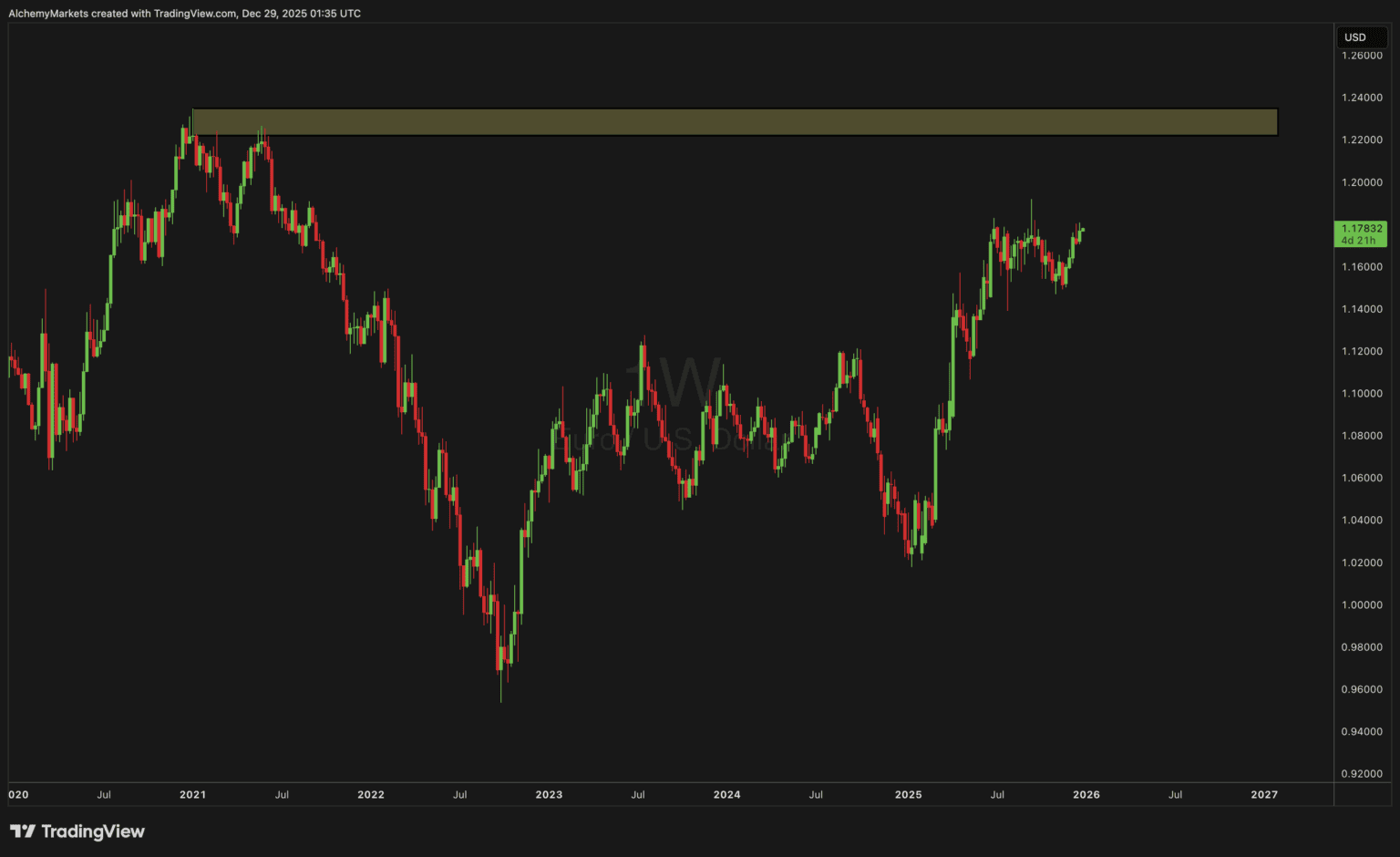
From a technical perspective, EUR/USD remains constructive. The pair has established a clear higher-low structure following its 2022–2023 base and continues to respect medium-term support zones. Price action suggests sustained upside momentum rather than a corrective rally.
The technical roadmap points towards a move into the 1.22–1.23 region, where longer-term supply previously capped advances. Momentum indicators remain supportive and have yet to show meaningful bearish divergence.
Macro conditions quietly reinforce this bias. With the Federal Reserve easing and the ECB holding steady, interest rate differentials are no longer working decisively against the euro. As long as US data does not re-accelerate meaningfully, dips in EUR/USD are likely to be viewed as opportunities rather than trend reversals.
Q1 2026 bias: Bullish continuation towards 1.23.
USD/JPY

USD/JPY is at a technically delicate point. After an extended advance, the pair appears to be completing a broader corrective structure. The price action aligns with a potential move into an Elliott Wave triangle wave E, suggesting scope for a deeper pullback rather than immediate continuation higher.
Technically, momentum has begun to flatten, and the structure favours a corrective phase rather than trend acceleration. While the broader trend remains intact, the asymmetry now favours downside correction.
The macro catalyst that could trigger this move lies squarely with Japan. Any signs of sustained wage growth, firmer inflation prints, or clearer BOJ guidance towards further normalisation would be sufficient to compress yield spreads and strengthen the yen. In an environment where US yields are already drifting lower, USD/JPY becomes increasingly sensitive to even modest Japanese policy shifts.
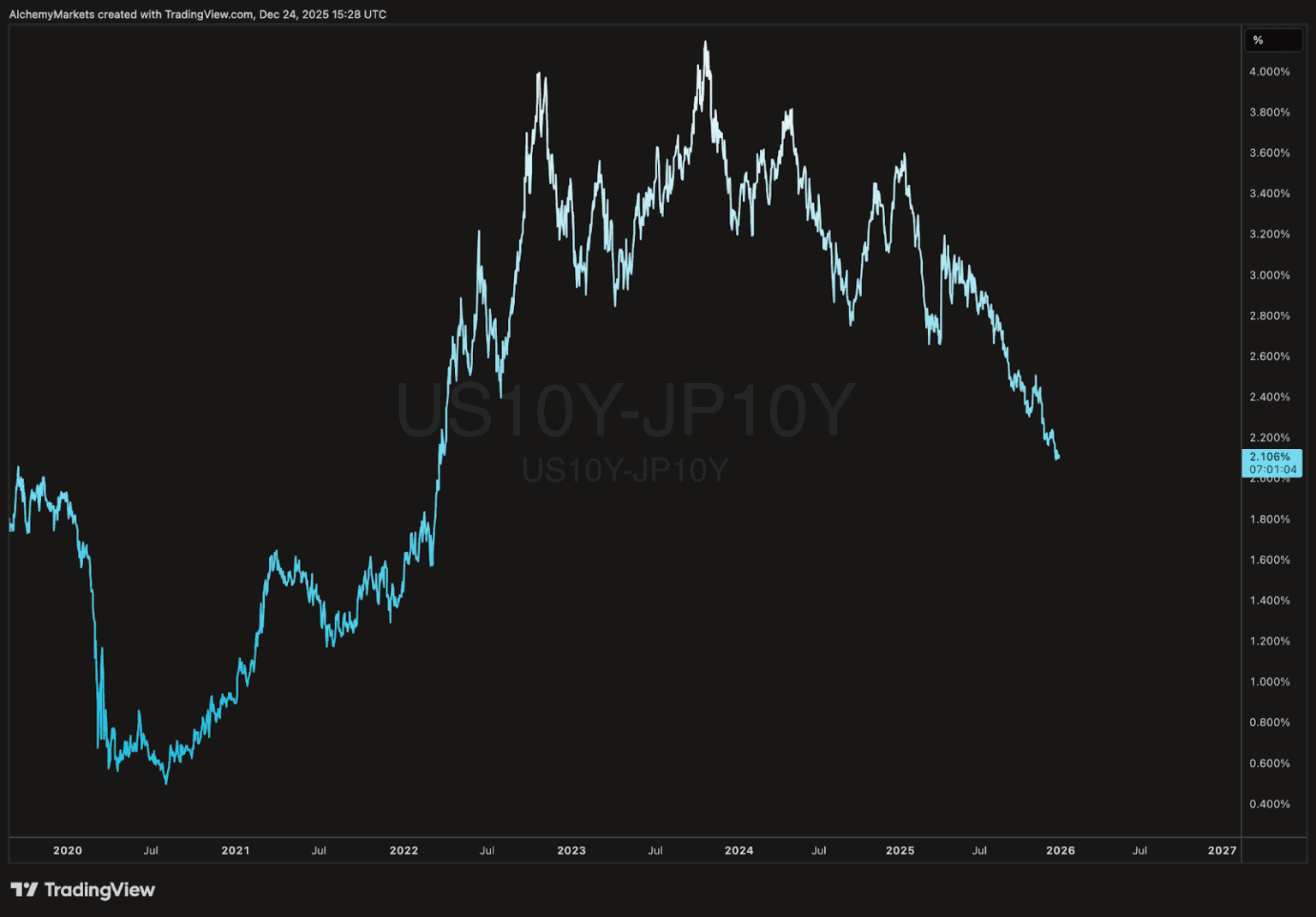
Importantly, the US–Japan 10-year yield spread has been trending lower, removing a key pillar of USD/JPY support. Unless this differential reverses decisively back in favour of the US, rallies are likely to remain corrective, reinforcing the case for further downside into Q1.
Q1 2026 bias: Corrective move lower into wave E.
GBP/USD
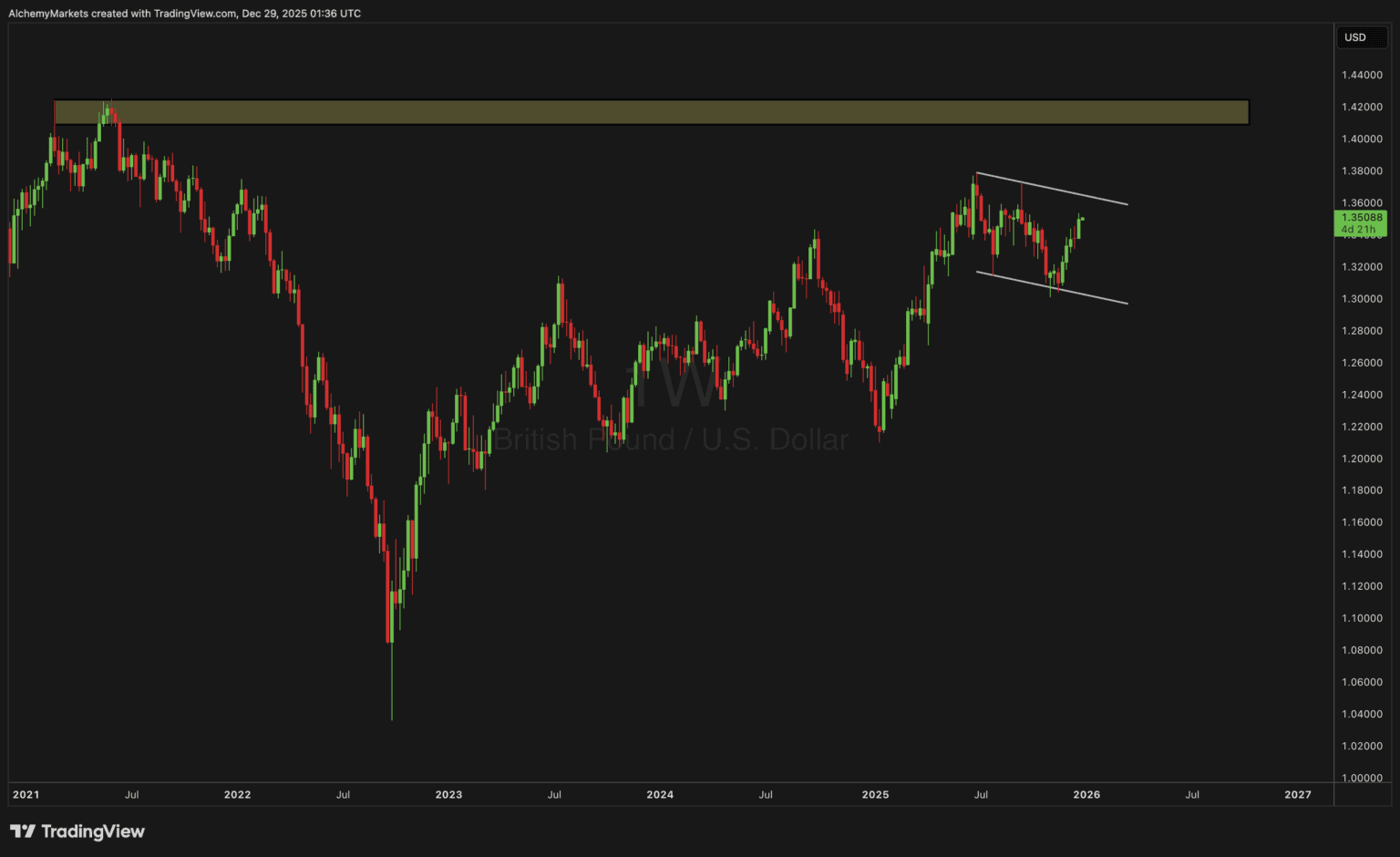
GBP/USD continues to consolidate within what increasingly resembles a bullish continuation flag rather than a broader corrective structure. Price action has respected higher lows while compressing beneath resistance, suggesting accumulation rather than distribution.
Technically, the bias favours a break higher from the flag, with momentum stabilising and structure supporting continuation. A confirmed breakout would shift focus towards higher-timeframe resistance, rather than a return to the lower bounds of the pattern.
From a macro perspective, the backdrop remains quietly supportive. With the Federal Reserve easing and the Bank of England maintaining a cautious, measured stance, rate differentials are no longer a meaningful headwind for sterling. Provided UK data avoids material deterioration, macro conditions do little to obstruct a technical breakout.
Q1 2026 bias: Upside continuation following a flag break, targeting the 1.42 region.
USD/CHF
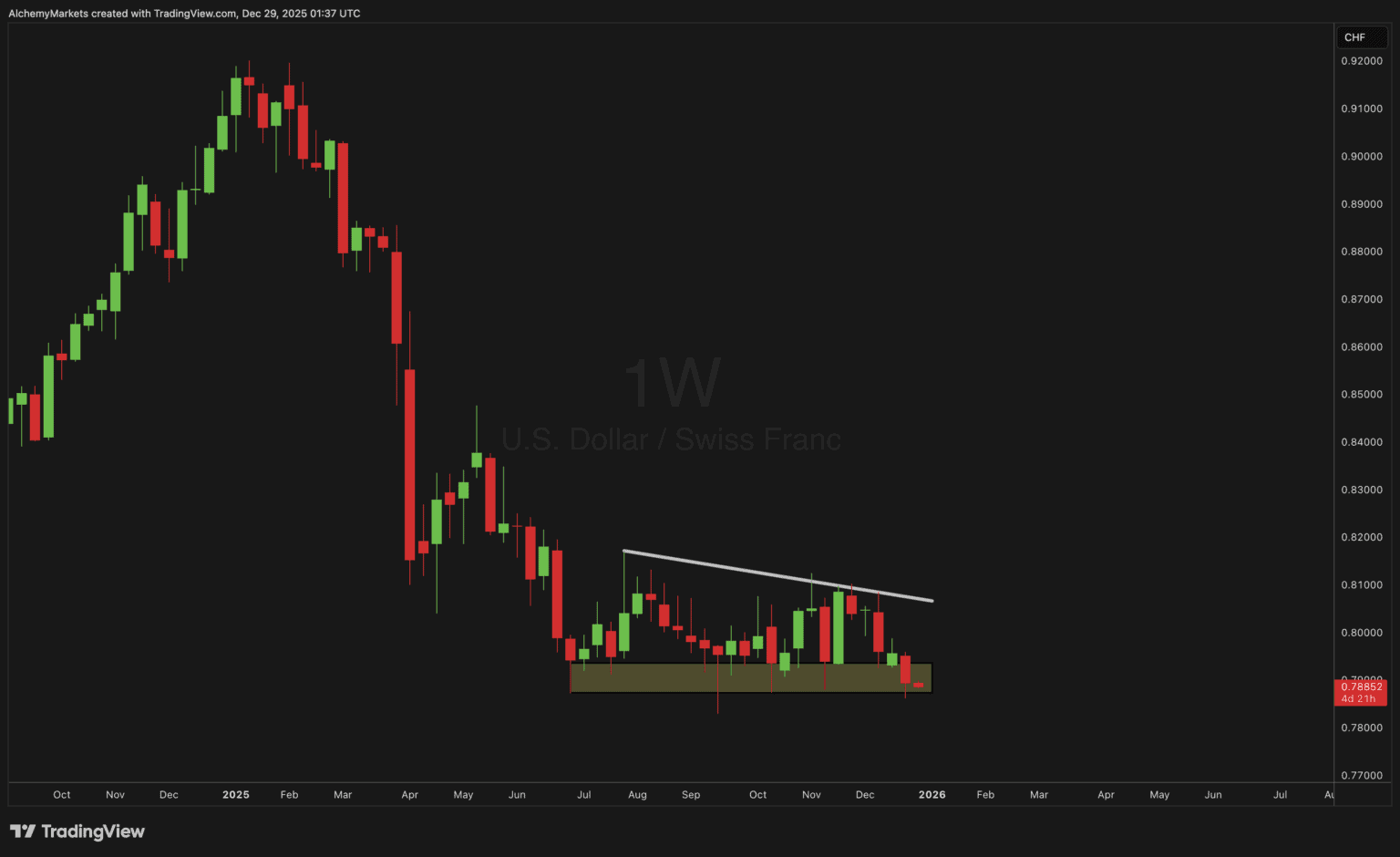
USD/CHF presents one of the cleaner technical structures among the majors. The pair is trading within a descending triangle, with repeated failures at lower highs compressing price against a well-defined base.
This pattern favours a downside resolution, particularly if support gives way on a closing basis. Momentum indicators remain soft and do not suggest imminent reversal.
Macro conditions align neatly with the technical picture. With the Swiss National Bank largely on hold and global risk sentiment stable, CHF strength is more likely to emerge through USD weakness rather than domestic tightening. In risk-neutral to mildly risk-on conditions, USD/CHF downside becomes increasingly plausible.
Q1 2026 bias: Bearish breakdown from the descending triangle.
AUD/USD
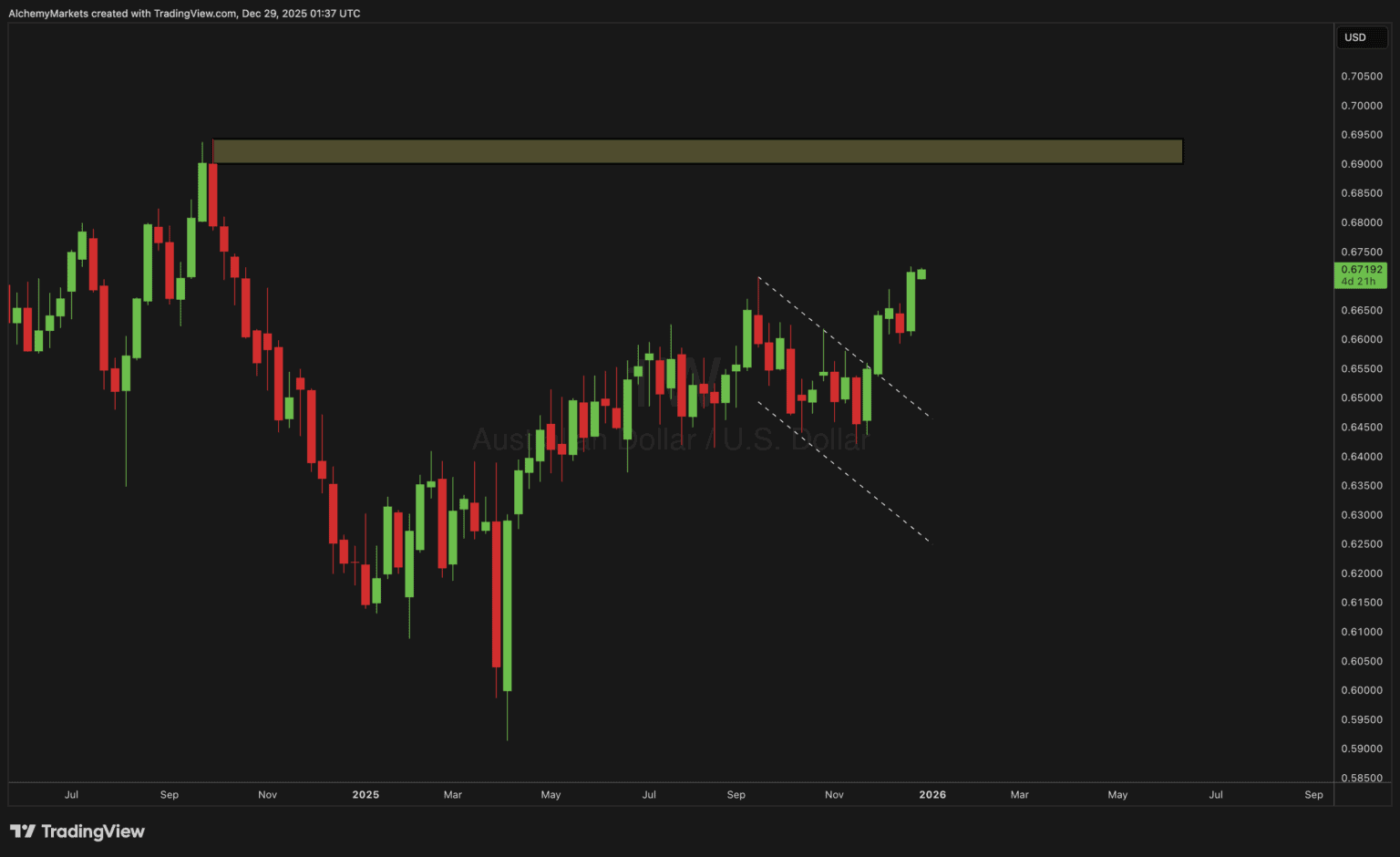
AUD/USD remains constructive but measured. The pair has recovered strongly from its 2025 lows and continues to build a base beneath longer-term resistance.
Technically, price action supports a move towards the 0.69 region, though the structure suggests this level may not be fully reached within Q1 alone. Momentum is improving, but not yet stretched.
Macro conditions provide gentle tailwinds rather than strong propulsion. The RBA’s reluctance to signal rapid easing contrasts with a dovish Fed, while stabilising commodity demand supports the broader AUD outlook. That said, the absence of a strong global growth impulse limits upside velocity.
Q1 2026 bias: Gradual upside towards 0.69, potentially incomplete.
USD/CAD
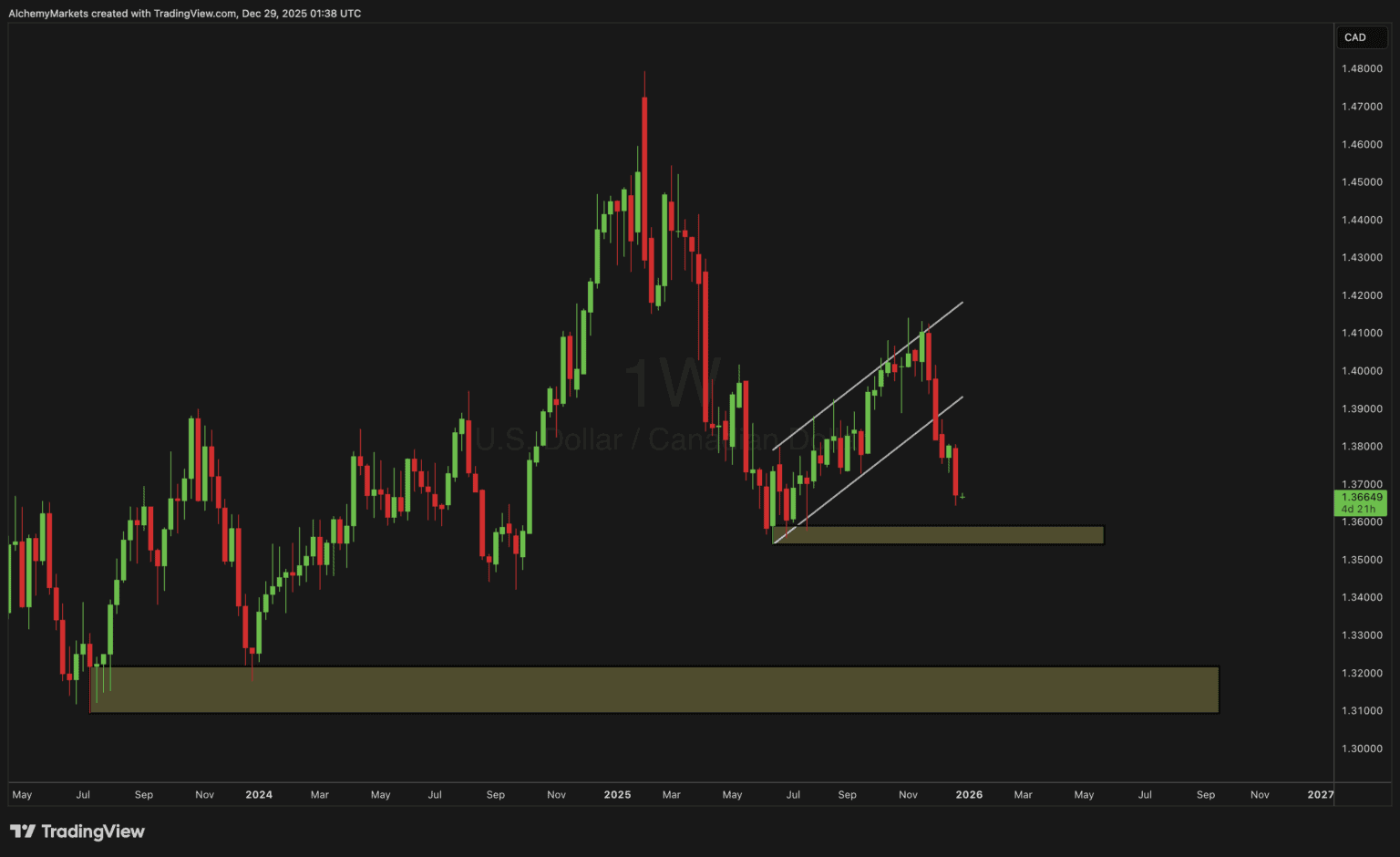
USD/CAD has decisively broken lower from a bearish continuation structure, shifting the technical bias firmly to the downside. Recent price action suggests the market is now entering the next phase of that move rather than merely correcting within a range.
Technically, the near-term focus is on a move into the 1.36 region, which represents the first key support area. A clean break below this level would confirm continuation and open the door towards the 1.32 zone, where longer-term demand previously emerged and where the broader move would likely begin to stabilise.
From a macro perspective, the backdrop remains consistent with this view. A Federal Reserve easing cycle combined with a steadier Bank of Canada stance leaves USD/CAD vulnerable, particularly if oil prices remain supported. Until proven otherwise, rallies appear corrective rather than trend-changing.
Q1 2026 bias: Initial move towards 1.36, followed by downside continuation towards 1.32 on a confirmed break
NZD/USD
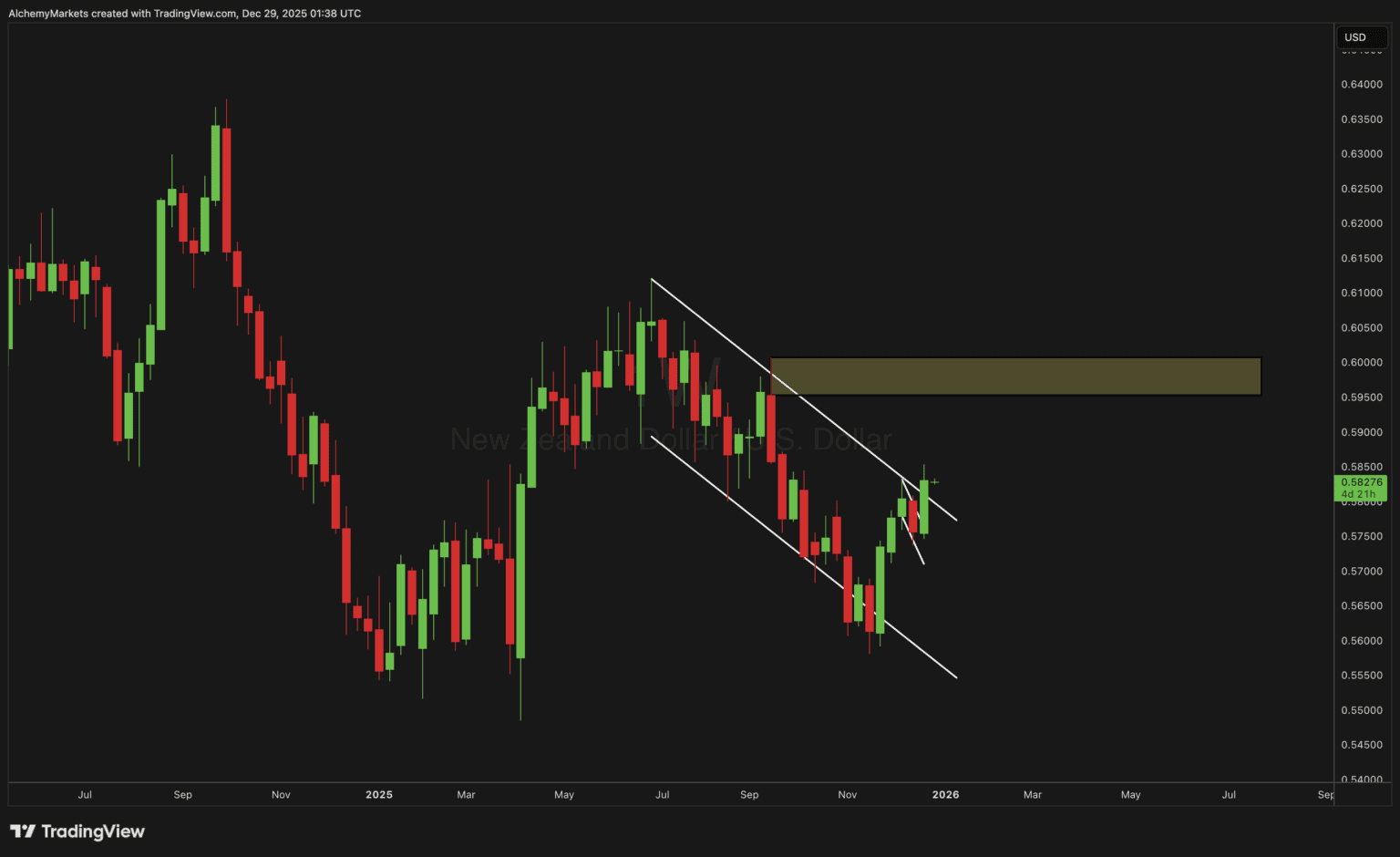
NZD/USD has broken higher from a bull flag, confirming a medium-term shift in structure. However, the follow-through appears measured rather than explosive.
Technically, while a full measured move towards the flag base remains possible, price is more likely to target the next key resistance zone near 0.60 within the quarter. Momentum is constructive but not extreme.
Macro conditions echo this tempered optimism. The New Zealand dollar remains highly sensitive to global risk appetite and commodity flows, both of which are supportive — but not accelerating sharply.
Q1 2026 bias: Upside continuation towards 0.60, partial move.
Author
Zorrays Junaid
Alchemy Markets
Zorrays Junaid has extensive combined experience in the financial markets as a portfolio manager and trading coach. More recently, he is an Analyst with Alchemy Markets, and has contributed to DailyFX and Elliott Wave Forecast in the past.