EUR/USD Forecast: A weekly close above 1.0700 could be a bullish sign
- EUR/USD has managed to capitalize on risk flows.
- The pair remains on track to close the second straight week in positive territory.
- Dollar struggles to keep its footing ahead of the key inflation data.


EUR/USD has regained its traction and continued to push higher after having closed above 1.0700 on Thursday. The pair remains on track to post gains for the second straight week and the technical outlook suggests that sellers remain on the sidelines.
The positive shift witnessed in risk sentiment in the American session on Thursday caused the dollar to lose interest. The S&P 500 Index gained nearly 2% and the greenback struggled to find demand with investors moving away from safe-haven assets. The US Dollar Index, which tracks the dollar's performance against a basket of six major rivals, trades at its lowest level in a month below 102.00 early Friday, allowing EUR/USD to stay afloat above 1.0700.
Earlier in the day, European Central Bank (ECB) Governing Council member Pablo Hernandez de Cos reiterated that the first rate hike will come shortly after they end the QE in Q3 but added the process of increasing rates should be gradual. Nevertheless, investors paid little to no attention to these comments.
In the second half of the day, the US Bureau of Economic Analysis' Personal Consumption Expenditures (PCE) Price Index will be watched closely by market participants. Investors expect the Core PCE Price Index, the Fed's preferred gauge of inflation, to decline to 4.9% on a yearly basis in April from 5.2% in March. A higher-than-expected print could revive inflation fears and trigger a flight to safety. In that case, the dollar could gather strength ahead of the weekend and weigh on EUR/USD.
US Core PCE Preview: Why there is room for a dollar-lifting upside surprise.
On the other hand, a soft PCE inflation print should allow risk flows to dominate the financial markets and help EUR/USD preserve its bullish momentum.
EUR/USD Technical Analysis
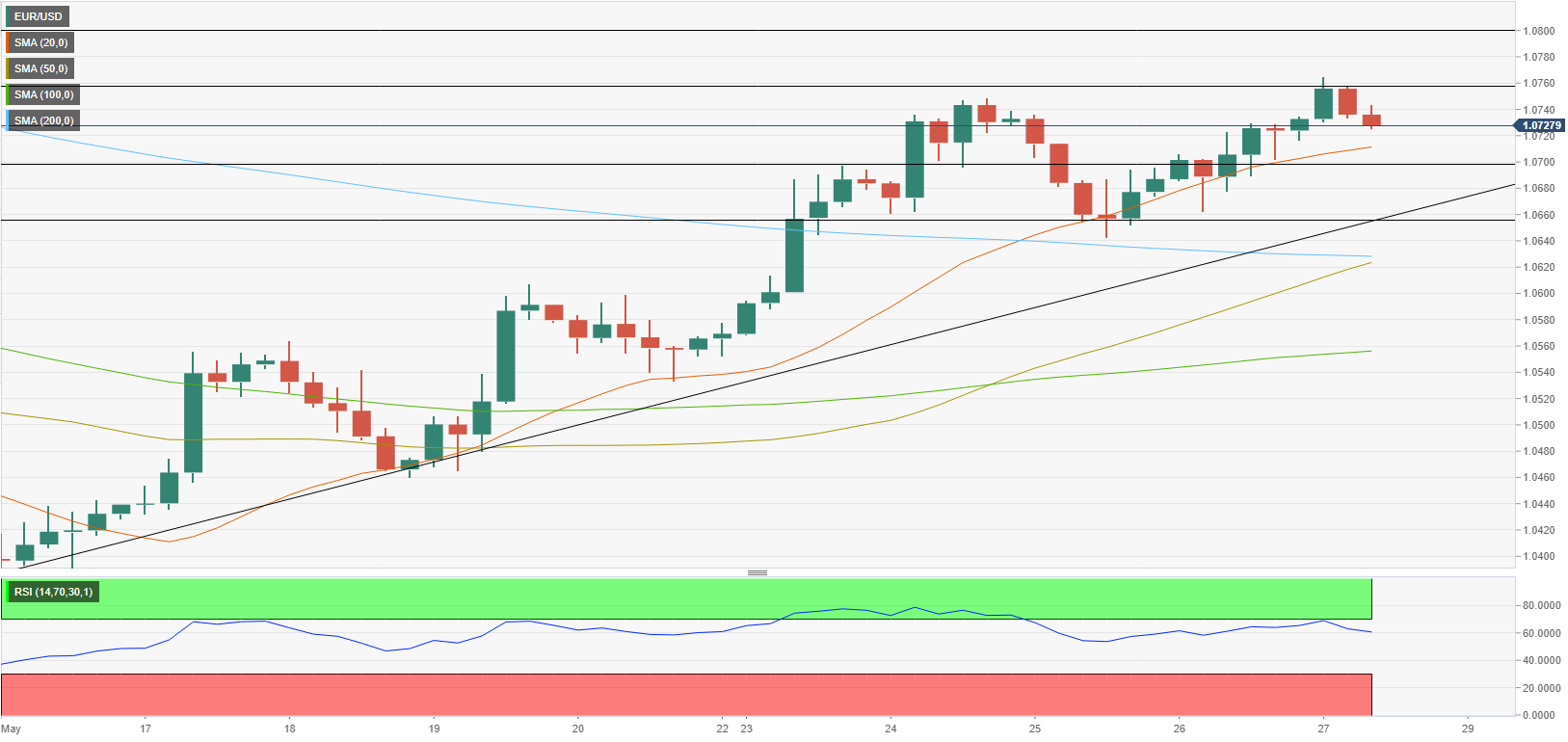
The near-term technical outlook shows that the bullish bias remains intact for the time being. EUR/USD holds above the ascending trend line coming from mid-May and the Relative Strength Index (RSI) indicator on the four-hour chart holds comfortably above 50.
On the upside, static resistance seems to have formed at 1.0760. 1.0800 (psychological level) aligns as the next hurdle.
Initial support is located at 1.0700 (psychological level, 20-period SMA) before 1.0660 (ascending trend line, static level) and 1.0630 (200-period SMA). As long as the pair manages to end the week above 1.0700, sellers are likely to remain on the sidelines.
Premium
You have reached your limit of 3 free articles for this month.
Start your subscription and get access to all our original articles.
Author
Eren Sengezer
FXStreet
As an economist at heart, Eren Sengezer specializes in the assessment of the short-term and long-term impacts of macroeconomic data, central bank policies and political developments on financial assets.