EUR/USD Analysis: Remains trapped in a nearly two-week trading range
- EUR/USD edges higher on Tuesday.
- Expectations for additional ECB rate hikes underpin the Euro and act as a tailwind.
- Bets for an imminent pause by the Fed weigh on the USD.


The EUR/USD pair attracted some dip-buying near the 1.0675 region on the first day of a new week and finally settled near the top end of its daily trading range. The Euro got a minor lift after European Central Bank (ECB) President Christine Lagarde said that additional interest rate rises were likely as there is no clear evidence that underlying inflation has peaked. This comes on the back of the recent hawkish comments by several ECB officials and reaffirmed market bets that the central bank is not done raising rates despite a fall in inflationary pressures. Headline Eurozone CPI decelerated more than anticipated to 6.1% YoY in May from 7.0% in April. Moreover, Core CPI slowed from 5.6% YoY to 5.3% last month. Apart from this, the emergence of some US Dollar (USD) selling contributed to the pair's goodish intraday bounce of around 50 pips.
In fact, the USD Index (DXY), which tracks the Greenback against a basket of currencies, lost steam and surrendered modest intraday gains following the disappointing release of the US ISM Services PMI, which fell to 50.3 in May. This, along with the last week's dovish rhetoric from several FOMC officials, reaffirmed market expectations for an imminent pause in the Federal Reserve's (Fed) policy tightening cycle. In fact, markets are pricing in a greater chance that the US central bank will leave interest rates unchanged at the end of a two-day policy meeting on June 14. This led to the overnight sharp decline in US Treasury bond yields, which keeps the USD bulls on the defensive through the Asian session on Tuesday and continues to lend support to the EUR/USD pair. That said, the cautious market mood could lend some support to the safe-haven buck and cap gains for the major.
Nevertheless, the aforementioned fundamental backdrop seems tilted in favour of bulls and supports prospects for some intraday appreciating move for the EUR/USD pair. Market participants now look forward to the release of German Factory Orders data and the Eurozone Retail Sales figures for a fresh impetus. Meanwhile, there isn't any relevant market-moving economic data due for release from the US, leaving the Greenback at the mercy of the US bond yields and the broader risk sentiment.
Technical Outlook
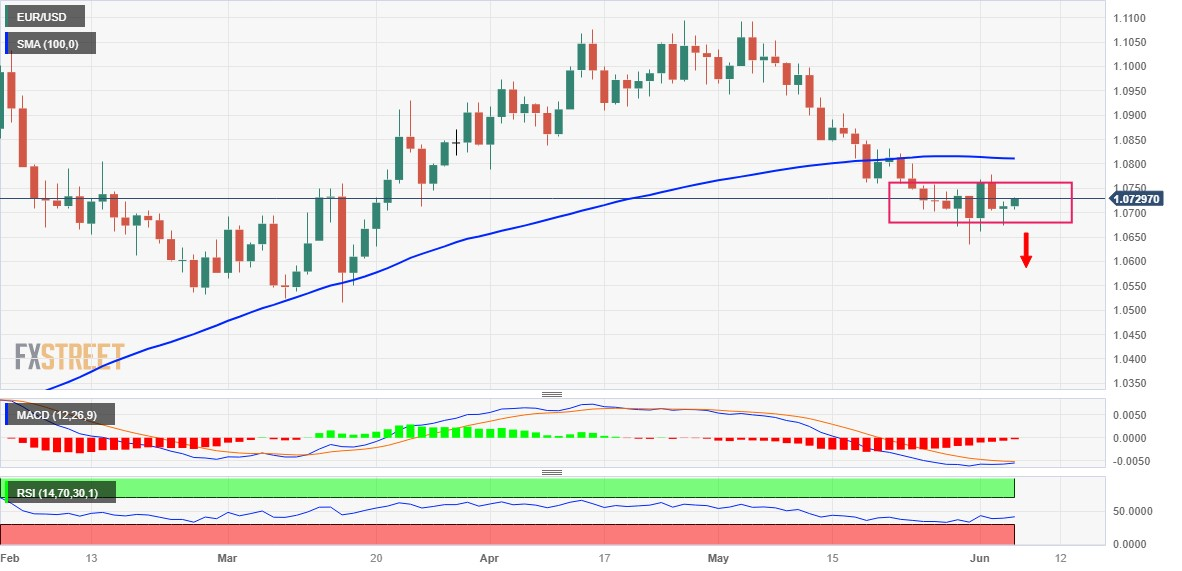
From a technical perspective, the EUR/USD pair has been oscillating in a familiar trading band over the past two weeks or so. The range-bound price action constitutes the formation of a rectangle on the daily chart. Against the backdrop of the recent pullback from over a one-year high and a breakdown below the 100-day Simple Moving Average (SMA), this might still be categorized as a bearish consolidation phase.
Moreover, oscillators on the daily chart – though have been recovering from lower levels – are still hovering in the negative territory. Bearish traders, however, need to wait for acceptance below the 1.0700 mark before positioning for any further losses. This is followed by last week's swing low, around the 1.0635 region, below which spot prices could weaken further below the 1.0600 round figure, towards testing intermediate support near the 1.0540-1.0535 area before eventually dropping to the 1.0500 psychological mark.
On the flip side, any subsequent move-up is likely to meet with a fresh supply around the 1.0760-1.0770 zone and remain capped near the 1.0800 mark. The latter coincides with the 100-day SMA, which if cleared decisively will negative the near-tern negative outlook and trigger a short-covering rally. The EUR/USD pair might then climb further below the 1.0855-1.0860 region and aim to reclaim the 1.0900 mark.
Premium
You have reached your limit of 3 free articles for this month.
Start your subscription and get access to all our original articles.
Author
Haresh Menghani
FXStreet
Haresh Menghani is a detail-oriented professional with 10+ years of extensive experience in analysing the global financial markets.

















