EUR/USD analysis: nearing 1.1400 ahead of ECB's monetary policy meeting

EUR/USD Current Price: 1.1386
- Hopes of a soon-to-come end to the US government shutdown diluted, hurting the greenback.
- The ECB is largely expected to maintain its policy unchanged, statement seen dovish.
The market woke up from its lethargy and the result was no good for the greenback. The American currency was sold off in the last trading session of the day, as hopes for a soon solution to the ongoing government partial shutdown diluted after the Republican Leader of the Senate, McConnell said that they plan to hold a vote on Thursday on funding the government until February 8, but won't discuss funding a border wall as believed earlier. US President Trump has rejected similar bills coming from the House of Representatives, so prospects are no good. The EUR/USD pair, which was trading around 1.1360 jumped to flirt with the 1.1400 figure but was unable to regain it. The common currency rallied in spite of local consumer confidence remaining subdued, as the preliminary reading for January came in at -7.9, worse than the -6.5 expected. The US just released minor figures that failed to impress.
Thursday will be quite a busy day, as not only the US Senate will meet, but also, European policymakers. The ECB is expected to maintain its current monetary policy unchanged after putting an end to QE last December. Head Draghi recently said that the economy is doing worse than expected, clarifying that a recession is still out of sight. Given that data has remained soft ever since the last meeting, the market is pricing in a dovish outcome, but not a dovishness that can rock the boat. Preliminary January PMIs for the EU and the US will also be out this Thursday, with the European indexes expected to have picked up slightly from final December figures, and US ones seen worsening, also when compared with the previous month.
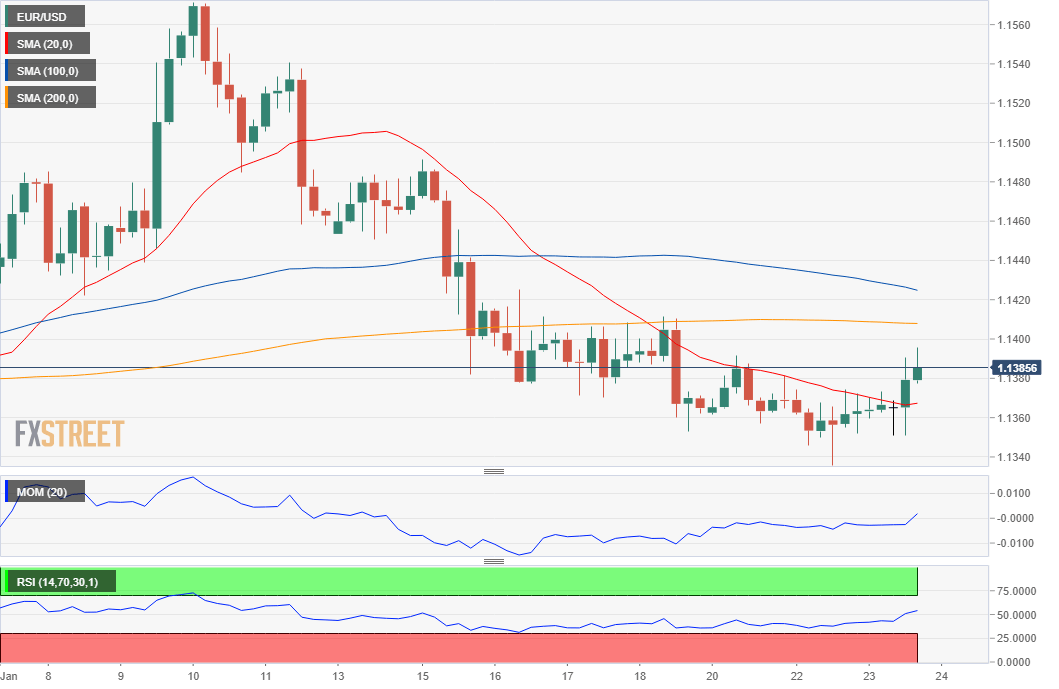
Heading into the Asian opening the EUR/USD pair trades around 1.1380 a major Fibonacci level that has been bothering speculative interest for already a week, as the pair seems unable to catch directional momentum either side of it. The 4 hours chart shows that the pair recovered above its 20 SMA, still developing below directionless 100 and 200 SMA, while technical indicators turned higher, entering positive ground although with limited upward strength, falling short of confirming further gains ahead. The upside will look more constructive on a break above 1.1425 strong static resistance area, also the 50% retracement of the December/January rally.
Support levels: 1.1350 1.1310 1.1275
Resistance levels: 1.1425 1.1460 1.1500
Author

Valeria Bednarik
FXStreet
Valeria Bednarik was born and lives in Buenos Aires, Argentina. Her passion for math and numbers pushed her into studying economics in her younger years.

















