EUR/GBP poised for potential breakdown amid key data

Since the late-August high just above the 0.9300 handle, EUR/GBP has mostly been in a virtual freefall that has been driven in large part by both a European Central Bank that has been vague and hesitant on the prospective tapering of its massive stimulus program, as well as a Bank of England that has been sending hawkish signals on the potential for higher rates and tighter monetary policy in the UK. Exacerbating pressure on the euro most recently was the German federal election over the past weekend which, despite a win for incumbent Chancellor Angela Merkel and her party, saw the unexpected rise to prominence of a right-wing, nationalist group in the AfD.
The end of this week brings a few more key data points that could result in a further significant impact on the EUR/GBP currency pair. Friday brings current account and trade data from the UK along with UK GDP, both for the 2nd quarter of this year. Additionally, Bank of England Governor Mark Carney will speak at a BoE conference. Also on Friday, the Eurozone will release key inflation data in the form of CPI and core CPI (excluding food, energy, alcohol, and tobacco) flash estimates.
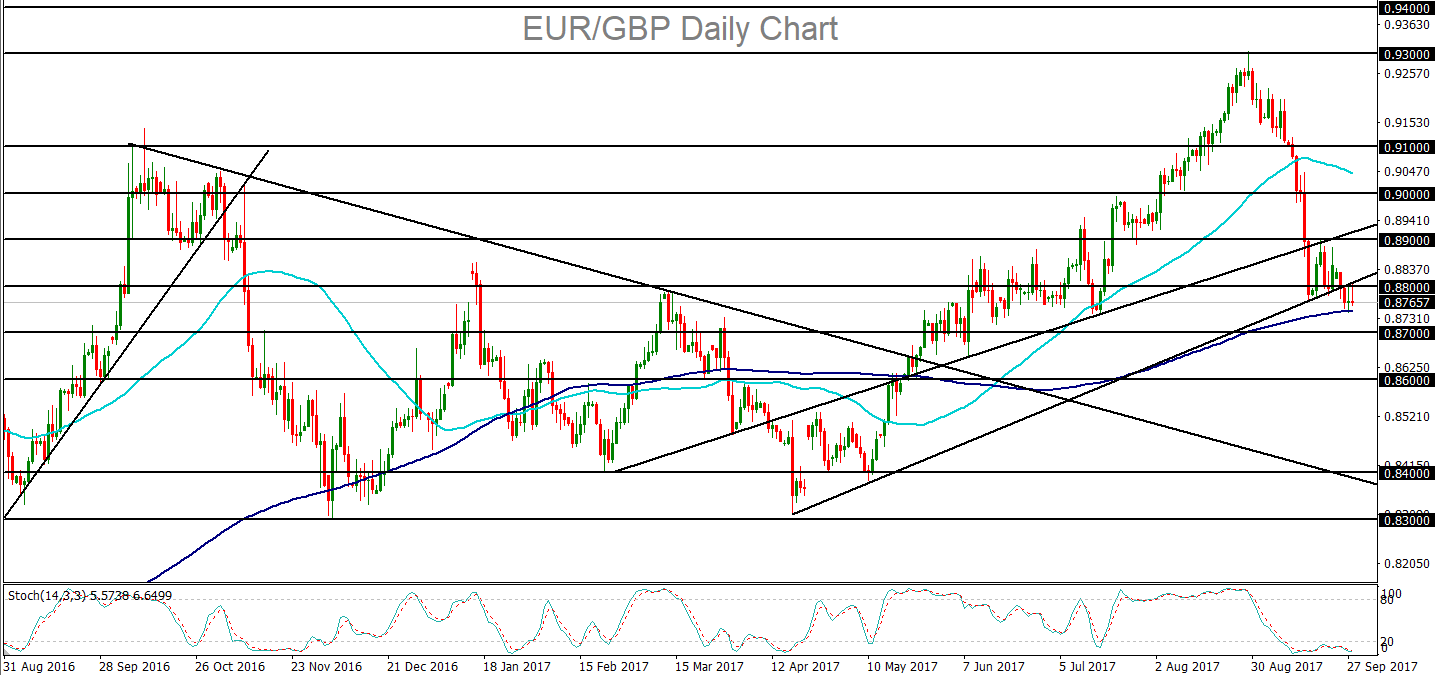
From a technical perspective, the EUR/GBP chart continues to look exceptionally bearish, as it has since hitting its late-August highs. Earlier this month, the currency pair consolidated its large previous losses by trading in an inverted pennant pattern. This consolidation pattern was broken to the downside in the aftermath of last weekend’s German election. In the few days since that breakdown, the pair has again consolidated, this time just above its key 200-day moving average, which it has been trading well above since late May. Amid Friday’s key economic data from both the UK and Eurozone, there is potential for continued downside pressure on EUR/GBP to resume the bearish trend. With any major break below its 200-day moving average, the potential for further losses and downside momentum increases. In the event of such a breakdown, the next near-term bearish targets are around the 0.8700 and 0.8600 support levels.
Author

James Chen, CMT
Investopedia
James Chen, Chartered Market Technician (CMT), has been a financial market trader and analyst for nearly two decades.