EUR/GBP: On the eve of the August meetings of the central banks

As follows from the report of the Office for National Statistics, published on Wednesday morning, annual inflation in the UK in June fell to 7.9% (stronger than the forecast of 8.2% and well below the May value of 8.7%). The core CPI (excluding food and energy prices) fell in June to 6.9% from 7.1% in May, the PPI - by -3.1% compared to the May value of +0.4%, to -2.7% (in annual terms).
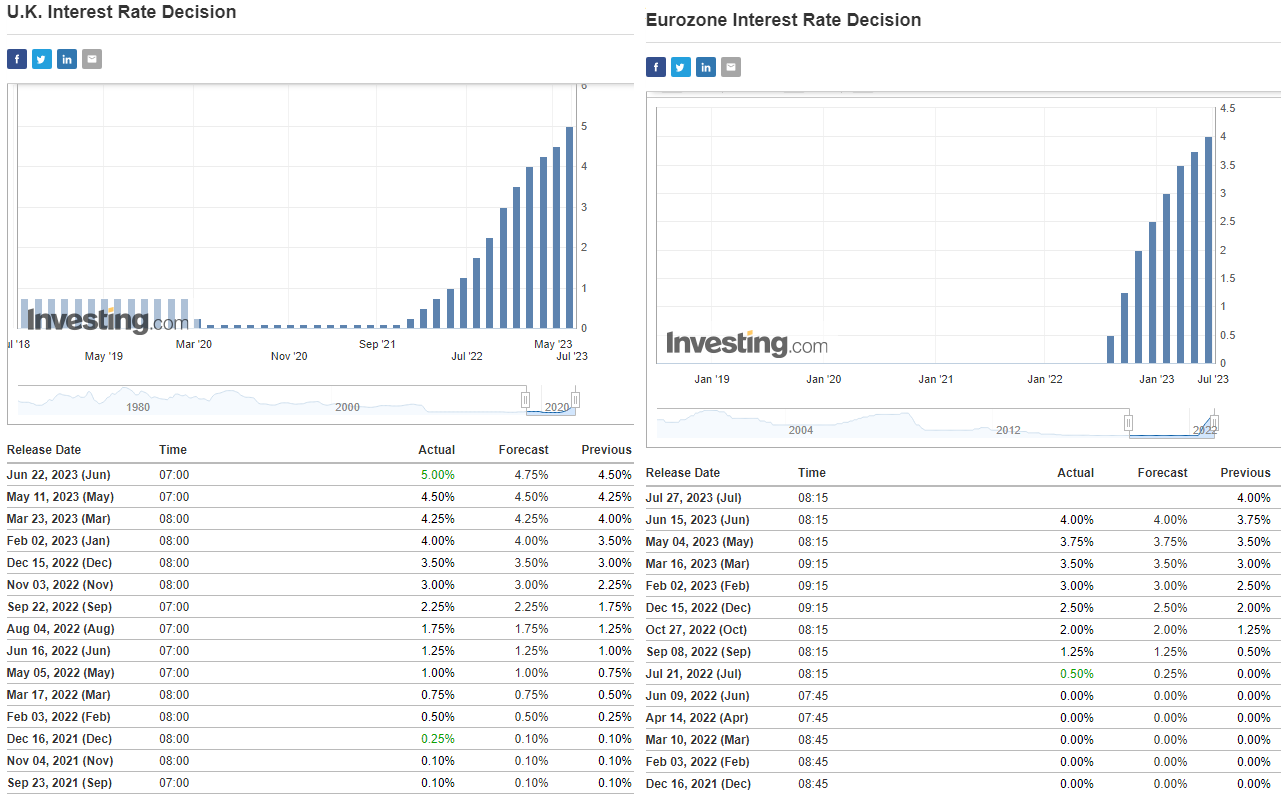
Economists note that the Bank of England is in a much worse situation than the Fed and the ECB. A recent report on the state of the British economy, published last week, signals the imminence of a short-term recession: the country's GDP fell by -0.1% in May (after growing by +0.2% a month earlier) and -0.4% in annual terms (against +0.5% growth in the previous month). At the same time, the volume of industrial production corrected by -0.6% (against -0.2% in April).
In addition, the UK labor market report, also presented last week, indicated an increase in the unemployment rate (for the 3 reporting months to May) from 3.8% to 4.0% and an increase in the number of applications for unemployment benefits in June by +25.7 thousand (after a decrease of -22.5 thousand in the previous month).
Now, after the release of all the above macro data, economists are wondering if the Bank of England will go for a further increase in interest rates at its meeting in August.
It is possible that yes, given the still fairly high level of inflation. Despite the decline, inflation in the UK remains several times higher than the Central Bank's target level of 2% and at the levels of 40 years ago.
But if inflation still continues to slow down, as the presented data showed, then, given the negative impact of a high level of interest rates on the economy, the Bank of England may refrain from such a step.
This means that the pound has room for significant weakening, including against the euro, given the hawkish rhetoric of ECB leaders regarding the parameters of the bank's monetary policy. In other words, the EUR/GBP pair has a chance of resuming a long-term bullish trend.
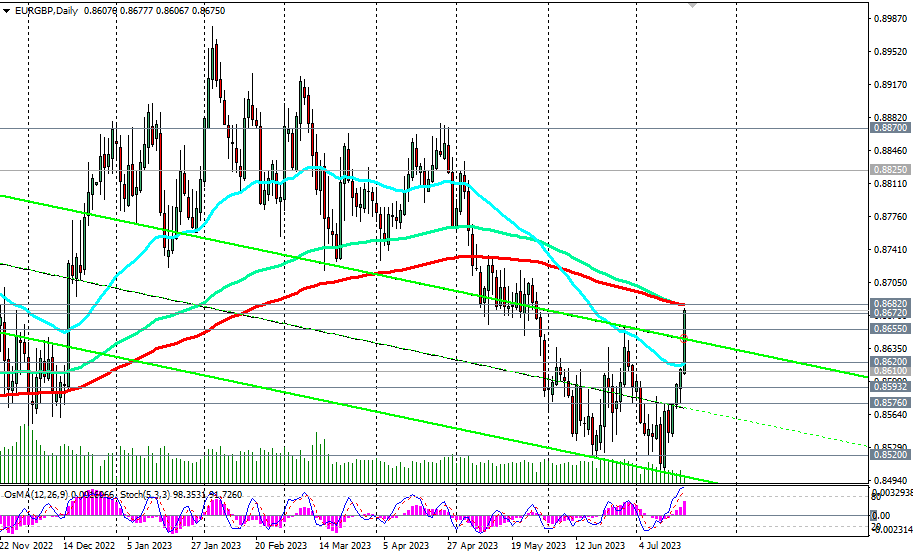
The update of the local high of the environment at 0.8685 and the confirmed breakdown of the key resistance level of 0.8682 will be a signal to resume long positions on EUR/GBP.
In an alternative scenario, EUR/GBP will return to the zone of long-term and medium-term bear markets. Breakdown of the key support level 0.8655 will be the first signal to resume short positions with immediate targets at support levels 0.8620, 0.8600, 0.8593.
Support levels: 0.8655, 0.8620, 0.8600, 0.8593, 0.8576, 0.8520, 0.8500, 0.8485, 0.8400.
Resistance levels: 0.8672, 0.8682, 0.8700, 0.8800, 0.8825, 0.8870.
Author

Yuri Papshev
Independent Analyst
Independent trader and analyst at Forex market. Trade experience - more than 10 years. In trade Yuri Papshev uses a combination of fundamental and technical analysis.