|

EUR/CAD buying the dips at the blue box area

In this technical article we’re going to take a quick look at the Elliott Wave charts of EURCAD published in members area of the website.  As our members know, the pair is showing bullish sequences in the cycle from the August 2022 low.  Our team recommended members to avoid selling , while keep favoring the long side.  Recently we got correction that reached our buying zone. The pair found buyers and made rally from the blue box as expected. In the further text we are going to explain the Elliott Wave Forecast and trading strategy.

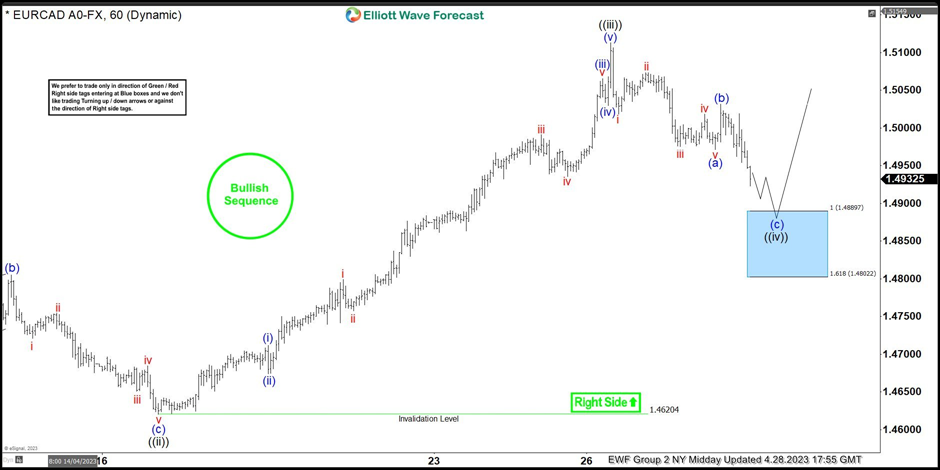
EUR/CAD Elliott Wave 1 hour chart 04.28.2023

The pair is giving us wave ((iv)) pull back that is unfolding as Zig Zag pattern. We expect to get more short term weakness toward 1.4889-1.4802 area which will be our buying zone. We don’t recommend selling the pair against the main bullish trend. Strategy is waiting for the price to reach blue box- equal legs zone, before entering the long trades again.  Once bounce reaches 50 Fibs against the (b) blue high , we will make long position risk free ( put SL at BE) and take partial profits. Invalidation for the long trades is break of 1.618 fib ext : 1.4802.
Chart

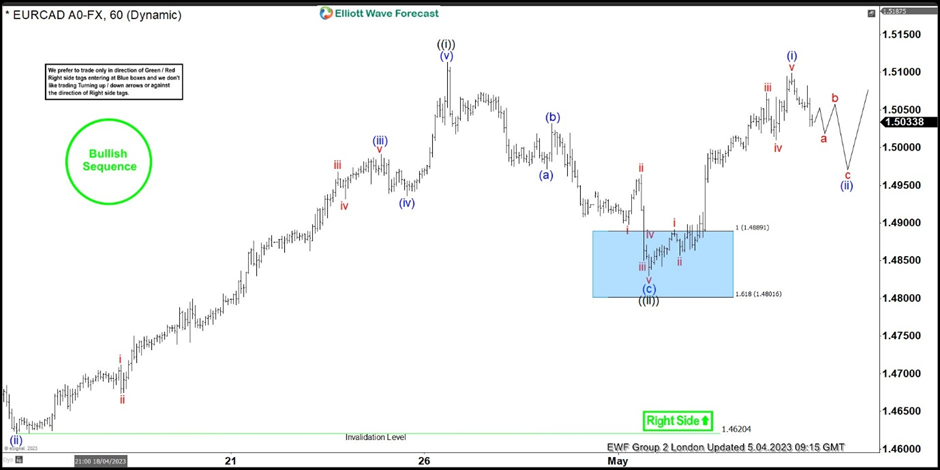
EUR/CAD Elliott Wave 1 hour chart 05.04.2023

EURCAD made decline in (c) leg and reached buying zone at 1.4889-1.4802 area( blue box) . Pull back completed at the 1.4841 low and we got a  very good reaction from the buying zone. Members who took the long trade are enjoying profits now in a risk free positions. Currently EURCAD is giving us pull back against the 1.4841 low. If pivot at that low gives up, we can get a deeper pull back per alternative view.
Chart

Author

Elliott Wave Forecast Team

Elliott Wave Forecast Team

ElliottWave-Forecast.com

More from Elliott Wave Forecast Team
Share:

Editor's Picks

AUD/USD tumbles amid soaring US yields, ahead of jobs data

The Aussie Dollar stumbles over 1% against the US Dollar on Wednesday as US Treasury yields soar, with the US 5- and 10-year T-note yields surpassing the 5% threshold amid investor confidence in further Federal Reserve tightening. The AUD/USD trades at 0.7039 after peaking at 0.7118.

USD/JPY stands firm near mid-157.00s, close to two-week high

USD/JPY hovers around mid-157.00s in the Asian session on Wednesday, near two-week highs touched last Friday as the BoJ's dovish rate hike continues to undermine the Japanese Yen. Meanwhile, the US Dollar remains firm amid the Fed's hawkish stance, adding support to the pair, though JPY intervention fears cap further gains. Markets pay little heed to the completion of the round of US-Iran indirect talks ahead of Trump-Xi meeting.

Gold falls to weekly troughs below $4,300

Gold rapidly leaves behind two daily upticks in a row and comes under heightened downside pressure midweek. Indeed, the precious metal breaches below the $4,300 mark per troy ounce to reach weekly lows amid the marked recovery in the US Dollar and the generalised upbeat tone in the US money market.

Australia unemployment rate expected to remain unchanged at 4.5% in August
Australia will release the August monthly employment report on Thursday at 01:30 GMT. Ahead of the announcement, analysts expect the country to have added 20K new jobs in the month, while the Unemployment Rate is expected to remain steady at 4.5%. The Australian Bureau of Statistics (ABS) report is also expected to show that the Participation Rate stood at 66.9%, unchanged from the previous month.
Freight costs may reach US shelves after the Fed plans to stop hiking

The Federal Reserve has forecast its main reference rate unchanged through 2027, a year when higher shipping costs are likely still reaching US store prices. Shipping a container from Asia to the US costs more than four times what it did before the war with Iran began in late February. International Monetary Fund research puts the peak effect on shop prices roughly a year out, in 2027.

BoJ Recap: Not as hawkish as expected

The Bank of Japan (BoJ) raised its short-term interest-rate target to 1.25% from 1.00% in a 7-2 vote, marking another step in the normalisation of monetary policy and widely matching what everyone has been expecting for weeks.