ETF of the week: Yellow card for sports ETF

Last Friday (20-08-21), Cristiano Ronaldo announced that he would be leaving Juventus FC (BIT: JUVE) and returning to play for the club where he started his professional career, Manchester United (NYSE: MANU). While I’m not a football fan or follower, I understand that Ronaldo is one of the most recognisable faces on the planet and one of the highest-paid athletes. Hence, this transfer can have huge financial ramifications for Ronaldo and associated clubs, apparel makers, and sponsors.
Coincidently, both Juventus and Manchester United are two of the few football clubs publicly listed and traded on open exchanges. Here we can see the Ronaldo effect in action. In the hours immediately preceding the transfer announcement, MANU shares jumped 8% before subsiding, ending the Friday session up 5.8%.
Meanwhile, JUVE rose 1.2%, presumably on the notion that the club will now be able to acquire younger (and less salary heavy) substitutes to help them to return to championship contention.
In light of this announcement, what better time to highlight sport-themed ETFs. Some of which will no doubt have been impacted by Ronaldo’s presence in the sport and his recent transfer between football behemoths.
Roundhill pro sports, media and apparel ETF (MVP)
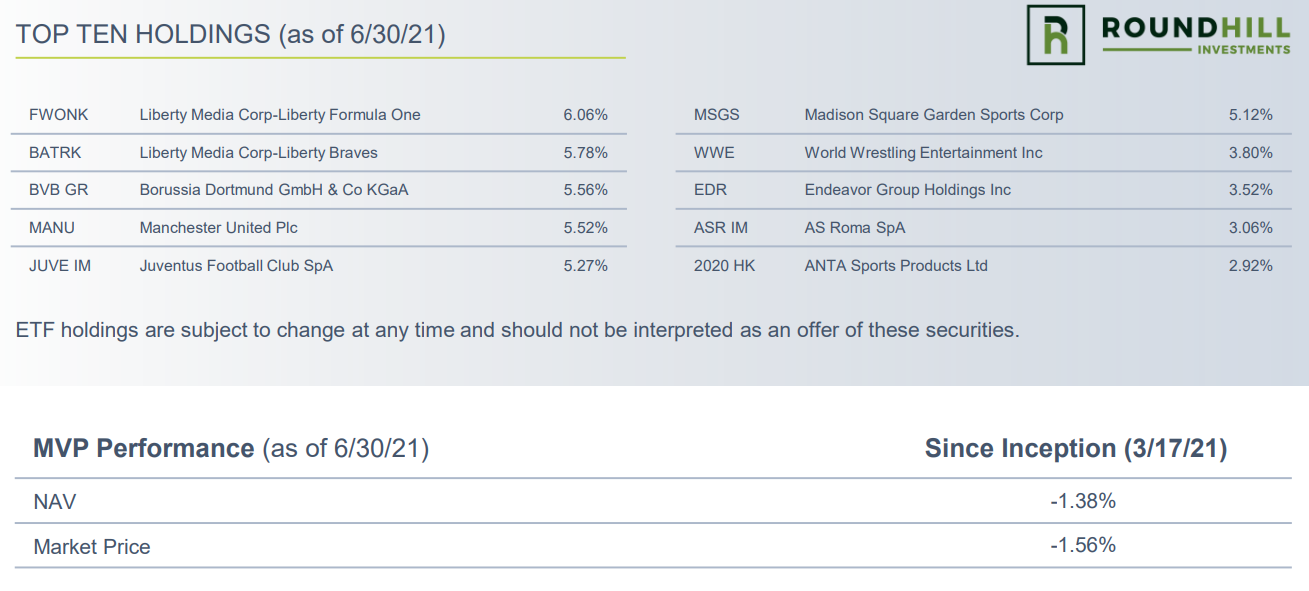
There are surprisingly few ETFs centred on sport-based equities. I assumed the popularity of sports would translate into the popularity of stocks and funds comprised of sporting teams and sporting gear makers. However, there are very few available. One that fits the bill is Roundhill Pro Sports, Media & Apparel ETF.
The selection of equities in the fund will impress football fans more than followers of other sporting codes. The ETF consists of all the major listed Football franchises, including AFC Ajax (AMS: AJAX), AS Roma (BIT: ASR), and Lazio Soc Sportiva (SSL: IM). MANU and JUVE are both included in the fund, each held at a weight above 5% of the total.
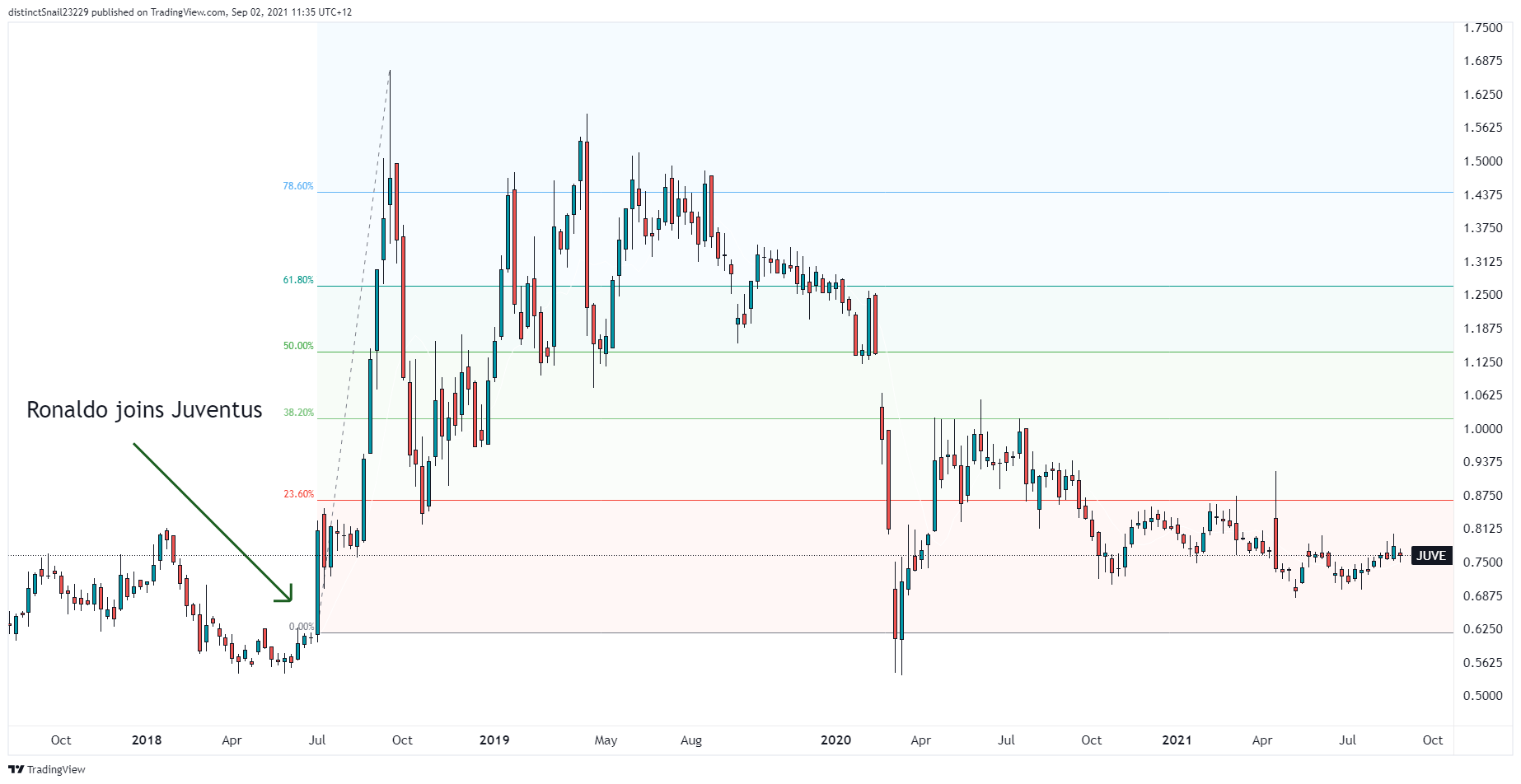
It should be noted, the stock prices of many of these Football clubs have performed rather poorly of late, compared to the overall market. One issue these clubs face is scaling further and gaining new fans while already at the pinnacle of the sport. This could be why their respective stock prices are relatively stagnant. Buying top-rated players, such as Ronaldo, could be one way to overcome limitations in reaching new fans. This strategy clearly worked for Juventus, but is evidently not a great long term solution. JUVE has since retraced to below the 23.6% FIB level.
Non-Football holdings
For the fans of other sporting codes, the fund includes holdings in the New York Knicks and New York Rangers (NYSE: MSGS), Ferrari (BIT: RACE), and Callaway Golf (NYSE: ELY).
Sports Apparel Companies such as Asics (TYO: 7936), Adidas (ETR: ADS), Nike (NYSE: NKE), Puma (ETR: PUM), and Under Armor (NYSE: UAA) are all included in the ETF and will undoubtedly be some of the better performers. For the past six months, Puma, NKE, and Asics are up 18.4%, 21.7%, and 31.6%, respectively.
Admittedly, MVP ETF isn’t the best performing fund around… yet
In its short history (released March 2021), the fund is down 1.56%. This value is not hugely disappointing, but nothing to celebrate, considering the broader market (S&P500) is up 12.2% in this timeframe.
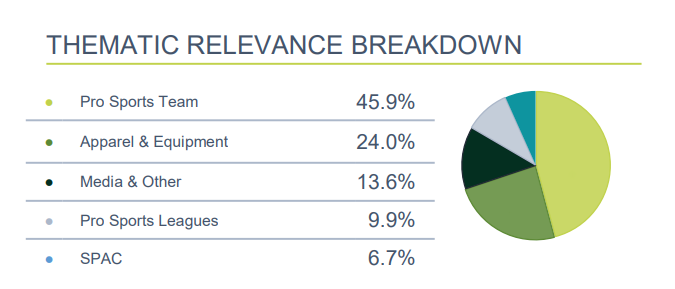
Arguably the fund is too young to judge in terms of returns. Interestingly, you will find several SPACs within the fund that has yet to acquire a suitable sporting-based company. Now, I don’t know how common it is for ETFs to be loaded with SPACs. At a glance, I count five SPACs, including the Alex Rodriguez associated, Slam Corp. Perhaps the number of SPACs included in this ETF indicates a lack of viable sports-based equities available. Either way, MVP’s success might be dependent on the future decisions of the SPACs included in the fund.
Author

Mark O’Donnell
Blackbull Markets Limited
Mark O’Donnell is a Research Analyst with BlackBull Markets in Auckland, New Zealand.