Emerging Asia under delta pressure


Summary
Once relatively insulated from COVID-related stress, emerging Asia has come under pressure as a result of the new Delta COVID variant. Confirmed cases have risen across the region, forcing governments to impose new restrictions on their respective countries.As a result, volatility in local financial markets has also risen over the last month and multiple regional currencies have sold off. While the path of the Delta variant is very unclear and further short-term depreciation possible, we believe current exchange rates at attractive levels for corporates with local currency expenses.
Delta variant spreading throughout Asia
Generally speaking, COVID-related developments seem to still be trending in a positive direction. However, recent headlines suggest a more transmissible form of COVID, the Delta variant, has been spreading rapidly, particularly throughout Asia. Originally identified in India during the country's severe second wave of infections, the Delta variant is believed to be more contagious than other strands of the COVID virus. Given the close proximity to India and the nature of border controls, the Deltavariant has spread across Southeast Asia and pushed daily case levels in multiple countries to all-time highs (Figure 1).

Indonesia is currently recording over 21,000 new cases per day, a record high, while Thailand and South Korea also reported record daily case numbers. Even the Philippines has seen an elevated case burden and has reported the Delta variant as responsible for a sizable portion of new case numbers.
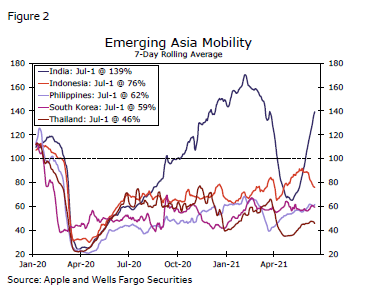
The regional response to rising cases has been to impose new restrictions, or at a minimum, delay the reopening process. New restrictions and travel curbs have gone into place in Indonesia and the Philippines, while Korea has delayed a further reopening of its economy for at least another week. Thailand, an economy heavily dependent on travel, has opted to open the island of Phuket to tourists; however, the majority of the local tourism industry will remain closed for the time being. With most region-wide re-openings delayed, mobility continues to sufier. With the exception of India, mobility across most emerging Asian nations is still well below pre-COVID levels, and recently, has either at-lined or trended lower (Figure 2).
Local financial markets have been volatile since the rise in Delta variant cases. Most emerging Asian currencies were already dealing with a post-hawkish FOMC meeting; however, over the last few weeks, regional currencies have come under additional pressure as sentiment has soured. To that point, the currencies of all countries mentioned above have sold through their respective 50-day moving averages and have broken through other key technical levels. But, in our view, this recent sell-off represent an opportunity, especially for corporates with expenses dominated in these local currencies.
Going forward, we expect vaccination rates to rise across the region, which can create more positive virus dynamics within each country. Asian countries have already demonstrated an ability to contain the virus, and we believe these governments will be able to effectively weather another wave of infections. Under that assumption, it may be prudent for corporates with local currency expenses to accelerate purchases or lock in current exchange rates. We believe emerging Asian currencies at these levels are oversold and corporates can benet from these attractive exchange rates. On the other hand, corporates with revenues denominated in these currencies could exercise patience. Over time, these currencies should recover and, that eventual rebound should boost cash flows.
The one exception we would make relates to the Indian rupee. Despite COVID infections falling just as sharply as they rose and mobility signiflcantly improving, we continue to believe the rupee could weaken from here. India's second wave of infections is likely to have a damaging effect on the economy. We believe the Reserve Bank of India (RBI) will keep interest rates on hold and keep its asset purchase plan in place longer than initially expected as a result. In addition, we believe the RBI may look to intervene in FX markets and artiflcially weaken the rupee in an effort to support the economy via more competitive exports. The depreciation of the rupee is likely to be gradual, but nonetheless noteworthy, as we are optimistic on emerging Asian currencies with the exception of the Indian rupee.
Author
Wells Fargo Research Team
Wells Fargo

















