Economic outlook 2026-2027: Advanced economies face the risk of stagflation
Before the outbreak of war in the Middle East in late February, our 2026 forecasts for the major advanced economies pointed to higher growth and lower inflation. However, this new conflict in the Persian Gulf is a game-changer. The resulting energy shock is of a stagflationary nature: growth forecasts are being revised downward and inflation forecasts upward, with variations observed across different countries. Most of the supportive factors that were present in 2025 are expected to remain in place in 2026, providing some buffer against the shock. Under the central scenario of the conflict losing intensity by the end of the second quarter, growth forecasts for 2026 are lowered by 0.4 percentage points (an average of the revisions for the countries considered here) while inflation forecasts are revised up by 1.1 percentage points. Fiscal support is expected to remain limited and targeted, with little room for manoeuvre. Monetary support, however, is not currently on the agenda. For the time being, central banks are more concerned about inflationary risks than the negative impact on growth. They appear ready to raise their policy rates, although a definitive decision has yet to be reached. This is our scenario for the ECB and the Bank of England (BoE). For the Bank of Japan (BoJ), such a hike would align with the ongoing process of monetary tightening. The Fed, for its part, would stick to the status quo.
At the start of the year, we expected 2026 to be as turbulent as 2025 (judging by geopolitical upheaval and tensions in the early days) as well as characterised by stronger growth, this latter being driven by the reinforcement of the supportive factors at work in 2025 (lower uncertainty, favourable financial conditions, low oil prices, resilient global trade, the AI boom, European revival, good labour market performance, lower inflation, less restrictive monetary policy, and broadly neutral fiscal policy). The challenge was to capitalise on the momentum and, as in 2025, overcome obstacles despite the risks: upward pressure on long-term interest rates, the full impact of the U.S. tariff shock, escalating trade tensions, AI-driven stock market correction, threats to the Fed’s independence, and geopolitical tensions.
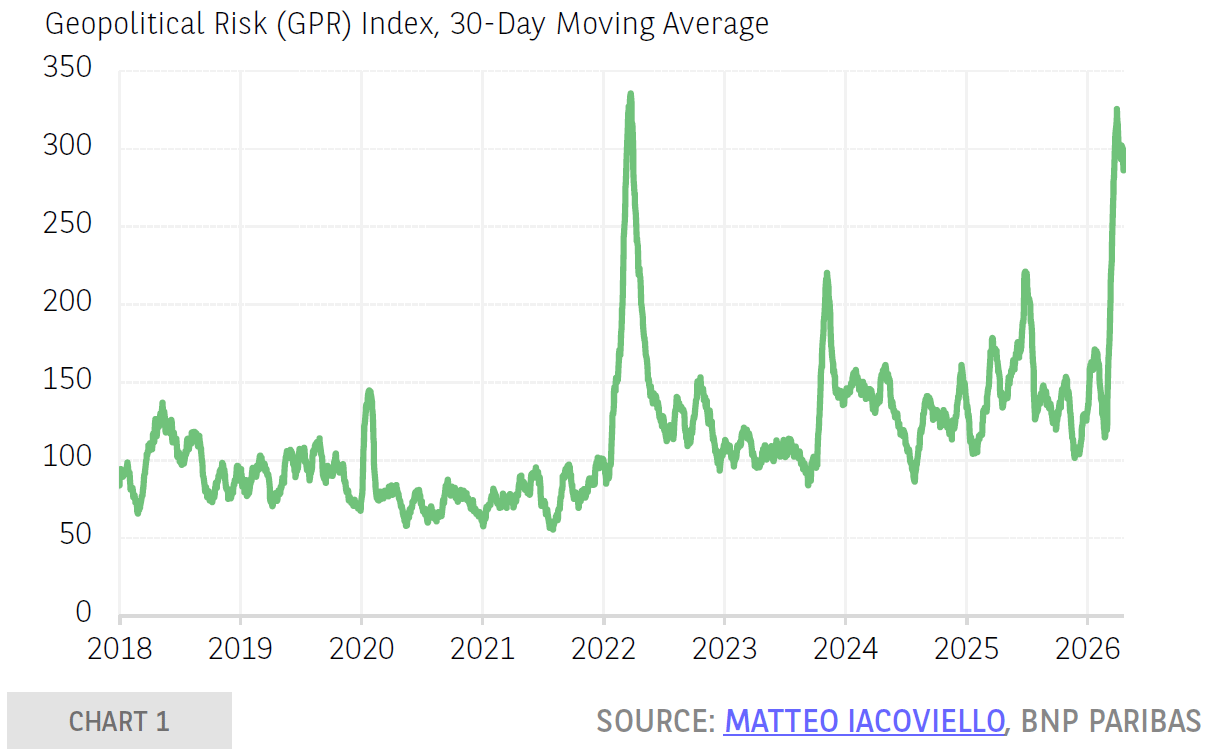
The war in the Middle East is driving geopolitical risk to a peak close to that seen at the outbreak of the war in Ukraine.
From one shock to another
A few months later, geopolitical risk resurfaced. The Israeli-American offensive in Iran on 28 February, along with the spread of the conflict throughout the region, propelled the geopolitical risk indicator to an historic high, comparable to that reached when the Russian offensive in Ukraine began (see Chart 1). The resilience of the global economy is being severely tested by the new energy shock triggered by this latest war. This shock affects all countries, albeit to varying degrees, depending on their level of exposure and their capacity to absorb the impact. This is a negative shock for the global economy, in which there are only losers, even if net hydrocarbon-exporting countries will be less impacted than net importers. Of the seven advanced economies reviewed in this issue of EcoPerspectives, the United States is the least vulnerable, while Italy, Germany, the United Kingdom and Japan are more exposed; France and Spain fall somewhere in between.
Deprived of a number of its supporting factors (oil prices, uncertainty, inflation and monetary conditions, all previously favourable), to what extent will growth withstand the shock thanks to the cushioning effect of the remaining factors still in play? To what extent should we also be concerned about the apparent disconnect between, on the one hand, the stock markets’ rather benign outlook and the geopolitical de-escalation they seem to be factoring in, and, on the other hand, a more difficult, complex and uncertain reality on the ground, characterised by substantial concerns (disruptions in fuel and derivative supplies, a prolonged and delayed return to normalcy)? Is there excessive optimism on one side and excessive pessimism on the other? At this stage, it is not easy to decide.
In summary, our new baseline scenario strikes a balance: it acknowledges a definite shock mitigated by several structural supportive forces at play. However, a scenario involving a severe economic crisis cannot be ruled out: the longer the shock lasts, the greater the risk of cascading and non-linear negative effects will become, especially as the likelihood of reaching the limits of fiscal and monetary policies also increases.
Our baseline scenario posits that the conflict and associated supply disruptions will subside by the end of the second quarter. According to our forecasts, the energy shock is expected to reduce growth by 0.4 percentage points in 2026 (averaging our forecast revisions for the economies covered in this publication) and add 1.1 percentage points to inflation. The countries with the most significant revisions are Germany for the growth forecast (revised downward) and Italy and Germany for inflation (revised upward); the countries with the least significant revisions are Spain for growth and the United States for inflation (see Charts 2 and 3). Due to ongoing tailwinds, the shock is anticipated to remain generally manageable, particularly as the economic environment appears, at first glance, less inflationary than in 2022. The spillover of rising energy prices to other components of the consumer price index will, nevertheless, be closely monitored.
Author

BNP Paribas Team
BNP Paribas
BNP Paribas Economic Research Department is a worldwide function, part of Corporate and Investment Banking, at the service of both the Bank and its customers.

















