ECB Preview: Lower macro projections set the stage for a prolonged period of policy stand-off
- The ECB Governing Council is expected to keep the rates on hold in March with no changes made to its forward guidance yet.
- ECB staff macroeconomic projections will downgrade the grown and the inflation forecast, especially the near-term projections.
- The ECB is expected to opt for a wait-and-see policy stance rather than launch the long-debated TLTROs as lending supporting mechanism.
- The main message is expected to voice the risks to the Eurozone growth outlook tilted top the downside with the outlook for rates currency bearish.

The ECB Governing Council is expected to keep the monetary policy unchanged while downgrading its near-term growth and inflation forecasts provided in staff macroeconomic projections. The key policy message will be up to the ECB President Mario Draghi to communicate during the press conference on Thursday, March 7.
While the main message from the ECB is expected to remain broadly unchanged from January with the Governing Council echoing the risks to the Eurozone growth outlook tilted top the downside, the uncertainty is likely to hold the policymakers back in terms of launching another stimulus program just three months after the asset purchasing program ended last December.
The rate and currency market implications from the ECB meeting are rather bearish with lower macroeconomic projections on growth and inflation outlook meaning the policymakers can afford to hold back with the launch of alternative stimulus and will likely opt for a more wait-and-see approach. Even with the press conference of Mario Draghi traditionally implying higher volatility, the EUR/USD is expected to remain capped within 1.1200-1.1400.
The general assessment of the economic situation in the Eurozone is realistic but conditional, with policymakers considering the current slowdown a natural pullback after years of expansion.
The National Bank of Austria Governor Ewald Nowotny said on February 27 for the Italian newspaper La Stampa that it is natural to have a slowdown in the Eurozone economic growth after 4-5 years of remarkable expansion. “The slowdown of the European economy is significant and the ECB could change its interest-rate guidance if it becomes clear the situation isn’t temporary,” Banque de France Governor Francois Villeroy de Galhau said on February 17 for Spanish El Pais.
The launch of the long-debated targeted long-term refinancing operation (TLTROs) is probably not on the agenda yet even with the tool considered an overall success according to the ECB top officials from the Executive Board. The ECB chief economist Peter Praet said on February 19 for German newspapers Börsen-Zeitung that TLTROs have been a very useful tool to deal with impairments in the transmission of monetary policy and they are part of the toolbox, especially in the situation when the Eurozone economy was to slow more sharply.
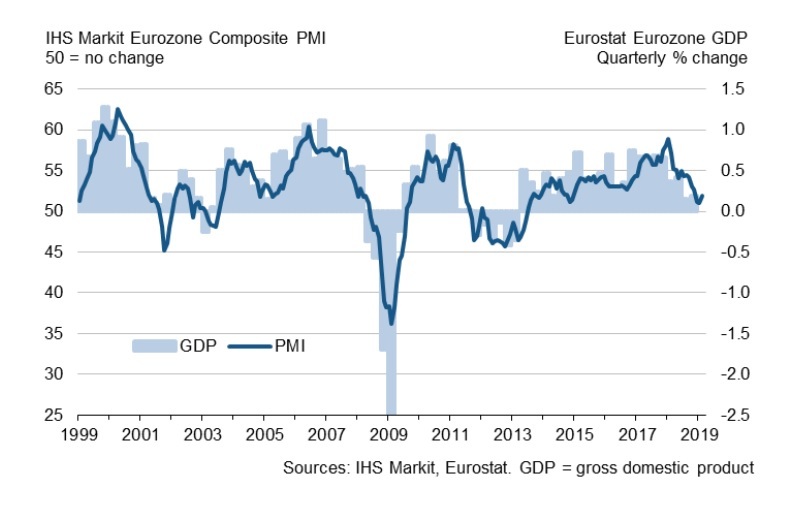
The Eurozone composite PMI and GDP growth
Author

Mario Blascak, PhD
Independent Analyst
Dr. Mário Blaščák worked in professional finance and banking for 15 years before moving to journalism. While working for Austrian and German banks, he specialized in covering markets and macroeconomics.
















