ECB Meeting: markets already priced in the dovish tweak
- EU policymakers would likely repeat their latest stance with risk tilted to the downside.
- No changes to the current policy are expected, neither details about the TLTROs.

European policymakers start their two-day meeting this Tuesday, unveiling their decision Wednesday, at 11.45 GMT. With economic growth slowing, policymakers decided in their previous meeting to announce a new round of TLTROs', downgraded their forecasts on growth and inflation, and changed its forward guidance, replacing with 'through the end of 2019' the previous 'through the summer of 2019' when referring of the time frame in where rates are expected to remain at current record lows.
Such a dovish tweak to the central banks' stance anticipates a wait-and-see stance for this month, as the central bank has plenty of time to decide and make announcements on TLTROs, which will roll out next September. The details are expected to be unveiled in the next meeting that will take place in June.
Meanwhile, the economic data released during these last six weeks have confirmed Draghi & Co. fears. German business activity has shown a significant cooling in the first three months of the year, and the latest data on industrial production, manufacturing orders, and factory activity declined, suggesting the worst is yet to come. Furthermore, the country's GDP declined in the third quarter of last year by 0.2% and failed to grow in the following three months.
ECB's members are finding themselves with little room to maneuver, once again, and will probably reiterate that the risks are tilted to the downside, with no relevant shifts in the ongoing policy.
There's a small chance of a surprise: President Draghi suggested they will take a look into their negative interest-rate policy and their impact on banks, although the latest news' headlines suggest that the ECB is no rush to change it.
EUR/USD levels to watch
The dovish stance from the central bank and a delay in rate hikes have been already priced in, also the new round of TLTROs. Given that the market isn't expecting details on these last, the central bank would likely have a limited impact on the EUR/USD pair.
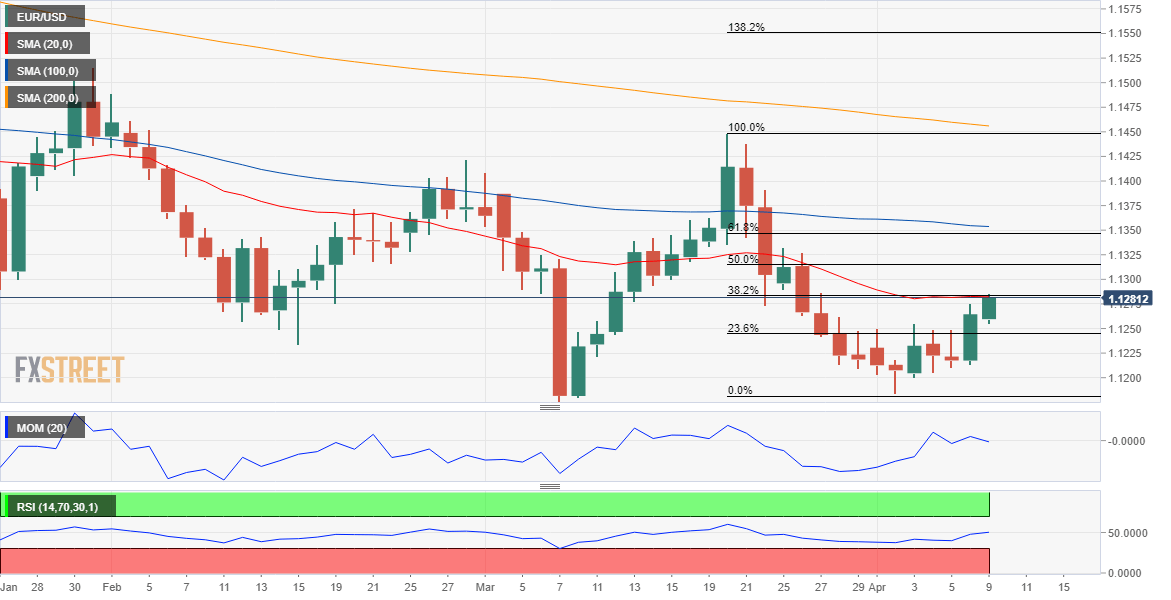
The pair has been in corrective mode these last few days, breaking above the 23.6% retracement of its latest daily slump, the immediate support at 1.1245, now battling with the 38.2% retracement of the same slide at 1.1285.
The daily chart shows that the 20 DMA is directionless converging with the mentioned Fibonacci resistance, while the longer ones maintain their bearish slopes far above the larger ones. The Momentum indicator heads lower within negative ground, while the RSI recovered up to 50, losing upward strength around the level, all of which suggest that buying interest is limited. Still, the corrective movement could continue up to 1.1350 without actually affecting the dominant bearish trend. Below 1.1245, the pair could extend its decline toward the yearly low at 1.1175.
Author

Valeria Bednarik
FXStreet
Valeria Bednarik was born and lives in Buenos Aires, Argentina. Her passion for math and numbers pushed her into studying economics in her younger years.
















