ECB Interest Rate Decision Preview: Bank expected to unveil new economic support measures
- No change anticipated in the main refinance rate.
- ECB expected to increase its bond buying program.
- Current limit is €750 billion includes sovereign debt.
- New bank programs unlikely to provide support to the euro.
- Borrowing costs have risen for Italy and others recently.

The European Central Bank is expected to ramp up its bond purchase program when it meets on Thursday to assist governments in defraying the cost of fighting the Coronavirus public health crisis.
National expenditures in the eurozone have jumped as governments have deployed hundreds of billions of euros to support their economies with payments to individuals and businesses in their mostly closed economies.
Though it is illegal under European Union rules for the ECB to directly finance national government deficits, the current €750 ($815 billion) program includes sovereign debt on the secondary market so the restriction seems to be largely academic.
Economic support from the ECB has been modest compared to the efforts of the US Federal Reserve which has launched a $700 billion bond purchase program, a $2.3 trillion local government and business loan facility, an essentially unlimited quantitative easing program and greatly enlarged its swap lines with other central banks suppling dollars to the world’s financial system.
Italian and Spanish yields
Borrowing costs for Italy have risen sharply since late February. The yield on the 10-year bond has climbed 85 points in the last two months to 1.759%. It had been as high as 3.012% on March 18th. Although this represents a rapid increase in Rome’s interest expense yields were substantially higher from May 2018 through June last year and the reached 3.712% in October 2018.
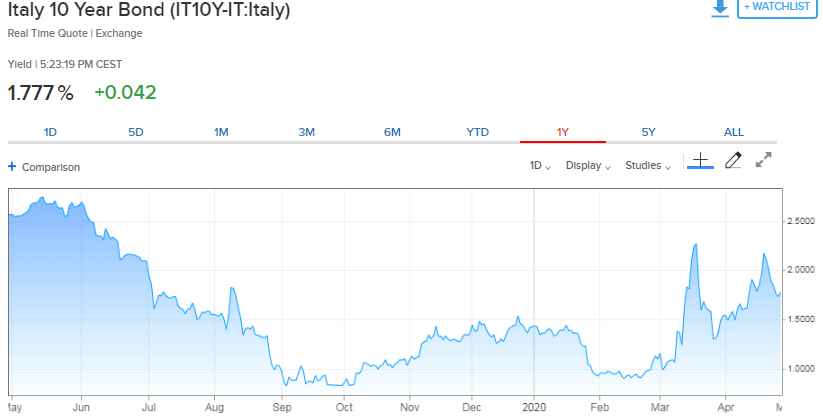
Italy has suffered the greatest fatalities in the eurozone from the pandemic. Its national debt at 134.8% of GDP in 2019 was already the highest in the EU before government expenses soared in the last two months.
Spanish 10-year rates have also increased about 60 points moving from 0.141% on March 4 to 0.789% today.
Euro impact
The lack of a coordinated fiscal response by the eurozone has weighed on the united currency when compared to the massive stimulus and support programs coming out of Washington and the Federal Reserve. Together the Americans have poured more than $6 trillion into the US economy in stimulus and direct support for individuals, business and local governments.
Although European governments agreed earlier in April on a €500 billion package of programs to help national governments meet the funding challenges of the crisis the amount is thought my many analysts to be inadequate. The much smaller EMU program is just one-twelfth the size of the US effort for a European Union economy whose combined GDP almost as large as the US, (IMF 2019 GDP: US $21.49 trillion, EU $18.70 trillion).

ECB bond program
The ECB has bought about €150 billion of eurozone bonds since March 18. Purchases under a prior program were mostly of Italian and Spanish debt but the layout of the new buying has not been disclosed.
The central bank may also begin other support measures including perhaps lower borrowing costs for commercial banks, or, following the Fed’s direction, loans to businesses and individuals or even junk bond purchases. Though possible, the last two are unlikely. A further cut in the main refinance rate, now at -0.1% is possible but thought by most analysts to be blocked by Northern European objections.
At her last press conference after the March 12 meeting ECB President Christine Lagarde observed that the bond purchase program is the bank’s preferred policy and that the governors are willing to do more to support the eurozone economy
Ms Lagarde and other bank officials have repeatedly pressed government to step up the fiscal response to the economic and public health crises and she will likely repeat that plea on Thursday.
Conclusion
The ECB’s new initiatives will be far less than necessary to impress the markets in the face of the massive US fiscal and monetary responses.
As the global pandemic wanes and American and continental markets reopen the dollar should replace its safety play with the traditional backing of a faster growing and more expansive US economy.
Author

Joseph Trevisani
FXStreet
Joseph Trevisani began his thirty-year career in the financial markets at Credit Suisse in New York and Singapore where he worked for 12 years as an interbank currency trader and trading desk manager.
















