ECB cuts rates, but not as we know it


The ECB cut interest rates as expected on Thursday, however, they have given no indication that they will cut rates again as the ECB staff forecasts revised up their growth and inflation forecasts for the currency bloc. Usually when central banks cut interest rates, they do not include in their statement comments such as it will keep rates ‘sufficiently restrictive for as long as necessary’. This is exactly what happened at today’s ECB meeting – they cut rates and simultaneously seemed to pull back on the prospect of future rate cuts. Thus, today’s cut can be considered hawkish, as the ECB has raised their inflation forecasts at the same time as saying that they remain committed to the 2% inflation target.
The markets seem to be struggling with how to react to a rate cut and a hawkish message both in the same meeting. EUR/USD initially moved higher and is now trading at the top of the recent range, although this pair has failed to break above $1.09. The Eurostoxx 600 index is trading at its lows of the day and the German 2-year bond yield has jumped back above 3% and is at its highs of the session. The spread between US and German 2-year bond yields continues to narrow.
Forecasts revised higher
Christine Lagarde has not given much away during her press conference, but the upward revisions to the Eurozone’s inflation and GDP forecasts have lowered the chances of further rate cuts this year. Forecasts for headline inflation were revised higher to 2.5% for this year and 2.2% for 2025. The March forecasts saw inflation revised down to 2.3% for 2024 and 2% for next year. This is fairly mild upgrade, however, it does suggest that inflation is moving in the wrong direction to support a rate cutting cycle from the ECB. More concerning for the ECB, was the upward revision to core inflation, this was revised higher to 2.8% for this year and 2.2% in 2025. Previously the ECB Staff forecasts projected core inflation of 2.5% in 2024 and 2.1% in 2025. Thus, the ECB expects inflation to remain sticky, which is not usually compatible with interest rate cuts.
Who dissented? Hawks and doves at the ECB
The decision to cut rates was almost unanimous, but not quite, with one dissenter. We will have to wait for the ECB minutes to find out who it was as Lagarde did not respond to questions looking for the name of the dissenter. Thus, we do not know if they dissented against any cut, or if they wanted the cut to be bigger. Recent ECB speakers have expressed a variety of views. The head of the Italian central bank warned this week that failing to cut rates quickly enough could cause problems down the line, however, the heads of the German and Austrian central banks have both sounded cautious about the prospect of rate cuts in recent speeches. These contrasting stances highlights how difficult it is for the ECB to set policy in the current environment.
Pared back rate cut expectations
The ECB has confirmed that they remain data dependent and that they will decide policy on a meeting-by-meeting basis. In the aftermath of this meeting, the market has pared back expectations for future rate cuts from the ECB. There is now just over 1.5 cuts expected for the rest of this year, recently three cuts had been priced in. The probability of a September cut is now 54%, while the chance of a December rate cut is at 55%, which suggests that the market has a fairly low level of conviction that future rate cuts from the ECB will happen this year. The market now expects interest rates in the currency bloc to end the year at 3.29%.
Why the ECB’s terminal rate could be higher than expected
This meeting was not unexpected, but it has moved the dial for Eurozone interest rate expectations. It also highlights how this next phase of monetary policy will not necessarily be a cutting cycle like we have seen in past history. There is unlikely to be a successive set of cuts, and Christine Lagarde would not talk about the ‘terminal’ rate at this meeting. However, since the ECB staff forecasts also revised up their GDP estimates for this year to 0.9% from 0.6% in March, one can assume that the terminal rate is not going back to the average of the last 5-years, which is 0.77%.
Chart: Eurozone deposit rate, last five years
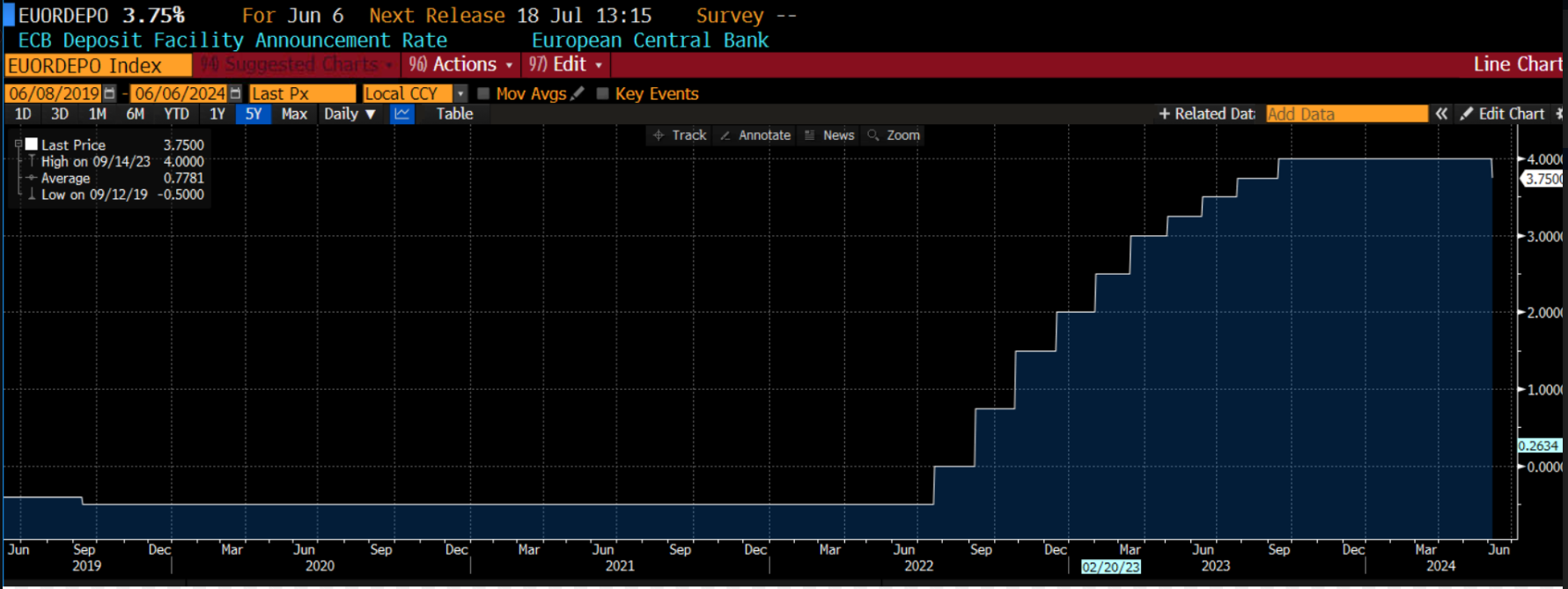
Source: XTB and Bloomberg
ECB and Fed to converge once more
Overall, central banking without forward guidance, but with economic forecasts, is a difficult game to play. We have spoken about how the ECB would strike out on its own and cut rates well before the Fed. It may have taken that first step, but ultimately, we believe that the ECB and the Fed’s paths will converge in the coming months, along with the BOE. The narrowing of the US-German short-term yield spread attests to this.
Author
Kathleen Brooks
XTB UK
Kathleen has nearly 15 years’ experience working with some of the leading retail trading and investment companies in the City of London.

















