|

ECB Boosts the Euro

EURUSD

The ECB Economic Bulletin suggests that the Central Bank keeps seeing an ongoing expansion in the economy but with increased downside risks. This is despite signs of moderating momentum, while global economic activity next year is expected to decelerate, with the announcement indicating that geopolitical factors, the threat of protectionism, vulnerabilities in emerging markets and financial market volatility remain prominent.

The Bulletin confirms that the key ECB interest rates will remain unchanged at least through the summer of 2019, while also noting that this could be “as long as necessary” to ensure that inflation remains close to, but below, 2% over the medium term. In addition, the Bulletin reaffirms that QE will end in December 2018.
 
Markets have reacted positively to these comments, as worries regarding growth appear to be mostly external to the Euro Area. Given that the rest of the world appears to have been caught in a trade war or in other types of uncertainty and tensions, the Euro Area, having resolved the Italian budget issue, and with a plan regarding the possibility of a cliff-edge Brexit deal, internal prospects appear to be better than ever before, at least in the last 10 years.
 
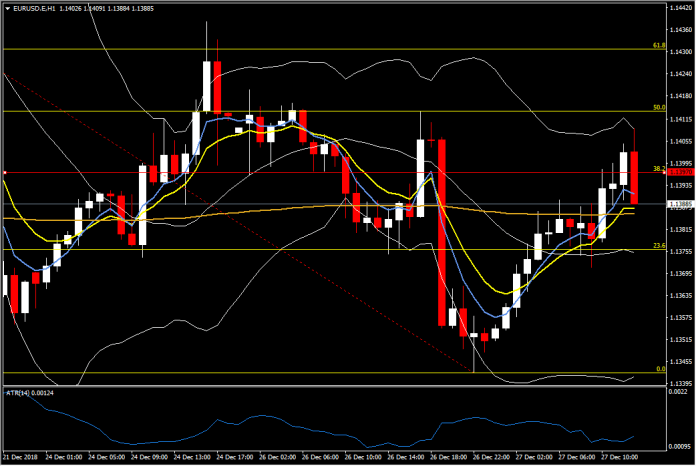
The Euro broke above the 200-period moving average earlier today, as the Bulletin was announced and the question now is whether it will be able to maintain its gains. The EURUSD pair has not managed to break through the 38.2% Fib. level, at 1.1397, although the major Support level currently stands at 1.1386, at the 200-period MA level.

Author

Dr. Nektarios Michail

With more than 4 years of experience at the Central Bank of Cyprus where he obtained hands-on experience with real-life economics, Dr Nektarios Michail is a supporter of a balanced approach between science and art when it comes to

More from Dr. Nektarios Michail

Share:

Editor's Picks

AUD/USD turns lower toward 0.7000 after mixed Australian jobs data

AUD/USD is losing ground toward 0.7000 in the Asian session on Thursday, following the release of the Australian August jobs report, which showed that the Unemployment Rate rose to 4.6% versus 4.5% expected, while Employment Change beat estimates, arriving at 39.5K. Traders also remain unnerved ahead of the critical Trump-Xi meeting.

USD/JPY keeps the red near 158.00 as Japanese Yen firms up

USD/JPY retreats from three-week highs and holds losses near 158.00 in the Asian session on Thursday. Surging Japanese bond yields lift the Yen amid looming intervention risks, while the US Dollar preserves overnight gains to a two-month high amid hawkish Fed bets and elevated US bond yields.

Gold consolidates below $4,300, awaits Trump-Xi meeting

Gold struggles below $4,300 in the Asian session on Thursday and seems vulnerable amid a bearish fundamental backdrop. US bond yields rallied to fresh multi-year highs amid rising Fed rate-hike bets, helping the US Dollar preserve Wednesday’s strong gains to a nearly two-month high and undermining the non-yielding bullion. Bears, however, seem hesitant ahead of the Trump-Xi meeting.

Bitcoin rallies above major cost bases as bulls eye $96K resistance
Bitcoin (BTC) has moved above several cost bases, strengthening the structure of its recent recovery as selling pressure remains relatively subdued. In a report on Wednesday, Glassnode stated that Bitcoin’s latest move is notable because the top crypto has recovered above the True Market Mean at roughly $77,000 and the Short-Term Holder (STH) Cost Basis.
Oil price rise weighs on stocks

Rising oil prices and higher yields have thrown the equity rally off track. After the risk-on start to the week renewed gains for oil prices and yields have weighed on indices.

BoJ Recap: Not as hawkish as expected

The Bank of Japan (BoJ) raised its short-term interest-rate target to 1.25% from 1.00% in a 7-2 vote, marking another step in the normalisation of monetary policy and widely matching what everyone has been expecting for weeks.














