Durable Goods Orders Rebounded in March


Durable goods orders rose 2.7% in March. Core capital goods orders suggest the economy has momentum going into Q2, but core capital goods shipments still suggest weak business spending in tomorrow's Q1 GDP report.
Orders Rebounded in March, Q1 Business Spending Still Weak
Durable goods orders rose a solid 2.7% in March, and February's decline was upwardly revised to a drag of 1.1% (-1.6% previously). Recent months have been influenced by the volatile commercial aircraft sector; orders jumped 31.2% in March after declining 25.4% in February. Orders excluding transportation rose a more modest 0.4% over the month.
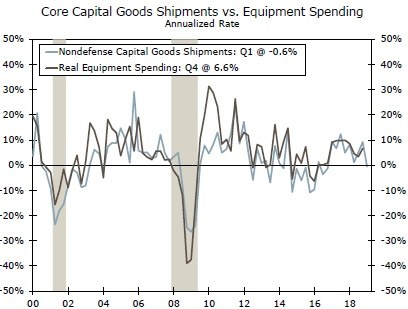
Core capital goods orders—a key leading indicator of future business spending—rose 1.3% in March, suggesting the economy may be carrying momentum into the second quarter. But, the fall in core capital goods shipments (down 0.2%) still suggests a weak outturn for business spending in tomorrow's first estimate of Q1 GDP.
If the jump in core capital goods orders is sustained in coming months, it would suggest stronger business spending in the second quarter—at the very least today's core orders figure suggests business spending is not slowing as rapidly as initially feared.
Impact from Boeing's 737 MAX
At the beginning of March, aviation authorities around the world grounded the 737 MAX aircraft after two fatal crashes, and Boeing announced a halt in deliveries and a production cut to the 737 family. As we have previously written, the total impact on durable goods shipments from the recent halt in deliveries could be substantial. Boeing's 737 MAX has comprised almost half of Boeing's orders in the past few years, and aircraft orders made up almost 10% of total durable goods orders last year.
The solid outturn for durable goods orders in March suggests the grounding of the 737 MAX wasn't a huge factor for March orders. Only one airline has cancelled an order and widespread cancellations remain unlikely, suggesting orders will likely still roll in. The halt of deliveries in mid-March, however, suggests the value of durable goods shipments will be dragged down by aircraft over the next few months. Nondefense capital goods shipments, which were flat in March, still suggest a weak outcome for equipment spending in the first quarter (bottom chart).
Boeing cut production of the 737 from 52 to 42 aircraft per month in mid-April, suggesting we will see an impact from the decreased production in the second quarter. We have cautioned the precise impact to our GDP outlook depends on a number of factors, including how long Boeing produces at the lower rate, when aviation authorities around the world give the airlines the all clear to fly and how quickly Boeing can clear some backlog. Further, given Boeing announced on Wednesday that it was withdrawing its forward financial guidance, the timing of the 737 MAX return remains largely uncertain. Under our current assumption, the 737 decreased production stands to reduce Q2 GDP growth by about 0.2 percentage points.
Author
Wells Fargo Research Team
Wells Fargo

















