Don’t believe this picture!

_XtraSmall.jpg)
(The Data are True, but the Impression is Misleading)
Perhaps one of the most reliable divides between Democrats and Republicans is that Democrats tend to view rich people as undertaxed, and Republicans see virtually everyone as over-taxed, but especially the rich. The implications of this difference in perspective are that Democrats tend to believe that we can afford greater government spending for any number of initiatives without increasing our deficit or the national debt by simply raising the taxes for richer Americans. Republicans largely reject most spending initiatives altogether, because, in their view, these programs would either add to the burden of the already-over-taxed, or they would unfairly pass the burden on to the taxpayers of the future.
For Democrats, the growth in wealth disparities has been facilitated by a tax system that is overly generous to the richest Americans as it deems a considerable amount of wealth appreciation as “untaxable.” Thanks to the magic of compounding and rising stock markets, those who have wealth to start with have been well-positioned to watch their wealth grow; and unless appreciated assets are sold, that wealth appreciation goes untaxed. The practice of only taxing realized gains is built into our tax code, but that doesn’t make it right or fair.
In 1990, the US counted 66 billionaires with an aggregate wealth of approximately $240 billion, but by March of 2021, the billionaires club exceeded 600, with a combined wealth of $4.18 trillion. Just in the first 11 months of the pandemic, when so many people lost jobs and income and were forced to dip into their savings, the collective wealth of billionaires in the US shot up by 44%. [Source: americansfortaxfairness.org]
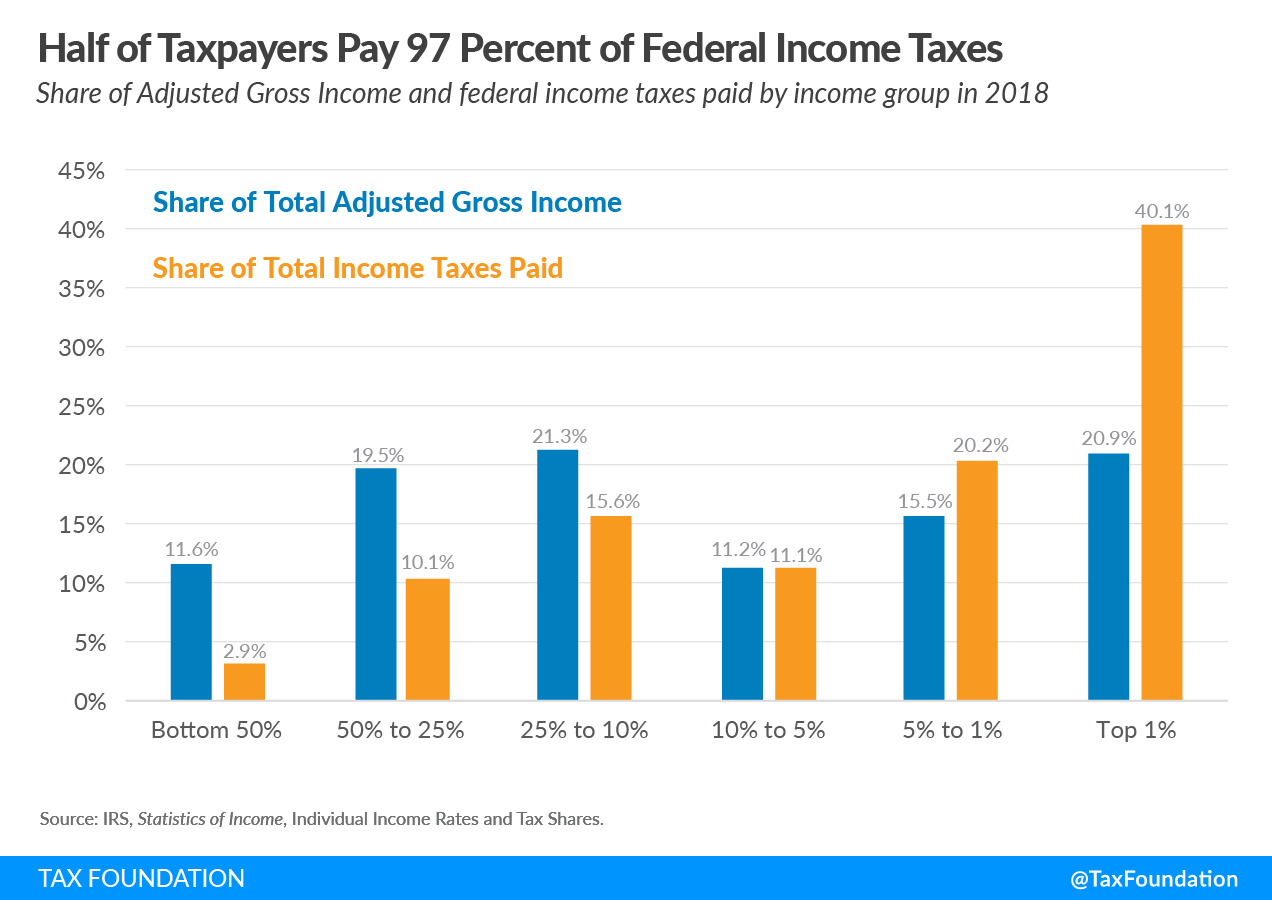
This history notwithstanding, the countervailing argument is that the rich pay more than their fair share. The graphic at the top of the page certainly conveys this message, showing that the top 1 percent of taxpayers by income pay over 40 percent of federal income taxes collected, while the bottom half pay less than 3 percent. In fact, the tax burden does fall disproportionately on the rich — an artifact of a progressive tax system — but the above graphic fosters a misleading impression.
The relatively large contribution to federal income tax revenues by rich taxpayers notwithstanding, as of the latest available data (2018), their effective tax rate stayed below 26%. This average rate derives from applying a series of seven distinct marginal tax rates for incremental income amounts — e.g., 10% on the first $9,950 for single filers; 12% on income above $9,951 up to $40,525; 22% on income above $40,426 up to $86.375; etc.
Also, in assessing whether our system is too progressive or not progressive enough, the above chart ignores critical tax revenues. Besides the revenues from income taxes, it is appropriate to include the effect of payroll taxes in our consideration. Payroll taxes are ubiquitous and happen to be the largest tax liability category for most taxpayers. In 2020, they contributed about 38.3 percent of the federal take or roughly 60 percent as much as the revenues derived from personal income taxes. Payroll taxes apply a 15.3% tax rate to incomes below $142,800. Thus, for those who earn more than the $142,800 maximum, the effective payroll tax rate falls as incomes rise.
The breakdown of these combined taxes (i.e., income taxes plus payroll taxes) shown by the following graphic offers a different perspective from the lead chart. [Source: taxpolicycenter.org] Including payroll taxes in the calculation reveals that the tax burden rises with income only through the fourth quintile, but the tax burden eases somewhat for those at the highest quintile.
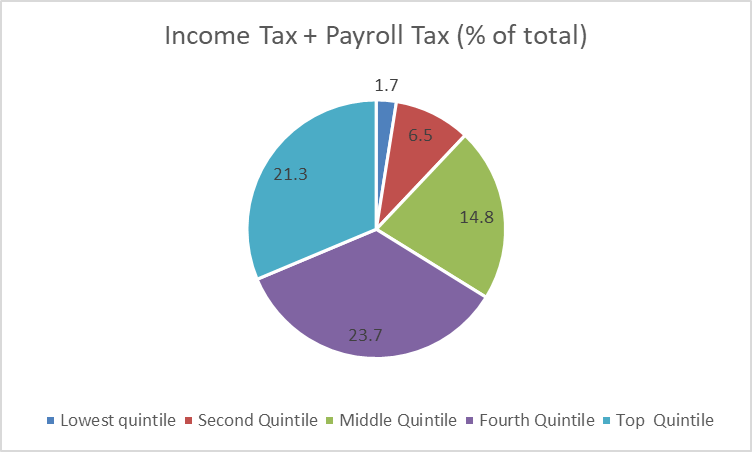
Even this assessment is biased, however, in that the composition of income used for stratification ignores wealth accumulation that derives from unrealized capital gains. Some would argue that this omission is as it should be, in that unrealized gains may very well evaporate at some future date. And if we were to tax unrealized gains, would we allow tax reductions for unrealized losses? I see these concerns as surmountable. For me, they can’t serve as the impediment to shield the wealthiest among us from being asked/required to bear a greater burden. That would be an acceptable price to pay, given the privileges they enjoy — their current tax bite notwithstanding — and their reliance on the infrastructure and protections afforded by operating in America.
Author
Ira Kawaller
Derivatives Litigation Services, LLC
Ira Kawaller is the principal and founder of Derivatives Litigation Services.

















