Dollar still pressured but poised for a potential comeback
- The Fed dealt a rather severe blow to the US dollar this week after it raised interest rates, as expected, but was less hawkish than anticipated in its outlook for policy tightening going forward.
- While the Fed’s statement and projections were indeed less aggressive than might be expected given the acknowledged improvements in the labor market and the rise in inflation expectations, the path of Fed tightening still remains in stark contrast with other major central banks.
- The fact that the Fed did not change its interest rate projections from December – the median outlook remaining at three quarter-point rate hikes in 2017 – should not necessarily be taken as an overly dovish signal.
- Rather, it is more likely that the Fed is simply exhibiting its characteristically cautious stance and adopting its usual wait-and-see attitude, especially with respect to how the Trump Administration unrolls its planned fiscal policies.
- The pace of Fed rate hikes and policy outlooks can change extremely quickly. We saw this first hand in the short period leading up to this week’s rate hike. Only a few weeks prior to Wednesday’s FOMC announcement, consensus expectations for a March hike were exceptionally low. What then followed was a concerted effort by Fed officials to warn the markets of the high likelihood of an impending Fed move, and market expectations then soared to a near-certainty.
- This same rapid change in expectations could very likely occur again at any time, assuming the Trump Administration’s fiscal plans begin to take root.
- Even without any change in the Fed’s policy trajectory, however, the fact remains that the Fed is at least on a steady path of higher interest rates. As currency exchange rates can only be derived by comparing currencies against each other, the relative discrepancy between a central bank’s stance and others becomes critically important. Currently, the so-called monetary policy divergence between the Fed and other major central banks is clear – the Fed is undoubtedly tightening while most others are still stagnated in easing mode for now.
- This divergence could begin to narrow somewhat, as there have been signs that some central banks are slowly beginning to reverse course. But the Fed should remain significantly more hawkish relative to its peers for the foreseeable future. There was some recent talk by the European Central Bank regarding the possibility of raising interest rates before ending its bond purchase program, but that discussion has been postponed for the time being. Also, while the Bank of England kept interest rates unchanged this week, one dissenting member voted for a rate hike. Though this gave some hope to sterling bulls, one dissenting vote is still far off from a
- Fed that is already entrenched within a clear tightening path.
- Therefore, while the US dollar has certainly stumbled after the Fed’s less-hawkish-than-expected projections, this is likely a short-term corrective move within a longer-term trend of dollar strength.
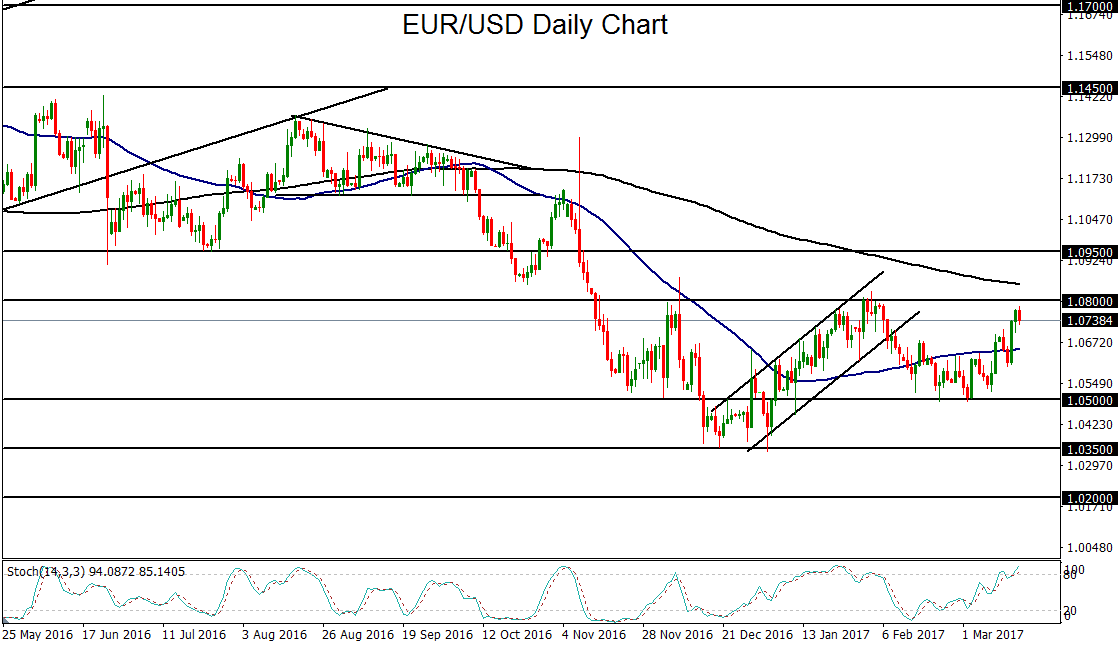
- From a technical perspective, the dollar’s Fed-driven fall combined with the euro’s recent rebound has pushed EUR/USD up to approach the key 1.0800 level, which has been well-respected as resistance since December. Friday saw a pullback from that level as the dollar regained a bit of ground. If the currency pair continues to respect that resistance in the coming week as the dollar stabilizes, EUR/USD is likely to continue its four-month trading range, with a major downside target at the key 1.0500 support level.

Author
James Chen, CMT
Investopedia
James Chen, Chartered Market Technician (CMT), has been a financial market trader and analyst for nearly two decades.
More from James Chen, CMT