Dollar mixed as US consumer confidence falls in February

EUR, AUD dip, NZD/USD soars; Wall Street stocks decline
Summary
Risk averse sentiment prevailed, weighing on US stocks while the Dollar finished mixed. US Consumer Confidence fell unexpectedly in February, which was the second consecutive fall.
Treasury bond yields finished mixed. The US 10-year bond rate slipped to 3.92% from 3.94% yesterday. Two-year treasuries were unchanged with a yield at 4.81%. Germany’s 10-year Bund yield climbed to 2.64% (2.53%). Japan’s ten-year JGB yield was last at 0.49% (0.50%).
A favoured gauge of the Greenback’s value against a basket of 6 major currencies, the Dollar Index (DXY), eased to 104.55, against yesterday’s 104.90. Against the Japanese Yen, the US Dollar fell to 136.15 (136.27). The Euro (EUR/USD) dipped to 1.0585 from 1.0605.
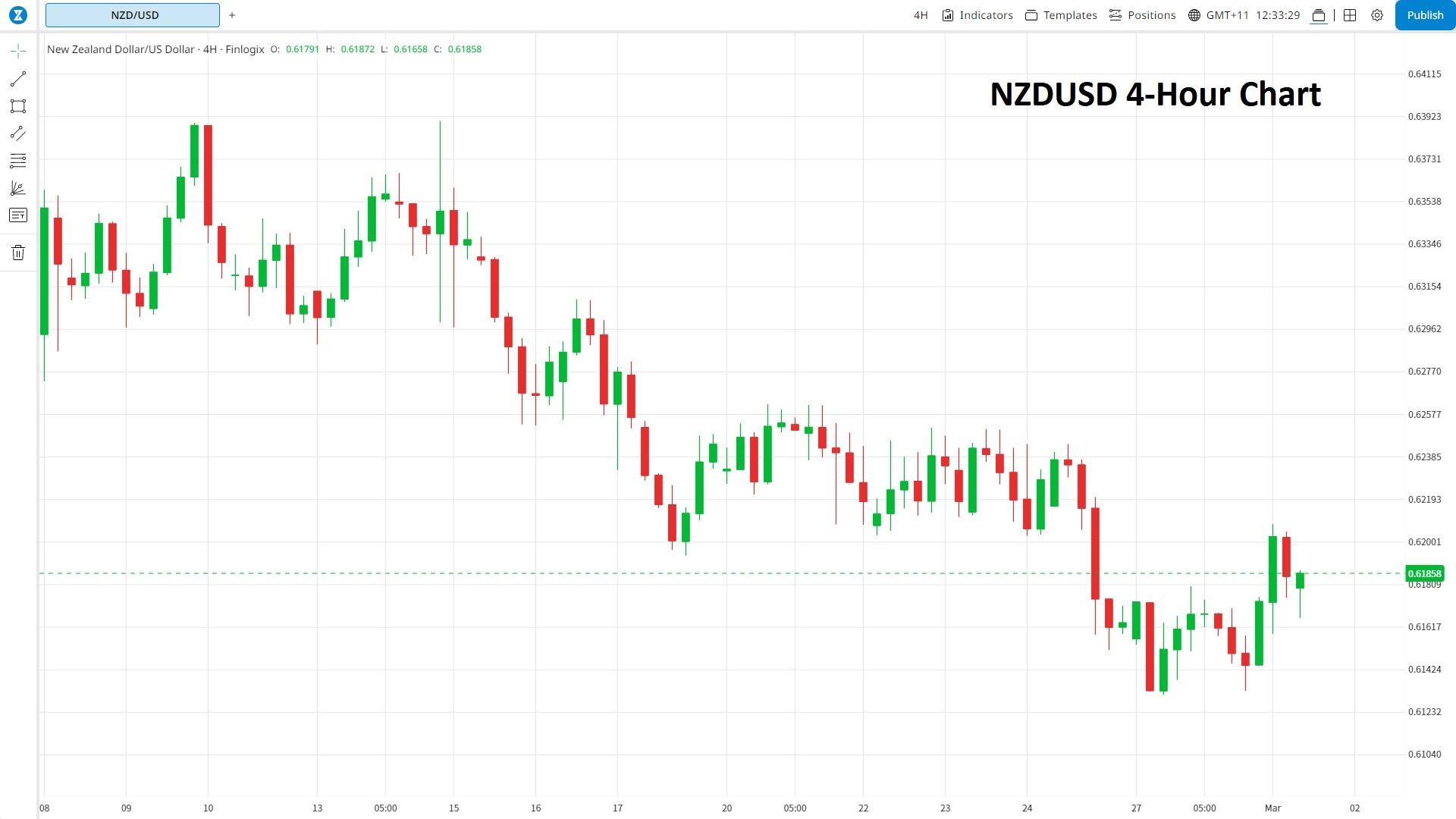
New Zealand’s Kiwi (NZD/USD) outperformed, climbing to 0.6190 against 0.6165 yesterday. Also known to traders as the “flightless Bird”, the Kiwi (NZD/USD) rose on month-end buying against the Australian Dollar which triggered position squaring.
The Australian Dollar (AUD/USD) finished little-changed at 0.6733 (0.6727). Despite an upbeat January Australian Retail Sales report, risk-off weighed on the Battler.
Following its rally yesterday, Sterling eased to 1.2055 from 1.2095 against the broadly based stronger US Dollar and the market’s risk-off stance.
The US Dollar was mostly higher against the Asian and Emerging Market Currencies. USD/CNH (Dollar-Offshore Chinese Yuan) rose to 7.8490 (7.8450). Against the Singapore Dollar, the Greenback (USD/SGD) rallied to 1.3481 from 1.3458.
US stocks declined. The DOW was last at 32,697 (32,830) while the S&P 500 dipped to 3,978 (3,985). The NASDAQ however, edged up to 12,087 (11,972). Australia’s ASX 200 eased to 7,225 (7,250).
Other economic data released yesterday saw Japan’s Annual Retail Sales climb to 6.3% from 3.8%, beating estimates at 4.2%. The Bank of Japan’s Annual Core CPI was unchanged at 3.1%.
New Zealand’s ANZ Business Confidence improved to -42.3 (-52.0). Australia’s January Retail Sales rose 1.9% against December’s fall of -4.0%, beating median forecasts at 1.6%.
French Preliminary Quarterly GDP eased to 0.0% from a previous 0.4%, and lower than estimates at 1.0%. Spain’s Annual CPI rose to 6.1% from a previous 5.9%, and expectations of the same.
The US Conference Board’s February Consumer Confidence Index slid to 102.9 from a previous downward adjusted 106.00 (10.7.1), and lower than forecasts at 108.5.
-
EUR/USD – The shared currency eased 0.22% to 1.0585 (1.0605). Overnight, the EUR/USD soared to an overnight high at 1.0645 before easing in late New York. Risk aversion amidst market fears of more rate increases by the Fed weighed on the Euro. Overnight low traded was at 1.0582.
-
USD/JPY – Against the Japanese Yen, the Greenback eased to 136.15 at the close of trade in New York. In another volatile session, the overnight high traded was at 136.92 while the low recorded was at 135.73. Incoming Bank of Japan Board members defended the central bank’s easy money policy.
-
AUD/USD – The Australian Battler finished little-changed against the Greenback at 0.6733. Overnight, the Aussie saw a high at 0.6757 while the low recorded was at 0.6704. A robust New Zealand Dollar provided support for the Aussie.
-
NZD/USD – Month-end position adjustments provided a lift for the New Zealand Dollar, which soared to an overnight high at 0.6208 (0.6165 Monday). Trading in the Kiwi was volatile with the overnight low recorded at 0.6133. Markets speculated that the Reserve Bank of New Zealand (RBNZ) will have to do more to cool the job market.
On the lookout
Today’s economic calendar is a busy one and kicked off with New Zealand’s Building Consents which on a monthly basis improved to -1.5% from a previous -7.1%. Australia followed with its Judo Bank Final Manufacturing PMI for February which rose to 50.5 from 50.0 and beating forecasts at 50.1. Australia’s AIG Industry Index for February follows (f/c -10 from –1.6 – ACY Finlogix); Australian GDP Growth Rate (q/q f/c 0.7% from 0.6%; y/y f/c 2.7% from 5.9% - ACY Finlogix). Next up is Australia’s Annual January CPI Indicator (f/c 7.9% from 8.4% - ACY Finlogix). China follows with its February NBS Manufacturing PMI (f/c 50.5 from 50.1); China’s February NBS Non-Manufacturing PMI (f/c 55 from 54.4 – ACY Finlogix), China’s February Caixin Manufacturing PMI (f/c 50.2 from 49.2). Europe sees the release of the UK’s February Nationwide Housing Prices (m/m f/c -0.4% from -0.6%; y/y f/c -0.9% from 1.1% - ACY Finlogix). Switzerland follows with its January Retail Sales (m/m f/c 0.8% from -1.7%; y/y f/c -2% from -2.8% - ACY Finlogix). Germany follows with its February Unemployment Rate (f/c 5.6% from 5.5% - ACY Finlogix), German February S&P Final Global Manufacturing PMI (f/c 46.5 from 47.3). Later in the day, Germany also releases its February Inflation Rate (y/y f/c 8.5% from 8.7% - ACY Finlogix). The UK follows next with its UK January Mortgage Approvals (f/c 38K from 35.612K – ACY Finlogix), UK January Net Lending to Individuals (m/m f/c GBP 3.1 billion from GBP 3.7 billion – ACY Finlogix). Italy releases its Full Year GDP Growth (f/c 3.9% from 6.6% - ACY Finlogix). Canada kicks off North America with its Canadian S&P February Global Manufacturing PMI (f/c 50 from 51 – ACY Finlogix).
The US rounds up today’s heavy calendar releases with its US S&P Final Global Manufacturing PMI for February (f/c 47.8 from 46.9) and US February ISM Manufacturing PMI (f/c 48 from 47.4) and US January Construction Spending (m/m f/c 0.2% from -0.4%). Whew…
Trading perspective
The Dollar finished mixed on the unexpected drop in US Consumer Confidence as well as month-end position adjustments. After falling in the early part of yesterday, the Greenback mostly rebounded against its Rivals. Markets expect that the Federal Reserve will have to raise interest rates more than initially expected which is supportive of the Dollar.
Data releases today will provide more evidence on where the US economy is headed. US Manufacturing PMIs are expected to ease. A weaker than expected outcome will weigh on the Greenback and squeeze out more speculative long US Dollar bets.
-
EUR/USD – The Euro which closed at 1.0585 should find immediate support at 1.0580 followed by 1.0540. On the topside, expect the 1.0610 and 1.0640 levels to provide immediate resistance. While the Euro feels heavy, would be wary of a squeeze if US data disappoints. Meantime, expect a likely trading range of 1.0570-1.0670. Trade the range.
-
USD/JPY – The Greenback dipped against the Japanese Yen to finish at 136.15 (136.27). In Asian trade, the USD/JPY pair has edged up to 136.28. Look for immediate resistance at 136.50 and 136.80 to cap any rallies. On the downside, expect immediate support at 135.70 (overnight low traded was 135.73). The next support level lies at 135.40 and 135.10. Look for another choppy ride in a likely range today of 135.70-136.70.
-
AUD/USD – The Australian Dollar steadied to 0.6733 from 0.6727, supported by a robust Kiwi (NZD/USD). Immediate resistance is found at 0.6760 (overnight high traded was 0.6757). The next resistance level lies at 0.6790 followed by 0.6820. Immediate support can be found at 0.6700 followed by 0.6670. Look for more volatile trade today in a likely range between 0.6700 to 0.6800. Trade the range, nice and wide.
-
GBP/USD – Sterling eased to 1.2035 from its New York close at 1.2055 and 1.2095 yesterday. Trading was choppy in the British Pound with the overnight high traded at 1.2143. On the day, look for immediate resistance at 1.2080, 1.2110 and 1.2140 to cap. Immediate support can be found at 1.2025 (overnight low traded was 1.2027). The next support level lies at 1.2000 and 1.1970. Look for Sterling to trade a likely range today of 1.2010-1.2110. Wary of getting short near the 1.2000 support level.
Have a good trading day ahead all. Happy Wednesday.
Author

Michael Moran
ACY Securities
Michael has over 40 years’ FX experience, including running FX trading desks for some of the largest banks in the world.