Dollar in freefall: The signal Wall Street doesn't want you to see [Video]
![Dollar in freefall: The signal Wall Street doesn't want you to see [Video]](https://editorial.fxsstatic.com/images/i/eur-usd-fix-02_XtraLarge.jpg)

The market just sent us a critical warning
Something unusual is happening in global markets that demands your immediate attention. For the first time in months, the U.S. dollar is falling without any interest-rate justification. This disconnect isn't normal, and institutional traders are already repositioning.
If you trade currencies, indices, or commodities, what you're about to read could completely change your strategy for the coming weeks.
The Dollar snomaly: When price ignores the cost of capital
Normally, the dollar's value moves in step with the Federal Reserve's interest rate decisions. It's such a predictable relationship that institutional algorithms program it as their fundamental baseline.
But this week breaks that pattern.
The dollar is falling while the Fed keeps rates unchanged. The reason? Massive capital flows are abandoning the greenback in search of alternative refuges: gold, European equities, and risk assets.
This dissonance reveals something crucial: the market is anticipating a regime change before official data confirms it. Experienced operators know these moments of fundamental-technical disconnect usually precede explosive moves.
What does this mean for your capital?
Dollar weakness has a direct domino effect:
- Dollar-denominated assets become cheaper for foreign buyers
- U.S. stocks become more attractive (especially technology)
- Dollar-priced commodities tend to rise (gold, oil, metals)
- Emerging market currencies gain ground against USD
The smart play isn't chasing the drop, but identifying technical retracements where the dollar bounces temporarily to position yourself in assets that benefit from its structural weakness.
Euro: The trend central banks are reinforcing
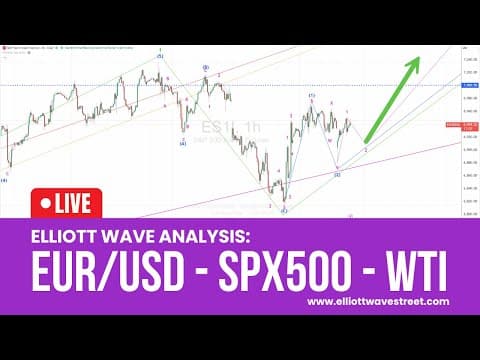
While the dollar weakens, the euro is building a textbook Elliott Wave pattern. Technical levels are validating the hypothesis of a developing impulse wave.
The amateur trader's death trap: entering at highs due to FOMO (fear of missing out).
The professional's strategy: waiting for confirmed pullbacks to build a position with controlled risk.
The Anatomy of a Professional EUR/USD Entry
Impulse moves in currencies rarely climb in a straight line. The market breathes. Strong hands accumulate on corrections, not on extensions.
Three probable technical scenarios:
- Moderate pullback (38.2%-50% Fibonacci): High-probability zone for reloads in traders with open positions. Low risk if a stop is placed below 61.8%.
- Sideways consolidation: Price digests recent gains. Requires patience. The subsequent breakout is usually explosive, but waiting for confirmation avoids false breaks.
- Parabolic extension: Dangerous intraday movement. Only for scalpers with ultra-tight stops. The probability of violent reversal increases exponentially.
Golden rule: If the price already climbed 200 pips in two sessions, the reward/risk of new buys deteriorates dramatically. The discipline to wait is what separates profitable accounts from liquidated ones.
S&P 500: The wave 3 that could redefine all-time highs
Last week presented a technical setup that Elliott Wave traders wait months (sometimes years) to see: institutional accumulation validated by volume profile in a critical support zone.
The result was predictable for anyone who knows the method: a clean bullish impulse with confirmatory volume.
The Target: 7,100-7,200 Points
According to the current wave count, the S&P 500 is developing the major Wave 3 of a larger cycle. In Elliott theory, Wave 3s are the longest and strongest of the impulse cycle. They're the movements where consensus shifts, where fundamentals "finally" validate what price was already anticipating.
Characteristics of a genuine Wave 3:
- Increasing volume on each new high
- Shallow pullbacks (typically 23.6%-38.2%)
- Momentum sectors leading (technology, consumer discretionary)
- Sentiment shifting from skepticism to gradual euphoria
- Institutions repositioning from bonds toward stocks
The Trader's Paradox: When Making Money Becomes Dangerous
Here's the psychological problem that destroys more accounts than any crash: in the final phases of a Wave 3, easy profits generate overconfidence.
Traders who operated correctly through stages 1 and 2 start to:
- Increase position size (right when risk increases)
- Relax stops (right when volatility expands)
- Ignore distribution signals (right when institutions start selling)
Survival protocol for the coming weeks:
- Don't buy at all-time highs without pullback. Wait for retracements to key EMAs (20, 50 period).
- Maintain tight trailing stops. In Wave 3, price shouldn't violate prior candle lows. If it does, the structure is probably mutating.
- Take partial profits at Fibonacci resistances. 1.618 extension from previous lows is a magnetic zone for institutional profit-taking.
- Monitor RSI/MACD divergences. When price makes new highs but indicators don't, Wave 3 is aging.
The difference between a profitable trade and a disastrous one in this phase isn't direction (bullish is obvious), but exit management.
Crude Oil: The opportunity that repeats every 7-10 days
WTI is trapped in a well-defined range that short-term traders can exploit systematically. It's not the most glamorous trading, but it's among the most consistent when executed with discipline.
The Range Strategy: Sell at $60, Target $55
Crude has established a clear pattern this year:
- Range ceiling: $60-62 per barrel (institutional supply zone)
- Range floor: $55-53 per barrel (structural demand zone)
- Average cycle duration: 2-3 days from entry to target
Trade mechanics:
- Entry: When price reaches $60 with rejection signals (long upper wicks, volume divergence, reversal candle patterns).
- Stop-loss: $61.50 (above range ceiling + buffer for noise).
- Target: $55.00 (range floor).
- Management: Move stop to breakeven when price hits $58. Take 50% profits at $57, let the rest run with trailing stop.
Why Does This Range Stay Stable?
Two opposing forces create this equilibrium:
On the supply side: U.S. production remains robust. Inventories are at comfortable levels. OPEC+ has spare capacity to increase production if prices spike.
On the demand side: China shows no signs of strong economic acceleration. Europe is in tepid growth. Seasonal demand doesn't justify significant premiums.
Until one of these fundamental factors changes dramatically, the range persists. And while it persists, swing traders have a well-calibrated money machine.
Critical warning: Ranges eventually break. When they do, the movement will be violent. Don't fall in love with the strategy. If price closes outside the range with volume, abandon the range plan immediately.
Natural Gas: Crude's volatile sibling
Similar to WTI but with 3-4x greater intraday volatility. The same range strategy applies, but with adjustments:
- Wider stops (normal volatility can trigger tight stops)
- Smaller position sizes (to compensate for additional risk)
- Greater attention to inventory reports (disproportionate impact on price)
The Scenario Nobody Wants to Imagine
What if Jerome Powell surprises with hawkish language in the press conference? What if employment data comes out 3 standard deviations above consensus? What if an unexpected geopolitical event shakes the markets?
Traders without a plan: Frozen, watching their positions bleed, hoping "price comes back".
Prepared traders: Stops triggered automatically, capital preserved, ready to re-enter when the dust settles.
Mental preparation for adverse scenarios isn't pessimism. It's professionalism.
Access to professional resources: How to keep learning
Professional trading isn't learned in a weekend. It requires:
- Continuous study of technical theory and fundamentals
- Systematic review of previous trades (winners and losers)
- Community of experienced traders to contrast ideas
- Historical data for strategy backtesting
Available Material to Accelerate Your Learning Curve
Historical recordings: Live trading sessions since 2016. Watching how analysis develops in real-time compresses years of experience into months of study.
Documented signals: Verifiable track record. Not promises, but history of actual trades with entries, stops, and exits.
Discord channel: Real-time ideas on multiple instruments. Collaborative analysis where traders from different time zones share perspectives.
Free educational material: Updated weekly with market analysis, technical tutorials, and fundamental concepts.
The critical week ahead
This week isn't just another one. Current setups in currencies, indices, and commodities are creating opportunity windows that appear 3-4 times per year maximum.
The dollar weakening without correlation to rates signals massive institutional repositioning.
The euro in clean impulse structure offers low-risk entries on pullbacks.
The S&P 500 in Wave 3 presents significant profit potential for those who respect technical levels.
Crude in defined range is a trading machine for disciplined swing operators.
But remember: market opportunities don't compensate for poor risk management. You can be right on direction and still lose money if your stop is too tight or your position size is excessive.
Conclusion: From analysis to intelligent action
Market analysis without disciplined execution is entertainment, not trading. This week, professionals will be:
✅ Monitoring the Fed statement with forensic attention
✅ Waiting for euro pullbacks before new buys
✅ Looking for S&P 500 retracements toward key EMAs
✅ Executing systematic sells in crude near $60
✅ Adjusting stops dynamically according to volatility
✅ Keeping powder dry for unexpected opportunities
The difference between speculators and professional traders isn't in knowing more patterns or indicators. It's in the discipline to execute the plan even when emotions scream to do the opposite.
Author
Juan Maldonado
Elliott Wave Street
Juan Maldonado has a University degree in Finance, and Foreign trade started his trading career in 2008. Since 2010 has been analyzing the markets using Elliott Wave with different strategies to spot high probability trades.