Dollar extends fall – US jobless rate climbs despite NFP gain

Yen, Asia-EMFX rally, China CPI up – First time since August
Summary
A rise in the US Unemployment Rate for February to 3.9% from 3.7% despite a payrolls gain weighed on the Dollar. The US economy added 275,000 jobs in February, up from January’s 229,000 and beating median estimates of 200,000.
Average Hourly Earnings fell while Employment gains in December and January were revised sharply lower. Further signs of cooling in the labor market reinforced bets of a Fed rate cut.
The Dollar Index (DXY), which gauges the value of the Greenback against a basket of 6 major currencies extended its fall to 102.35 from 102.45 Friday.
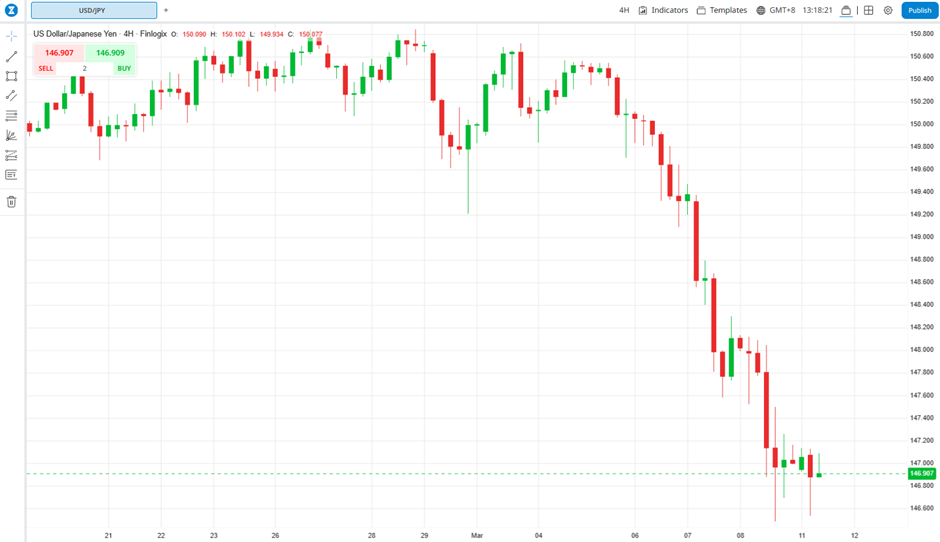
Against the Japanese Yen, the US Dollar tumbled 0.63% to 147.00 (148.02 Friday). The US 10-year treasury yield eased to 4.07% from 4.09% previously. Japan’s 10-year JGB rate was unchanged, at 0.72%.
The Euro (EUR/USD) settled at 1.0935, little changed from 1.0930 Friday. Sterling (GBP/USD), though, rallied to 1.2855 from 1.2805, up against the broadly based weaker US Dollar.
The Australian Dollar (AUD/USD) rose modestly against the Greenback, settling at 0.6625 from 0.6620 Friday. New Zealand’s Kiwi (NZD/USD) finished flat at 0.6180.
The US Dollar eased modestly against the Asian and Emerging Market Currencies (EMFX). The Greenback dipped against the Singapore Dollar (USD/SGD) to 1.3315 from 1.3335.
China’s inflation rate increased 0.7% in February from a year ago, it’s first rise since August 2023. Consumer prices rose due to a boost in demand for the Lunar New Year. The USD/CNH pair settled at 7.2000 against 7.2100 previously.
Other economic data released Friday saw Germany’s January Industrial Production climb to 1%, up from -2.1% previously, and beating expectations at 0.6%.
US Average Hourly Earnings in February dipped to 0.1% from 0.5% in January, and lower than estimates at 0.3%. China’s February Producer Prices (PPI) fell to -2.7% from -2.5% previously.
USD/JPY – In another roller coaster session the Greenback tumbled against the Yen to 147.00 from 148.02 Friday. The USD/JPY pair traded to an overnight high at 148.12. The overnight low recorded was 146.48. Lower US bond rates weighed on this currency pair.
EUR/USD – The shared currency finished little-changed against the US Dollar, at 1.0935. In choppy trade, the Euro soared to an overnight high at 1.0981 before tumbling. The overnight low recorded for the shared currency was 1.0917.
AUD/USD – The Aussie Battler gained modestly against the US Dollar to 0.6625 from 0.6617 Friday. A rise in China’s Inflation supported the Aussie, lifting hopes that consumer demand in the world’s second largest economy would pick up.
GBP/USD – Sterling soared against the US Dollar, finishing at 1.2855 in New York, up from 1.2805. In volatile trade the British Pound rallied to an overnight and fresh 7-month high of 1.2898 before easing. The overnight low recorded was 1.2801.
On the lookout
The week ahead kicks off with a light economic calendar today. Japan is scheduled to release its Final GDP report (q/q f/fc 0.3% from -0.8% previously; y/y f/c 1.1% from -3.3% previously - ACY Finlogix). Next up is Japanese February Machine Tool Orders (f/c -10.0% from -14.1% previously).
China releases its February Vehicle Sales (y/y f/c 41.0% from 47.9% previously – ACY Finlogix). Switzerland starts off Europe with its February Consumer Confidence (f/c -36 from -41 previously – ACY Finlogix). The US rounds up today’s economic data releases with its February Consumer Inflation Expectations (f/c 3% from 3% - ACY Finlogix).
Trading perspective
The Dollar extended its decline despite a mixed US Employment report. The rise in the US Unemployment rate reinforced bets that the Federal Reserve may trim rates by 0.25% in June. Treasury bond yields eased further with the 10-year rate settling at 4.07% (from 4.09% Friday). It was the lowest close for the 10-year yield in a month. Expect further selling pressure in the Greenback today. The only caveat is a short-covering rally from over-extended bearish Dollar bets.
USD/JPY – The Japanese Yen strengthened the most against the Greenback, leading the Dollar lower against other Rivals. The Dollar settled at 147.00 Yen, down from 148.02 previously. Today, look for immediate support in the USD/JPY at 146.70 followed by 146.40. Immediate resistance lies at 147.30, 147.70 and 148.00 (overnight high traded was 148.12). Look for more choppy trade in this currency pair, likely between 146.50-148.50. Trade the range, with the preference to buy USD/JPY dips.
AUD/USD – The Aussie Battler gained modestly against the Greenback to 0.6625 from 0.6620. Look for immediate resistance at 0.6650 followed by 0.6680 and 0.6910. On the downside, immediate support can be found at 0.6610 (overnight low traded was 0.6612). The next support level lies at 0.6580 followed by 0.6550. Look for the Aussie to trade a likely range today of 0.6580-0.6680. Neutral at current levels, trade the range.
EUR/USD – The shared currency finished little changed against the Greenback, at 1.0935 from 1.0930 Friday. Look for immediate resistance today at 1.0950 followed by 1.0980 (overnight high traded was 1.0981). The next resistance level can be found at 1.1000. The Euro has immediate support at 1.0900, 1.0870 and 1.0840. Expect the Euro to consolidate today in a likely range of 1.0900-1.1000. Prefer to sell rallies.
GBP/USD – The British Pound rallied against the Greenback, finishing at 1.2855 from 1.2805. Look for immediate resistance in Sterling today at 1.2880 followed by 1.2910 and 1.2940. Immediate support can be found at 1.2820, 1.2790 and 1.2760. Look for the British Pound to consolidate against the Greenback in a likely range today of 1.2800 to 1.2900. Preference is to sell Sterling on strength.
Author

Michael Moran
ACY Securities
Michael has over 40 years’ FX experience, including running FX trading desks for some of the largest banks in the world.