Deglobalisation – Is it really happening?
-
In the aftermath of the pandemic and amidst rising geopolitical tensions, the future of globalisation has been called into question and the most common argument is that we are entering an era of less economic integration.
-
We find no evidence of trade losing in importance, but rather changes in trading patterns and direction of flows. The US has become less reliant on trade thanks to the shale boom, while south-south trade led by China has definitely increased.

With the US-China trade war, the pandemic and rising geopolitical tensions, risks related to complex global supply chains to some extent materialised and quite legitimately, many seem to think that business leaders’ priorities have changed for good. Conclusions on whether we are past the ‘peak globalisation’ vary to some extent but often the message is the same: the golden years of globalisation have passed and we are entering an era of less economic integration. But is it, really?
The laziest argument for deglobalisation is that trade intensity, i.e. trade as a share of global GDP, has stalled after the global financial crisis. This is true, on the surface, if you look at merchandise trade (see Chart 1). Then again, growth in services trade continued to increase starkly until the pandemic disrupted the world’s travel, which accounts for app 10% of the total value of traded services. In 2021, global travel was yet to recover. Trade growth in ICT services, in turn, only accelerated in 2021, as did air freight services (see Chart 2). Even with traded goods, simply looking at trade-to-GDP ratios misses two key aspects: 1) changes in regional trends, and 2) changes in relative prices.
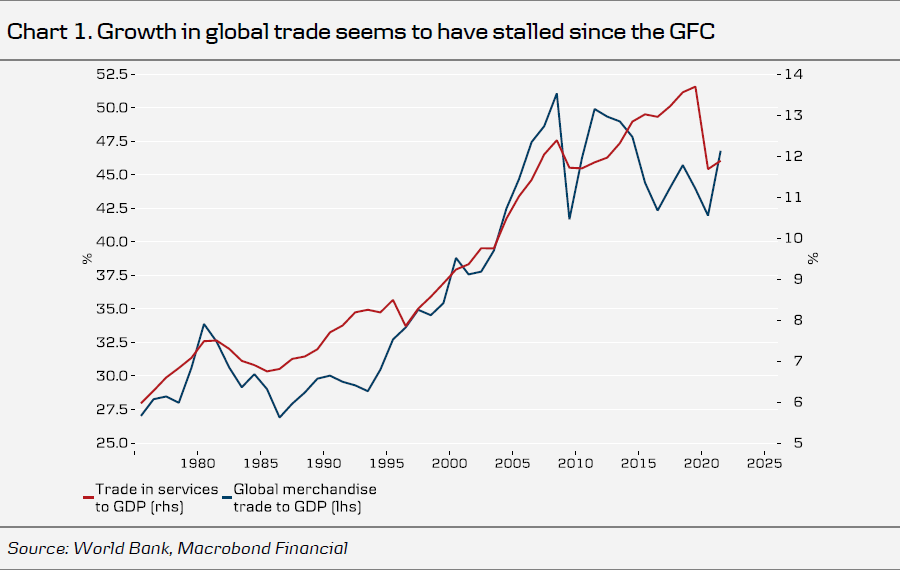
Regional breakdown of the data suggests that goods trade intensity did not peak globally around the GFC, and even today, trade appears to have peaked only in certain regions. In China, goods trade peaked already in 2006, while in the US, the same happened in 2011.
Author
Danske Research Team
Danske Bank A/S
Research is part of Danske Bank Markets and operate as Danske Bank's research department. The department monitors financial markets and economic trends of relevance to Danske Bank Markets and its clients.

















