Daniel Lacalle: Rate hikes won’t fix inflation or solve the debt problem
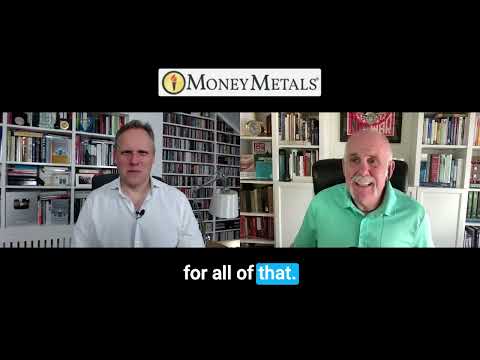
Economist Daniel Lacalle joined Mike Maharrey on the Money Metals Podcast to discuss the latest European Central Bank rate hike, the Federal Reserve’s upcoming September meeting, persistent inflation, sovereign debt, and what the environment means for gold and silver investors.
Daniel Lacalle, a professor at IE Business School in Madrid and a fund manager, argued that central banks are trying to solve the wrong problem. Raising interest rates, he said, will not bring down oil or natural-gas prices, curb government deficits, or reverse the monetary debasement that undermines purchasing power.
Rate hikes hit the private sector
The European Central Bank recently raised interest rates despite an economy Lacalle described as stagnant rather than overheated. He said private-sector lending, credit-card demand, and broader money-supply growth do not point to an economy running too hot.
Instead, he argued, much of the money-supply growth that remains is tied to government spending. In his view, an additional rate hike does little to address inflation while raising costs for households, small businesses, and medium-sized enterprises.
Lacalle noted that financing costs for small and medium-sized businesses in the euro area run between 7 and 12 percent. A 25-basis-point increase may sound minor in isolation, but for businesses already dealing with costly credit, it can mean the difference between accessing financing and getting none at all.
He warned that higher rates encourage banks to hold cash at the ECB instead of lending to businesses. The result, he said, is a policy that risks engineering a private-sector recession while government spending, deficits, and liquidity facilities remain in place.
The Fed faces a similar problem
Maharrey asked whether the Federal Reserve should follow the ECB’s lead at its September meeting. Lacalle said a U.S. rate hike would have no effect on energy prices or federal deficit spending, while it would add pressure to families and smaller businesses.
He emphasized that the Fed has a dual mandate of stable prices and full employment. According to Lacalle, roughly 90 percent of job creation in developed economies comes from small and medium-sized enterprises, the very businesses most affected by high borrowing costs.
Small-business financing costs in the United States, he said, are running between 6.5 and 8.5 percent. He also pointed to a New York Fed paper that he said found staying above the neutral rate in the average federal funds rate can destroy about 1 million jobs per year.
For that reason, Lacalle argued that the Fed has even less reason than the ECB to raise rates. He said another hike would be “hugely detrimental” to the U.S. economy.
Oil prices and monetary inflation are not the same
A central theme of the conversation was the distinction between individual price shocks and monetary inflation. Lacalle said policymakers and Keynesian economists often argue that higher oil prices automatically mean inflation is rising, but he rejected that premise.
If oil prices increase because of an energy shock while the amount of money in the system remains unchanged, consumers have less money to spend on other goods and services. In that situation, he said, other prices should remain stable or decline.
“War is inflationary” and “oil prices are inflationary” are common claims, Lacalle said, but he called them incorrect. In his view, oil-price shocks are disinflationary unless monetary inflation allows prices to remain elevated and continue rising over time.
What people feel in their daily lives, he said, is the destruction of a currency’s purchasing power. A reported CPI rate of 3.5 percent may not reflect the reality for families dealing with soaring housing, food, energy, and college costs.
Lacalle said consumers often blame the business owner who raises the price of bread instead of the government policies that debase the currency. That misunderstanding, he argued, makes it easier for advocates of greater spending and money creation to present themselves as the solution to affordability problems.
The global debt race is about who loses first
The conversation then turned to the U.S. debt, Treasury buybacks, and the broader global sovereign-debt problem. Lacalle stressed that America’s debt burden is serious, but he said the greater danger may lie in other advanced economies.
“The race of global debt is not a race to see who wins, but who loses first,” he said.
Lacalle pointed to France, the euro area, Japan, and the United Kingdom as countries facing high debt, large deficits, rising borrowing costs, and rapidly growing unfunded liabilities. He described unfunded liabilities as the part of the debt iceberg below the waterline.
He estimated France’s unfunded committed liabilities at roughly 450 to 500 percent of GDP and Germany’s at around 350 percent of GDP. These obligations come on top of governments that, in his view, remain unwilling to reduce spending or deficits.
The United States, he said, benefits from the dollar’s role as the world’s reserve currency. While the U.S. deficit is unsustainable, Lacalle argued that U.S. debt still plays a foundational role in the global financial system in a way that euro-area, Japanese, and British debt does not.
Rather than true de-dollarization, he said the world is experiencing “re-dollarization.” Investors and central banks may be reducing exposure to developed-market sovereign debt more broadly, but rising yields in the U.K., France, and Japan have been more dramatic than in the United States.
A sovereign debt bubble leads to stagnation
Lacalle said excessive sovereign debt may not trigger a conventional financial crisis. Instead, it can create long-term stagnation, persistent inflation, weak productivity growth, and falling real wages.
A real-estate bubble can burst, reprice, and eventually allow an economy to recover. A sovereign-debt bubble is different, he argued, because central banks and banks become focused on perpetuating the government-debt bubble rather than directing capital toward productive parts of the economy.
Lending to the real economy becomes a second- or third-best option, he said. Debt continues to rise as interest expenses rise, and governments struggle to solve the problem through more spending because new programs fail to make a meaningful dent in annual interest costs.
Lacalle also argued that government borrowing crowds out private investment. When the government can refinance debt easily while consumers face credit-card rates of 23 or 24 percent, he said, the private sector is effectively subsidizing the government’s cost of borrowing.
Why Gold and Silver investors should not fear rate hikes
For gold and silver investors, Lacalle’s message was direct. He acknowledged that precious metals do not rise in a straight line and that volatility should be expected.
But he said selling gold or silver solely because interest rates rise misunderstands the relationship between rates, government solvency, inflation, and currency debasement.
“If you sell silver and gold because there is a rate hike, then it’s because you don’t understand money,” Lacalle said.
A rate hike, he argued, can signal that government solvency is becoming less credible and that inflation remains persistent. Investors may receive a 5 percent yield on the bonds of an indebted government, but that does not necessarily provide a real economic return once currency depreciation and underlying asset losses are considered.
Lacalle noted that the sovereign-debt market has been in a recession since 2022 and has not recovered its 2021 highs. Gold, by contrast, has historically served as a reserve of value, a unit of measure, and real money.
He also said corrections in gold and silver often originate in paper markets that he estimated are at least 30 times larger than the physical market. Instead of treating volatility as a reason to sell, Lacalle encouraged investors to view sharp corrections as potential opportunities to add to positions.
The interview underscores a simple point for Money Metals listeners. Central-bank policy, rising debt, and persistent monetary debasement create volatility, but they also reinforce the case for holding real money and focusing on long-term purchasing power.
To receive free commentary and analysis on the gold and silver markets, click here to be added to the Money Metals news service.
Author

Money Metals Exchange
Money Metals Exchange
Now you can safeguard your assets from financial turmoil and the devaluing dollar – without paying costly middleman mark-ups or fending off high pressure, bait-and-switch sales tactics.