Diesel keeps climbing until someone reopens a pipeline

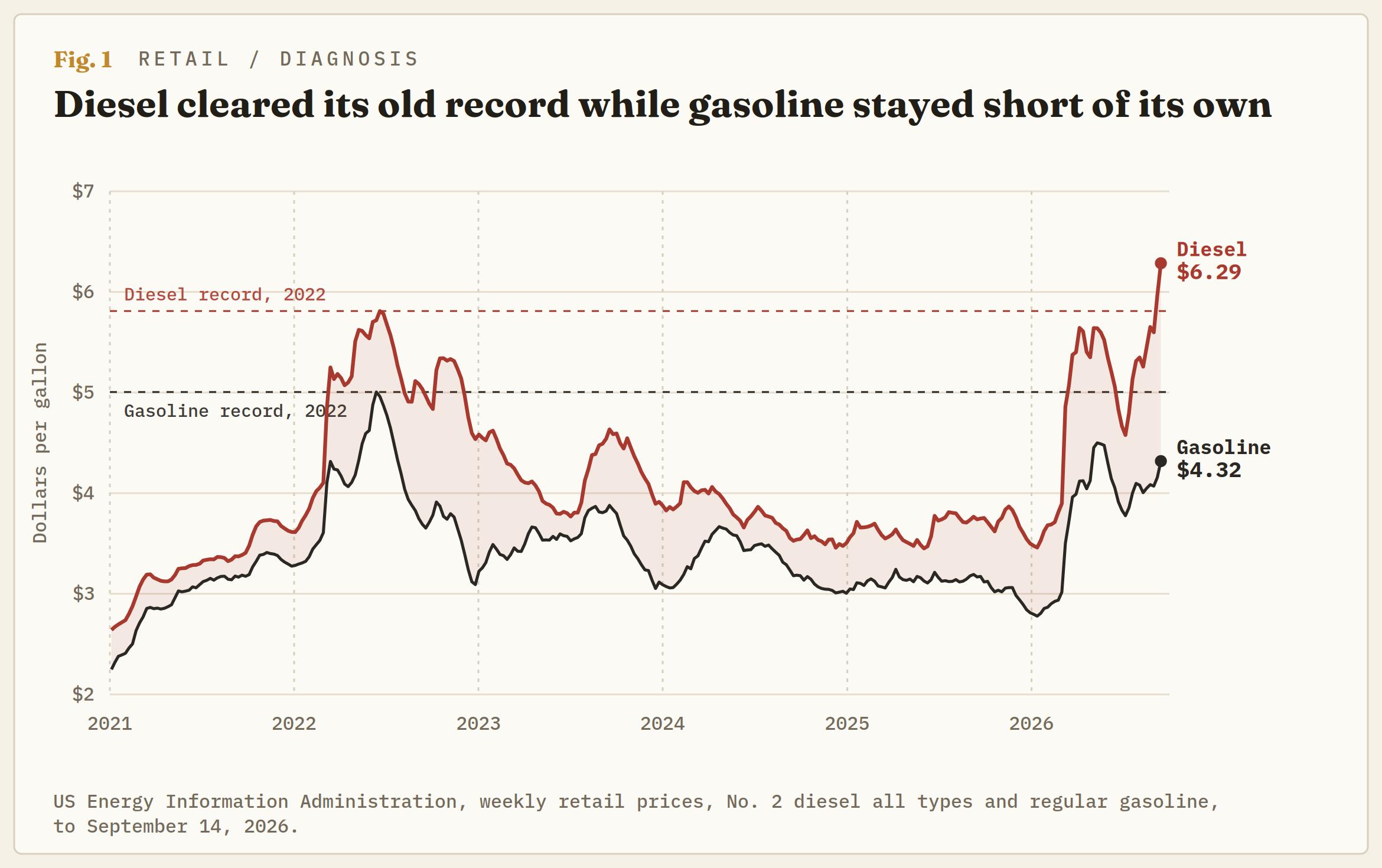
American Diesel costs $6.285 a gallon, more than it has ever cost, and it got there in a year when Gasoline never came close to its own record. Gasoline sits about 14% below the high it set in June 2022. Diesel sits about 8% above the high it set that month. Same crude, same refineries, same taxes, and nearly $2 a gallon between them. The world is not badly short of Oil. It is short of the machinery that turns oil into the fuel that moves freight, and it has been getting shorter since February.
That difference decides where the price goes from here. A crude shortage ends when somebody pumps more. A refining shortage ends when somebody builds a refinery, which takes about a decade, or when existing refineries stop getting hit.
You cannot make more diesel out of the same barrel
A barrel of Oil is not one product. A refinery cuts it into gasoline, diesel, jet fuel and heavy leftovers, and the split is decided by the metal in the plant rather than by what customers happen to want. A refiner can nudge the mix. Nobody can change it much, and nobody can change it quickly.
So the two pump prices have come apart. Diesel is up 81% since the first week of January, from $3.477. Gasoline is up about 55% over the same stretch and is still $0.69 short of its own high. Diesel is what trucks, tractors, trains, ships, and home furnaces burn, and it is the one that ran out.
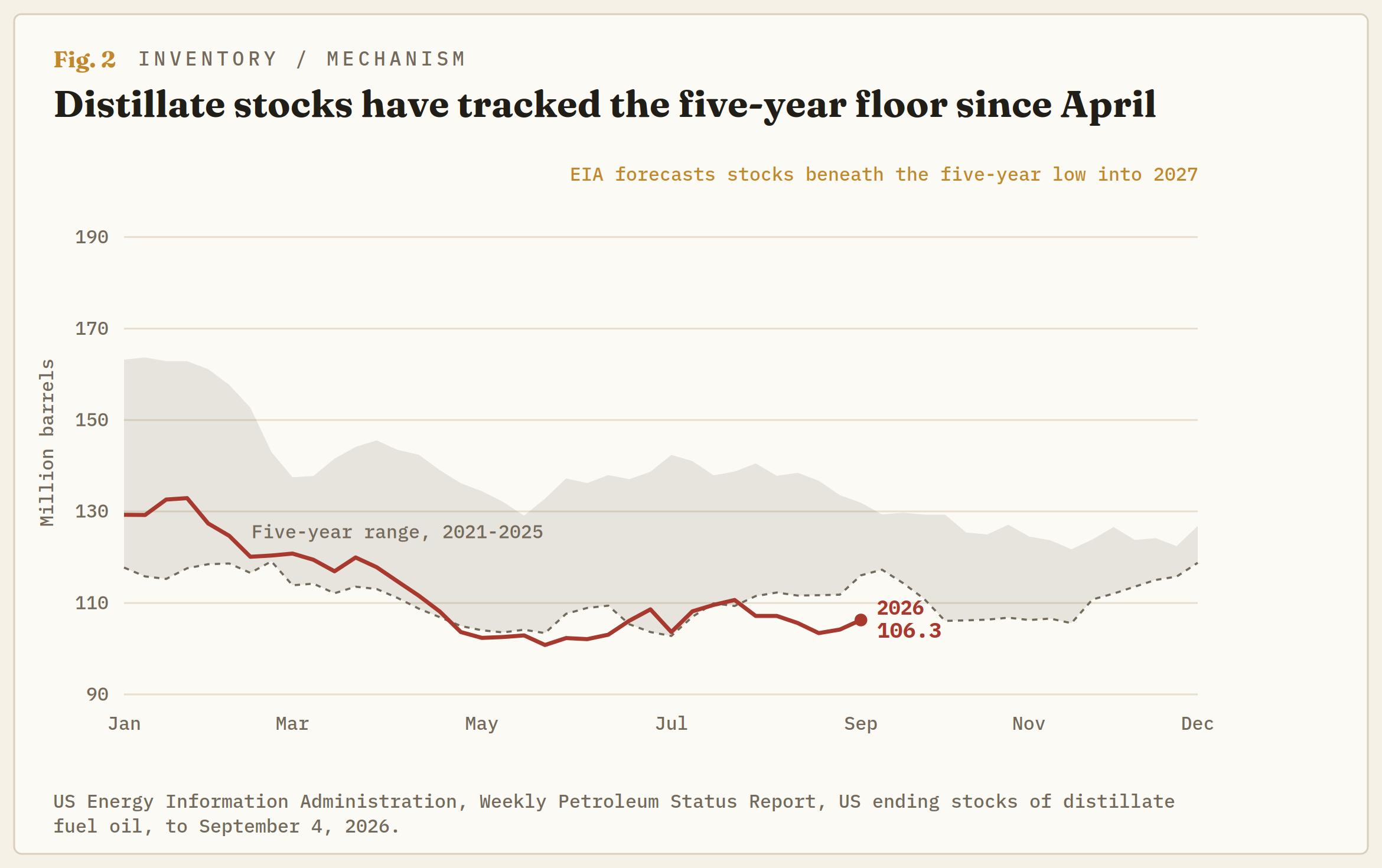
Distillate, the category covering diesel and heating Oil, held 106.274 million barrels in the week ending September 4. That is about 14% under its five-year average for that week, and lower than any of those five years managed in the same week. At the rate America burns it, that is roughly four weeks of diesel in the country. Crude in the same week sat at 424.1 million barrels, within half a percent of its own five-year average and comfortably inside its own range.
Two wars have been taking the world's refineries apart
Ukrainian strikes have repeatedly halted Russian refining and all but stopped its product exports, and the fighting between the United States and Iran has kept Gulf refineries from shipping. The International Energy Agency (IEA) puts a number on it. Net exports of diesel and gasoil from the Gulf and Russia ran 1.6 million barrels a day lower in August than in February, and back in February those two supplied almost 45% of the world's seaborne trade in it.
What is left is already flat out. Global refinery runs hit a summer peak of 81.4 million barrels a day in August and were still 4.2 million a day below the year before. American refineries ran at 97.8% capacity in the first week of September, about as high as they go, and they have shipped more distillate abroad this year than in any recent year, averaging 1.482 million barrels a day versus 1.267 million last year. Exporting at full tilt is the sensible thing to do with the best margins on record. It is also why the tanks at home have not refilled.
Then both ways out went down in the same week. With the Strait of Hormuz effectively shut since March, Saudi Arabia had been pushing roughly 5 million barrels a day across the country through the East-West pipeline to Yanbu on the Red Sea, on a line built for 7 million. Drones launched from Iraq hit its pumping stations on September 10 and the kingdom shut it. Repairs are being described in weeks. Days before that, Houthi forces took Mocha and the island of Perim, which sit at the mouth of the strait that any cargo leaving Yanbu has to pass through. Saudi Arabia now has no dependable way out to the east or the west.
Producers noticed the bill before consumers did
The August inflation numbers landed days before the Federal Open Market Committee (FOMC) meets, and they tell two different stories. The Consumer Price Index (CPI), released September 11, rose 0.4% in the month, with gasoline up 3.9% and responsible for more than a third of the increase. Read that one and this is a problem about filling up the car.
The Producer Price Index (PPI), out the day before, says something else. Diesel prices jumped 24.1% in August. That one item explains more than a third of the rise in what producers charged for goods and nearly two-thirds of the rise in processed goods sold on to other businesses. The Bureau of Labor Statistics (BLS) splits the production chain into four stages by how far a good sits from the shopper, and diesel turns up as a rising cost in every one of them. The firms that actually sell fuel watched their margins fall 11.3% in the same month, so the people with their name on the pump took a pay cut in the month everyone blamed them for the price.
Trucking prices rose 2.0% in August, and freight and warehousing rose 2.3%, because diesel is the biggest single variable cost in moving a box, and the contracts pass it straight through. The Fed's rate is 3.50%-3.75%; a rise to 3.75%-4.00% is priced at 92.5% for Wednesday, and futures have the rate at 4.17% by December. Diesel did not cause all of that. It is in every number the committee is reading.
Every forecast here assumes the ships come back
The official view is that this eases off. The Energy Information Administration (EIA) published its Short-Term Energy Outlook (STEO) on September 9 and expects the American diesel refining margin to hold above $2 a gallon through November and then fall steadily into 2027. The IEA's balance tips to surplus on much the same path. Both say that depends on tanker traffic through the Strait of Hormuz returning to normal, which would let Saudi and Kuwaiti refineries send distillate to the world again.
The EIA locked its inputs on September 3. The pipeline was destroyed on September 10.
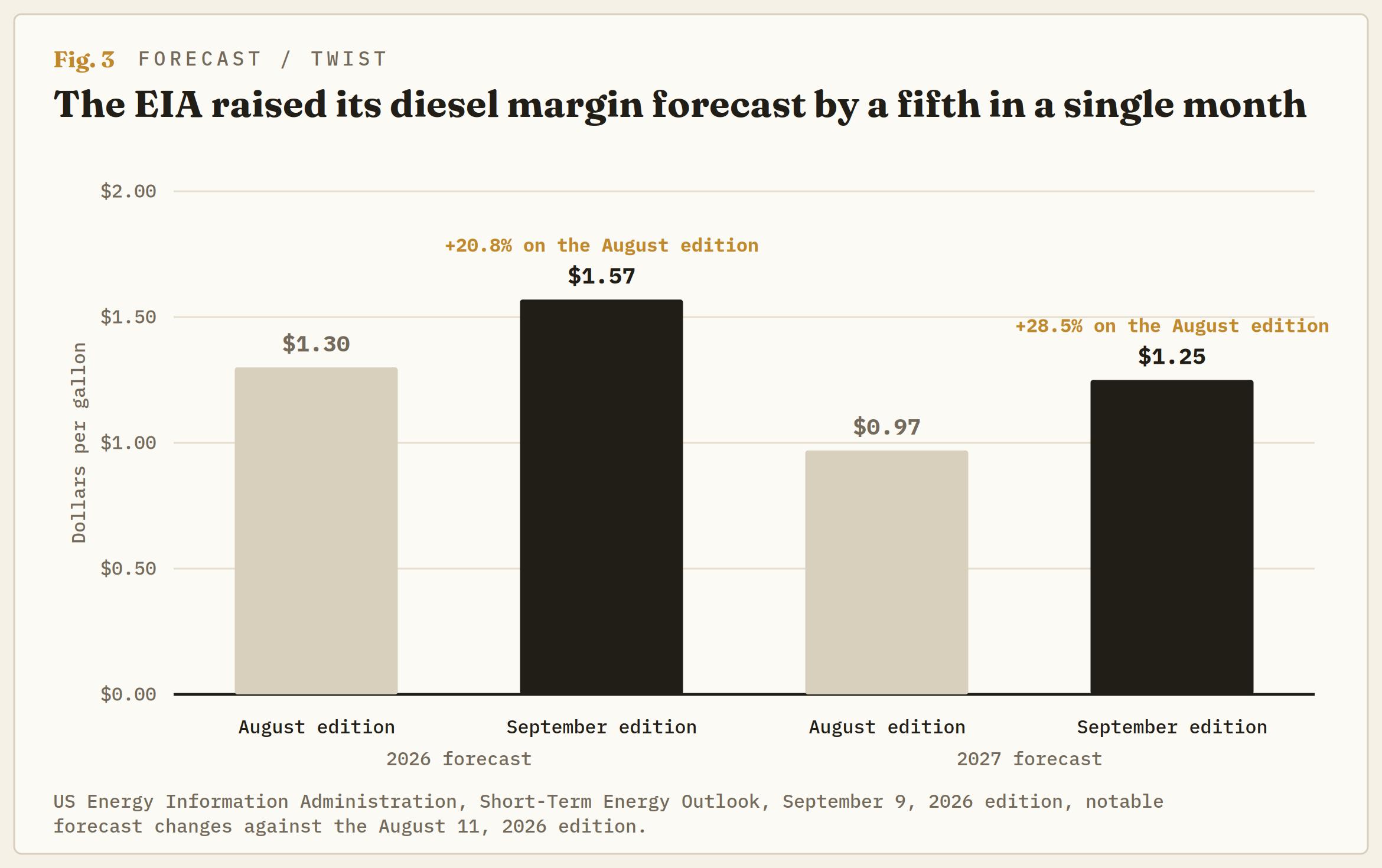
In a single month, the EIA raised its 2026 diesel margin forecast by 20.8% and its 2027 forecast by 28.5%, and put forecast retail diesel up to $5.07 for this year and $4.40 for next. Of the three changes it flagged as notable in that edition, two were diesel. Its path back down runs through a route that shut a week after it stopped typing.
The equity market worked this out months ago. Marathon Petroleum (MPC) is up 153% this year, Valero Energy (VLO) 143%, HF Sinclair (DINO) 142%, and Phillips 66 (PSX) 106%. Exxon Mobil (XOM) and Chevron (CVX), which mostly find and sell crude, are up about 40%, and the S&P 500 about 11%. For nine months, investors have paid roughly three times as much for the ability to process a barrel as for the barrel.
What would have to happen
Anyone long diesel here is betting on repair schedules in Saudi Arabia. Diesel futures trade just under $5.00 a gallon and the refining margin sits near $105 a barrel, down from $113, so the market already expects a fix at some point. The argument is about when it turns up.
It comes down to whether the fuel can move again before the season turns. Either the East-West line restarts within a few weeks and Hormuz traffic really does normalize, in which case the EIA's path is roughly right, the margin compresses from December, and the refiner trade hands back a large part of a very large year; or the repairs run long into an autumn that already has three demands stacked in it: refineries take capacity down for scheduled maintenance, the harvest burns diesel in the fields, and the heating season starts in the northeast with tanks under their five-year floor. Those three arrive on the calendar whatever the welders manage.
Four things will settle it:
- A restart date for the pipeline from Aramco, not political officials.
- Weekly distillate inventories against the 100 million barrel line, which the EIA expects will break this month.
- Refinery utilisation as the maintenance season starts, where a reading above 95% means operators are putting off maintenance to chase the margin and storing up a worse spring.
- And next month's outlook, where a second upward revision in a row would say the agencies are following this market rather than forecasting it.
The case is wrong on a durable reopening of both routes at once, on distillate stocks climbing back inside their five-year range, or on $6 diesel simply stopping freight from moving. That last one is the version where the price fixes itself by breaking the demand, and it takes the refiner trade down with it.
Author

Joshua Gibson
FXStreet
Joshua joins the FXStreet team as an Economics and Finance double major from Vancouver Island University with twelve years' experience as an independent trader focusing on technical analysis.