|

Cycle Trading: Weekend report preview

The Dollar

The dollar formed a swing low on Friday.
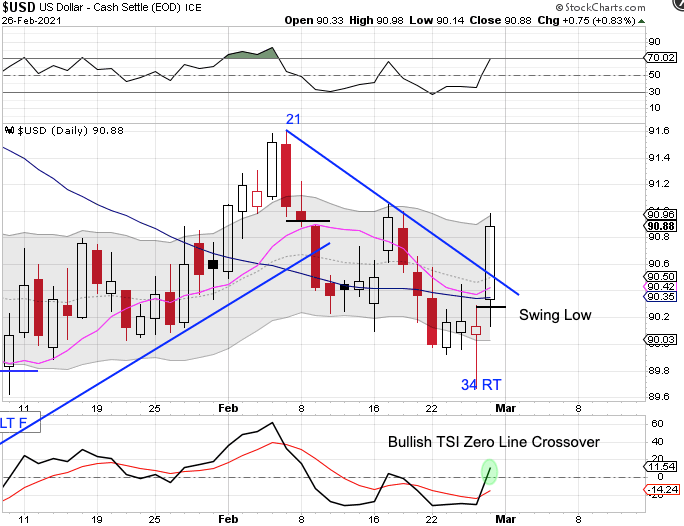
The dollar broke below the day 32 low on Thursday to extend its daily cycle decline. Thursday was day 34, placing the deep in its timing band for a DCL.  The dollar formed a swing low on Friday that closed above the 50 day MA, 10 day MA and the declining trend line to confirm the new daily cycle. The dollar is currently in a daily downtrend. But a close above the upper daily cycle band will end the daily downtrend and begin a daily uptrend.

Stocks

Stocks closed below the daily cycle trend line on Friday.

Stocks are showing signs of a change of character.  Stocks have been in a strong uptrend that has been characterized by RSI 05 forming quick bullish reversals once oversold and then embedding in overbought.  Tuesday’s bullish reversal followed by Wednesday’s bullish follow through did not even see RSI 05 reach overbought. Stocks were rejected by the declining trend line on Thursday then closed below the daily cycle trend line on Friday to signal the daily cycle decline. Any bearish follow through will send stocks to seek out their DCL. And with a peak on day 11, any bearish follow through will left translate this daily cycle to also lead to an intermediate cycle decline.

While stocks did close below the daily cycle trend line, they did not close below the 50 day MA. This is the last area for defense. If the Fed decides to intervene, a swing low here would have us label day 19 as a half cycle low. Stocks are still in a daily uptrend. If a swing low forms above the lower daily cycle band then stocks will remain in their daily uptrend and trigger a cycle band buy signal.

Author

LikesMoney

LikesMoney

Independent Analyst

Assets (such as stocks, gold, and the dollar) have identifiable cycles.

More from LikesMoney
Share:

Editor's Picks

GBP/USD nudges higher above 1.3350 despite Middle East turmoil

The GBP/USD pair rebounds to near 1.3385 during the Asian trading hours on Thursday. However, the potential upside for the major pair might be limited amid cooler-than-expected UK inflation data and escalating tensions in the Middle East. Traders will take more cues from the UK Retail Sales report, which is due later on Friday. 


EUR/USD stabilizes near 1.1400 as markets focus on geopolitics

EUR/USD trades in a narrow channel at around 1.1400 on Wednesday. In the absence of high-impact data releases, escalating geopolitical tensions in the Middle East caps the pair's upside. On Thursday, the European Central Bank (ECB) will announce monetary policy decisions.

Gold is at a critical juncture as Middle East conflict widens

Gold snaps a four-day recovery early Thursday as widening Mideast conflict-led rallying Oil prices spur inflation fears. The US Dollar stays defensive amid potential USD/JPY sell-off, as ‘Yenternvention’ risks loom. Gold at a crossroads, awaiting Bear Cross confirmation on the daily chart, as RSI flirts with 50.

Australia unemployment rate set to steady at 4.4% in June, signaling strong job market

Australia will publish the June monthly employment report on Thursday at 01:30 GMT, and market participants expect a modest increase in job creation in the land Down Under. The Australian Bureau of Statistics is expected to announce that the country added 15K new jobs in the month, while the Unemployment Rate is forecast at 4.4%, unchanged from May.

Senate Republicans release updated CLARITY Act with new crypto ethics restrictions
Senate Republicans released an updated version of the Digital Asset Market CLARITY Act on Wednesday following briefing calls with stakeholders. The update adds a package of ethics restrictions targeting digital asset activities by public officials and their spouses. The revised legislation comes after negotiations between the White House and Republican senators Cynthia Lummis and Bernie Moreno.
US Dollar mid-year outlook: Exceptional currency, exceptional risks?
The US Dollar enters the second half of 2026 in a markedly different position from a year ago. The King currency has recovered, reflecting persistent US inflation, changing expectations for Fed policy, geopolitical tensions and renewed demand for defensive assets.