Could rising yields support dollar recovery?

Benchmark government bond yields in the US have been creeping up again over the past few weeks. The yield on the 10-year Treasury is closing in on 2.9%. Meanwhile short-term rates have been rising even faster. That’s despite geopolitical tension rising recently and ongoing trade spat between the US and China. Two-year Treasury yields have risen to their best levels since before the financial crises in 2008, at around 2.43%. With short-term yields rising, so too have expectations over Federal Reserve rate hikes. Investors increased their expectations this week that the Fed would raise interest rates three or possibly four times this year. But the fact that the yields on the short-term debt have risen at a faster clip than the long-term, this suggests that investors may be concerned over long term economic growth. Still, they expect the Fed to hike rates another 2 or 3 times this year, having already raised rates once in March. And if these expectations remain elevated then we may see the dol nother 2 or 3 times this year, having already raised rates once in March. And if these expectations remain elevated then we may see the dollar make a more meaningful comeback in the coming days and weeks lar make a more meaningful comeback in the coming days and weeks.
ECB could prove to be more dovish than anticipated
Fundamentally, though, there isn’t much in the way of economic data from the US this or much of next week, except a few speeches from Fed members. But the Dollar Index could nonetheless find indirect support from the possibility that the European Central Bank next week will give a more dovish assessment of the Eurozone economy given the recent soft patch in German data. This could undermine the euro and underpin the dollar. In addition to the ECB, the Bank of Japan will also be making its policy decision next week, too. And if the BOJ also turns out to be more dovish than hawkish then this could further boost the Dollar Index. As far as the US is concerned, the first estimate of Q1 GDP will be published next Friday. So, there are in fact a few things to look forward to next week.
Tentative bullish signs for Dollar Index
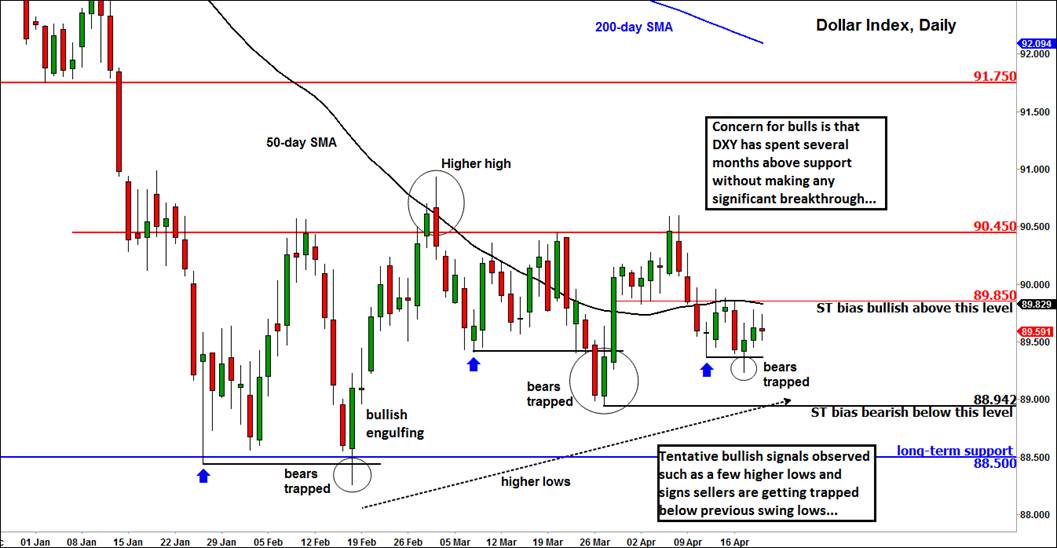
Ahead of next week’s fundamental events, there are tentative technical bullish signals observable on the daily chart of the Dollar Index, suggesting that it may be trying to form a base. However it’s early days and so far we haven’t had a decisive breakthrough. Indeed, one could even argue that despite holding its own above the long-term support at 88.50 for pretty much all of this year, the fact that the DXY has moved much higher is suggestive of a heavy market and that it could break down soon. Nonetheless, the tentative bullish signs may point to at least a short-term recovery.
As can be seen on the chart, the first sign of a potential reversal occurred when the DXY tried to break below its prior lows back on 16th February. The sellers failed to hold their ground below that 88.50 level and the bulls took full advantage of their weakness. By early March, the DXY had peaked above short-term resistance and previous short-term high around 90.50. That’s when it created a short-term higher high. However since that high was made the dollar has been unable to show any further bullish follow-through. If anything, it has since created two intermediate lower lows. But recently, the bulls stepped back in and another attempt was made to break that 90.50 level. But again, there was no real desire to push the dollar beyond this level. Crucially, however, the resulting sell-off has stalled ahead of the prior short term low at 88.95. Thus it may have created a short-term higher high within its existing consolidative range. The consolidation has allowed the 50-day moving average to flatten.
So, what we are seeing here could be smart money accumulation within the consolidation. But as we don’t have any concrete technical signals that would suggest that a breakout is imminent, conservative traders may wish to wait for further bullish signs to emerge before taking a medium to long term view on the dollar. If the DXY were to break above the 50-day average and short-term resistance at 89.85, this would be a further tentative bullish sign. But the key breakthrough would be if and when it breaks decisively out of its current range and above resistance at 90.50. If that were to happen then then the dollar could extend its gains to 91.75 resistance in the short-term.
Author

Fawad Razaqzada
TradingCandles.com
Experience Fawad is an experienced analyst and economist having been involved in the financial markets since 2010 working for leading global FX, CFD and Spread Betting brokerages, most recently at FOREX.com and City Index.

















