Could a shift away from US equities hasten de-Dollarization?

Could the recent sale of U.S. equities signal the beginning of a long-term trend that speeds up global de-dollarization?
Some analysts think it does.
One could certainly write this sentiment off as a knee-jerk backlash against the aggressive tariff policy being implemented by the Trump administration, and it may cool once new trade deals are inked. However, it’s undeniable that there has been a shift away from U.S. assets, and it’s important to consider at least those who are trying to tell us why.
According to a recent article published by the Financial Times, Wall Street banks see signs that investors are beginning to “trim their U.S. positions, on concerns over erratic policymaking, President Donald Trump’s attacks on the Federal Reserve chair, and the fallout from the trade war."
More concerning is the assertion that “the dumping of U.S. assets in favor of Europe’s resurgent markets signals the start of a much longer-term move by pension funds and other big institutional money managers to cut back their huge exposure to dollar investments.”
If this is a long-term trend, it could speed up de-dollarization.
The greenback’s role as the world’s reserve currency is already eroding. Last year, total holdings of dollar-denominated securities by foreign central banks fell by $59 billion.
As of the end of last year, dollars made up 57.8 percent of global reserves. That is the lowest level since 1994, representing a 7.3 percent decline in the last decade. In 2002, dollars accounted for about 72 percent of total reserves.
Now we’re beginning to see a decline in dollar-denominated assets held by investors.
While U.S. stocks have recovered most of their losses since the announcement of “Liberation Day” tariffs, they remain in negative territory for the year and are lagging foreign markets. According to a Bank of America survey, fund managers slashed their exposure to U.S. equities by a record amount in February and March. According to the survey, respondents were a net 36 percent underweight in U.S. equities.
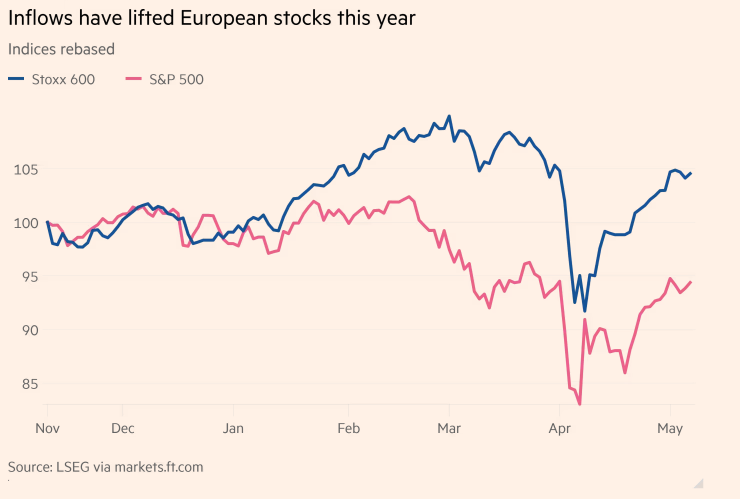
Meanwhile, the dollar has declined by around 7 percent this year. At the same time, the euro has surged along with German government bonds. Analysts say this suggests investors are seeking non-dollar safe-haven assets.
Deutsche Bank global head of FX research George Saravelos told the Financial Times he’s seen “significant selling of U.S. dollars from real money investors over the last three months,” and the CFO of an Australian pension company bluntly said, “Frankly, I think we’ve seen peak investment in U.S. assets.”
The flow of money out of European-based ETFs that invest in U.S. stocks and bonds is one sign of this trend. Outflows reached €2.5bn during April, the highest level since early 2023.
Morningstar principal Kenneth Lamont told the Financial Times the sale of dollar assets “reverses a long-term trend in which U.S. assets have been the beneficiary of consistently strong net inflows.”
Veritas Pension Insurance Company, based in Finland, cut its U.S. stock exposure. The company’s chief investment officer told the Times that given the high valuation of U.S. stocks, “the uncertainty and the communication around tariffs … the confusion and unpredictability associated with that made us question the idea that you should pay that sort of premium.”
Wellington Management analyst John Butler asked the key question.
"How far and how fast does it go?"
The U.S. has some things working in its favor. The U.S. stock market is supported by tremendous depth and liquidity, and the Treasury market is massive, totaling nearly $30 trillion. One investor told the Financial Times that they were having “an internal debate on U.S. exceptionalism."
“Experience says that you need to be careful with these shifts and that betting against the U.S. hasn’t worked out well.”
Blowback
However, the U.S. could be playing with fire. The government’s weaponization of the dollar, especially in the wake of the Russian invasion of Ukraine, made many countries wary of holding greenbacks. Now the U.S. government has weaponized trade.
The backlash shouldn’t come as a surprise.
If you know something makes you vulnerable, what do you do?
You try to minimize that vulnerability.
So, if you’re worried that the U.S. and its allies might cut off your access to dollars, what would you do?
Minimize your dependence on dollars.
In other words, if you are concerned that the U.S. could pull the "dollar rug" out from under you, why not pull out from the dollar system first?
While the U.S. policies may be justified, it is still important to consider the potential blowback.
Ramifications
Even a modest erosion of the dollar’s status could create significant problems for the U.S. economy.
Simply put, the U.S. needs the world to need dollars.
The U.S. depends on this global demand for dollars supported by its reserve status to underpin its massive government. The only reason Uncle Sam can borrow, spend, and run massive budget deficits to the extent that it does is the dollar’s role as the world's reserve currency. It creates a built-in global demand for dollars and dollar-denominated assets. This absorbs the Federal Reserve’s money creation and helps maintain dollar strength despite the Federal Reserve’s inflationary policies.
Even a modest de-dollarization of the world economy would cause a dollar glut. The value of the U.S. currency would further depreciate. That translates to more price inflation at home. In the worst-case scenario, the dollar could collapse completely, leading to hyperinflation.
There is a way to shield yourself from the impacts of de-dollarization -- minimize your exposure to the dollar. Instead of holding U.S. government fiat currency, buy gold and silver.
To receive free commentary and analysis on the gold and silver markets, click here to be added to the Money Metals news service.
To receive free commentary and analysis on the gold and silver markets, click here to be added to the Money Metals news service.
Author

Mike Maharrey
Money Metals Exchange
Mike Maharrey is a journalist and market analyst for MoneyMetals.com with over a decade of experience in precious metals. He holds a BS in accounting from the University of Kentucky and a BA in journalism from the University of South Florida.