Continuity Doesn’t Work When the Road is Changing

While it is perhaps comforting
Normalization: You can Check Out Anytime You Wish
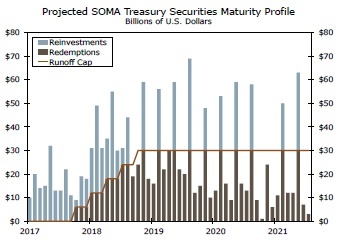
"Once the process of balance sheet normalization has begun, it should continue as planned as long as there is no material deterioration in the economic outlook," Jerome Powell, The Economic Club of New York (June 1, 2017). As illustrated in the top graph, the reduction in the balance sheet begins to make a difference in the second half of 2018 when there is an actual reduction in the Fed's balance sheet. However, at this point, the Treasury deficit financing needs will also start to rise along with the Federal deficit.
‘But You Can Never Leave.'
It is becoming increasingly likely that as the economic cycle ages, during a period when the Fed is slowly reducing its balance sheet, the size of the balance sheet will remain larger than the Fed's long-run goal. Also, given the possibility of a recession before the balance sheet returns to normal, the federal funds rate will likely remain low. In this type of environment, the balance sheet will likely resume its role as a policy tool.
Losing Weight While Eating Cheesecake?
"Two percent ...is a symmetric objective." The problem here is that the PCE deflator has run consistently below 2 percent during the current economic cycle and has averaged below 2 percent since NAFTA was implemented in 1994 (middle graph).
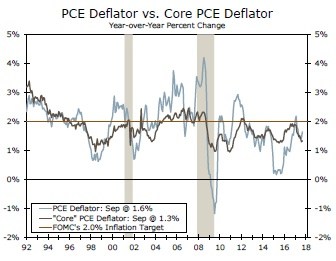
How can this work if the current dot-plot and balance sheet polices are followed? Something has to give. We project the PCE deflator will be at 1.7 percent by the end of 2018, and at that time the Fed will have continued to raise the funds rate and began to shrink the balance sheet in earnest, according to the current schedule. Something has got to give.
Second Verse, Same as the First
"And low rates can lead to excessive leverage and broadly unsustainable asset prices—things that we watch carefully for and do not observe at this point." Jerome Powell, 77th Annual Meeting of the American Finance Association, (January 7, 2017).
"The Federal Reserve is not currently forecasting a recession." Ben Bernanke, (January 10, 2008).
Forecasting is difficult – especially about the future. For private sector decision makers, the rapid turn in the credit cycle (bottom graph) indicates that difficult credit situations can appear very quickly. Ever since 1862, Washington has passed laws to prevent a repeat of the last recession, but there is no predicting the source of the next credit recession. Credit cycles are procyclical, and both business decision makers and policy makers have a recency bias—tomorrow will be like today.

Author
Wells Fargo Research Team
Wells Fargo

















