Consumer resilience wearing thin


Summary
The May personal income & spending report brought weakness and revisions that suggest some lost-swagger among the consumer. While inflation is a bit less benign than it has been in recent months, if you look closely you'll see signs of tariff-price pressure already appearing.
Forget what you thought you knew about the consumer
Real consumer spending fell 0.3% in the second month of the second quarter and that development comes on the heels of a sharp downward revision to first quarter consumer spending in yesterday's third-look at GDP. This may be a bit short of a seismic change, but it completely changes the narrative on the health of the consumer and reconciles the head-scratching disparity between plunging confidence and a swaggering consumer unencumbered by tariffs or a weakening labor market. The narrative of an unshakable consumer was never quite accurate. Some of that message was already revealed in yesterday’s GDP revisions which showed consumer spending is now estimated to have increased at a limping-along pace of just 0.5% compared to a more jaunty 1.8% pace in the initial estimate. Revisions were particularly hard on services where the pace of spending slowed to 0.6% from a first estimate of 2.4%.
Today's report gets into the detail a bit more and what emerges is a consumer whose spending patterns are more closely aligned with the deterioration in consumer sentiment we have seen in other reports. It also turns out that consumers were setting aside more in savings each month, a revelation brought on by the revisions. But as the nearby chart shows, households dipped into those savings in May (note how the red line comes down sharply). Yet, it bears noting that some of the apparent drop in savings is less a reflection of smashing open the piggy bank and instead simply a pass-through effect from a sharp drop in household income. Mathematically, if your spending goes down, but your income goes down faster, you are saving less. Yet income is down because strange things are afoot this month.
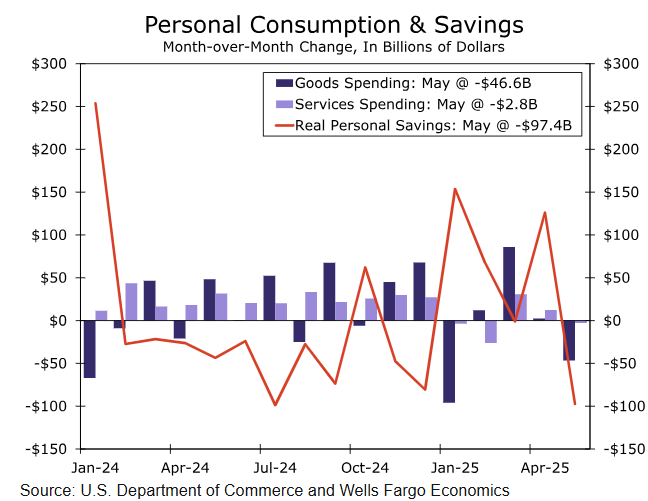
Specifically, the recent data have incorporated changes designated by the Social Security Fairness Act and American Relief Act. This led to a surge in social security and proprietors income in recent months, and now a tumble in May and was responsible for the 0.4% drop in personal income, or the first decline in nearly four years. Excluding social security and proprietors income, personal income would have risen closer to 0.2% during the month and importantly, wages & salaries, the bulk of income, was still rather strong rising 0.4% and suggests households still have the means to spend.
Author
Wells Fargo Research Team
Wells Fargo

















