US Conference Board Consumer Confidence June Preview: Pragmatism above all
- Conference Board Consumer Confidence expected to rise to 119.0 from 117.2.
- US consumer optimism may be hindered by slow employment and soaring inflation.
- Michigan Consumer Sentiment has barely stirred in the last four months.
- Markets will not trade changes in consumer outlook.

American's outlook will be little changed as the summer starts, with a slowly improving employment picture at odds with the bite of rising inflation on the family budget.
The Consumer Confidence Index from the Conference Board is expected to rise slightly to 119 in June from 117.2 in May. Consumer sentiment has recovered about two-thirds of the February 2020 to April pandemic plunge from 132.60 to 85.7. The majority of the rise has occured in the past three months as the index jumped from 95.2 in February to 114.9 in March.
Michigan Consumer Sentiment
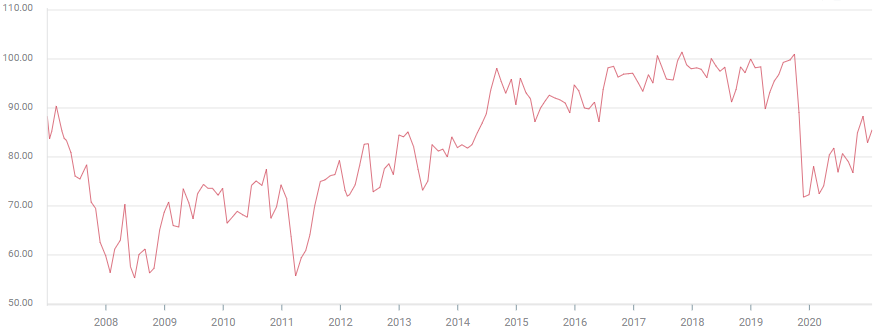
The Consumer Sentiment Index from the University of Michigan has moved in a narrow 5.4 range since March with April the high at 88.3 followed by the low of 82.9 in May. The June score of 85.5 is almost half-way between the February 2020 reading of 101 and the April low of 71.8.
Michigan Consumer Sentiment
Employment
Although by Nonfarm Payroll accounting only 66% of the lockdown layoffs of last March and April have been rehired through May, with 9.286 million jobs going begging in the April Jobs Openings and Turnover Survey (JOLTS), it is not for lack of opportunity. Employers have reported for several months that labor shortages are one of the chief constraints in expanding business.
A combination of extended and fortified federal unemployment benefits that are scheduled to run through the end of September have induced people to delay their return to work. For many lower wage jobs, insurance may pay nearly as much as employment, making the reluctance eminently logical.
Inflation and Retail Sales
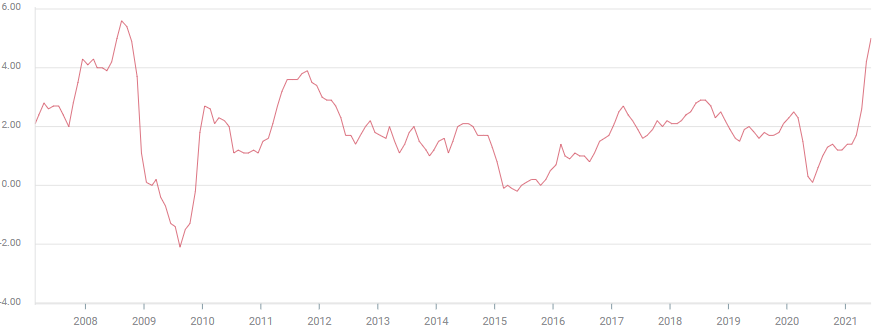
Price increases have taken a larger bite out of the consumer budget in the past several months than at any time in the last decade.
The Consumer Price Index jumped 5% annually in June, its biggest surge since August 2008. The yearly Personal Consumption Price Index (PCE) rose 3.9% in May. The core PCE rate, targeted by the Federal Reserve at 2%, climbed 3.4% last month.
CPI
FXStreet
The inflation drag on household financing may be partly responsible for the volatility in Retail Sales this year. Except for the stimulus boosted spending in January and March of 7.6% and 10.7% respectively, consumers have been chary of expenses. Retail Sales fell 2.9% in February, were up 0.9% in April and slipped 1.3% in May.
Retail Sales
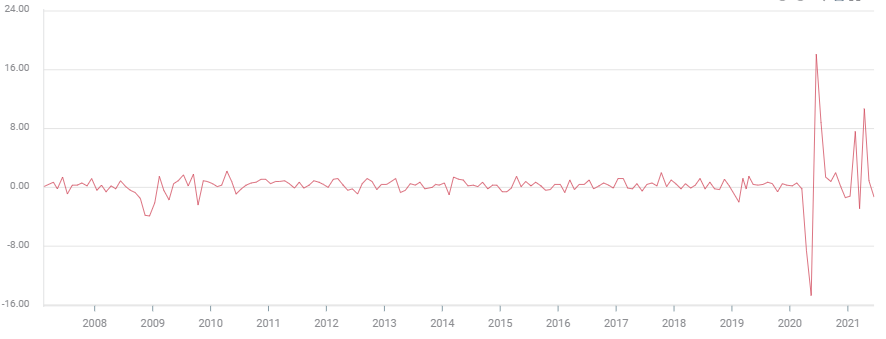
The overall average monthly increase of 3% in the first five months is wholly due to the government largesse in the first quarter.
Federal Reserve Chair Jerome Powell has insisted that the current inflation is a temporary phenomenon, prompted by the base effects on prices and shortages in production and material from from last year’s lockdowns.
While there is undoubted accuracy in the Fed’s analysis there are signs that many of the price gains have become endemic in the economy.
Gasoline prices, a major component in any American family's budget, are up more than 40% this year since the elections. With global demand expected to rise and supply curtailed by US domestic policy, prices are unlikely to come down anytime soon.
Conclusion
Despite the Fed’s reassurance that inflation will diminish and employment will fully recover, Americans are taking a sensible wait-and-see attitude.
Consumer spending reflects this practical approach. When the money does not come from the family budget it is spent freely. When spending depends on income, restraint and prudence are the orders of the day.
Americans are a pragmatic people. They may believe the best for the future but they will act only when it matches reality.
Author

Joseph Trevisani
FXStreet
Joseph Trevisani began his thirty-year career in the financial markets at Credit Suisse in New York and Singapore where he worked for 12 years as an interbank currency trader and trading desk manager.














