USD: Q1 Big Bang, or vol- and soul-crushing chop? – It depends on tariff announcements


The answers
USD longs are getting nervous into inauguration as positioning shows the largest, most unanimous USD long in years, the newsflow is confusing, and the ultimate timing and scope of announcements is unknown. There is a core group of large and devout USD longs, some dabblers, and just about exactly zero USD shorts.
Without further ado, here are the survey results with takeaways interspersed.
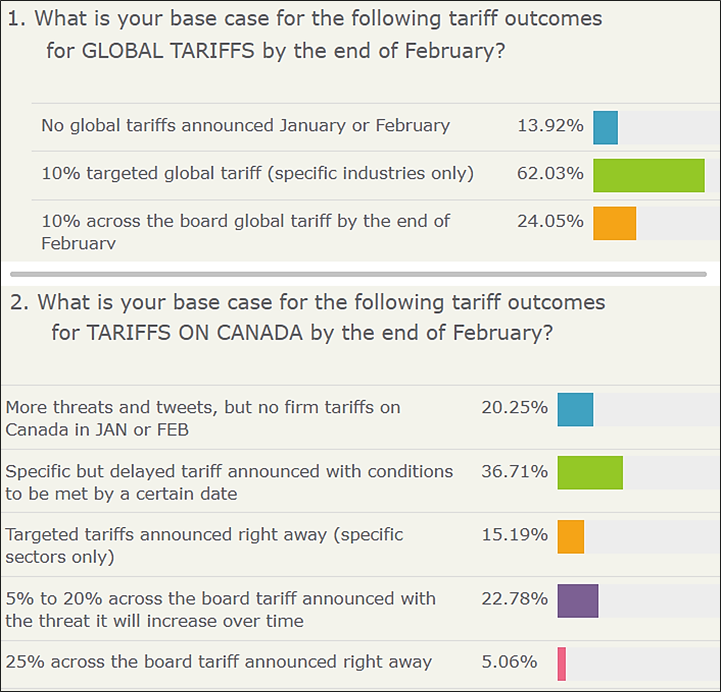
Takeaways: More than 50% of respondents expect no Day One tariffs on Canada. Wow. And the vast, vast majority do not expect a 25% tariff on Day One, despite warnings from US and Canadian policymakers. There is a huge delta to USDCAD, then, if the nuclear option comes to pass. This heavy favoring of the “no tariffs” option helps explain why USDCAD isn’t going up despite what appears to be a bevy of clear warning signs: A majority don’t believe the hype.
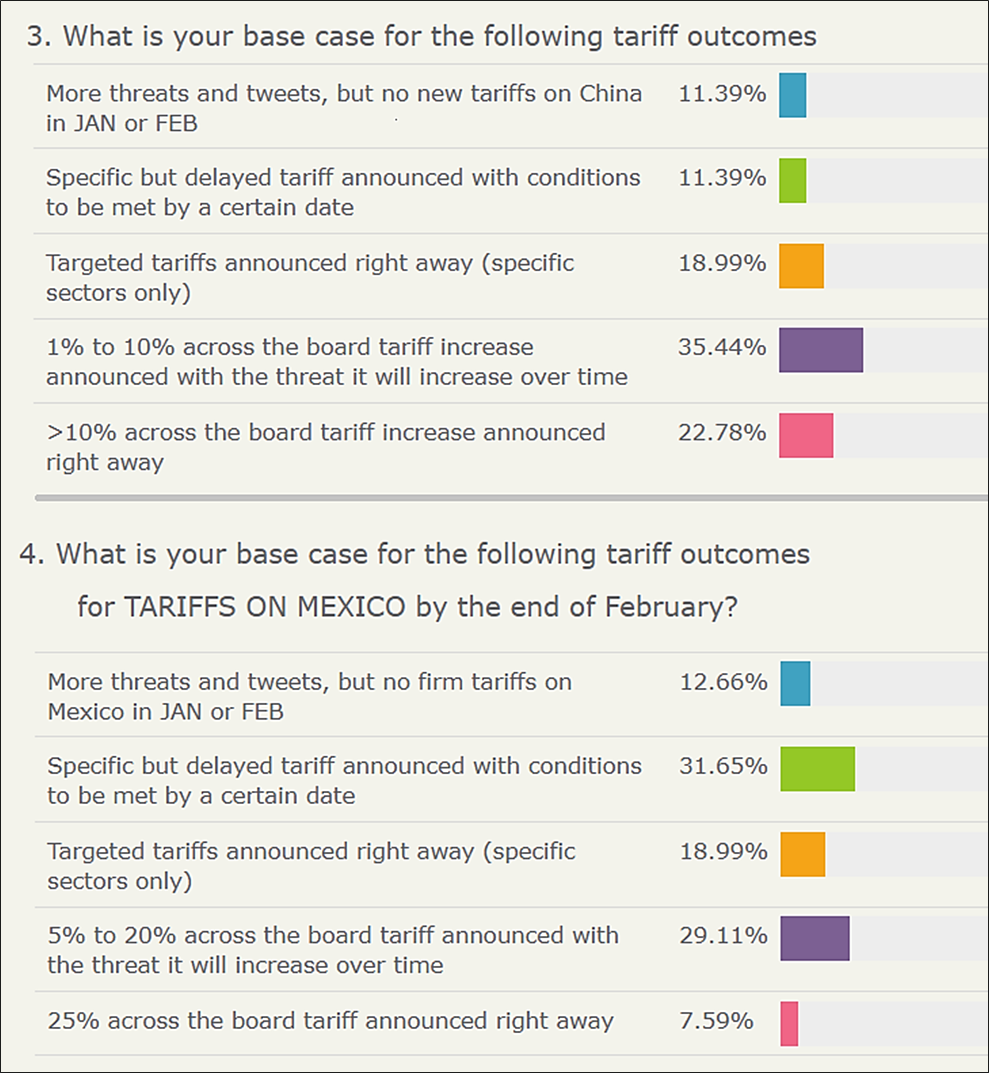
Takeaways: More consensus that China will be tariffed on Day One. This makes sense and I suppose people are using the logical but perhaps not applicable framework that Trump will hit the enemies and give the allies time to get respond or at least get ready. This may not be the right framework!
The Canada and Mexico numbers nearly match, which makes me feel like people took the survey seriously and responded with rational, consistent responses.
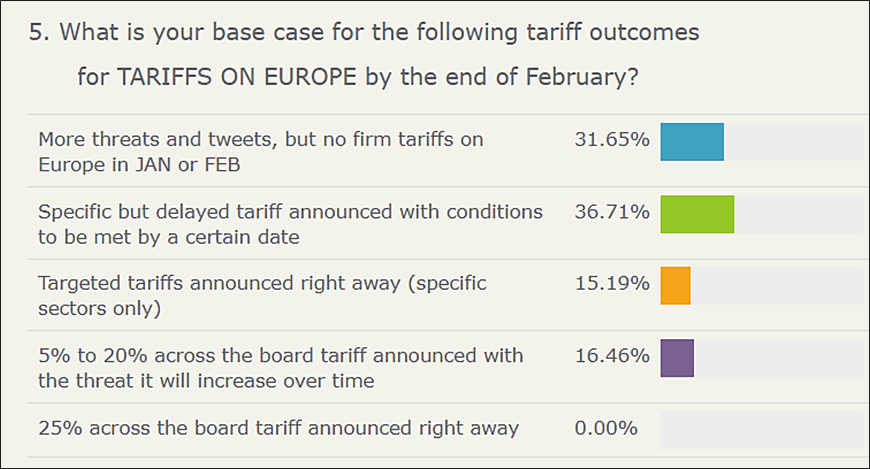
Takeaways: The blue bucket (threats but no firm tariffs) is by far the largest for Europe. This makes sense as there hasn’t been much direct talk of Day One tariffs on Europe. There were a few jabs at Denmark, but most of the specific rhetoric has been directed at Canada, Mexico, and China.
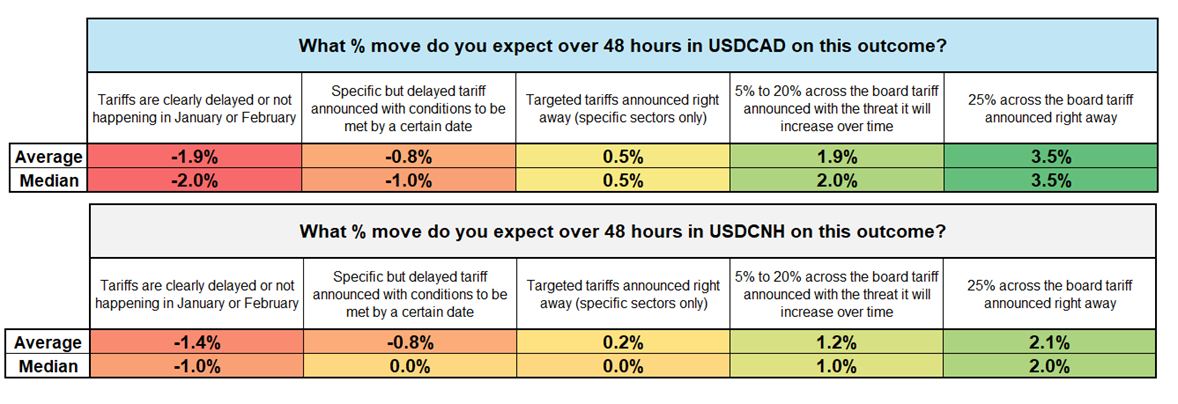
Takeaways: USDCAD is a free-floating currency pair and CNH is not. Then again, will the PBoC continue to smooth if a huge tariff is announced on Day One? It’s a good question! If they do, they are probably providing a service to speculators by offering below-market liquidity.
3.5% in USDCAD for a 25% tariff on Canada is way, way too low in my opinion, though I did say “over 48 hours” so maybe it’s not that far off. Still, a permanent 25% tariff would be worse for Canada than the Global Financial Crisis. I don’t think you should rule out this possibility as there is a nice opportunity for Trump to take advantage of the power vacuum in Canada and then make amends with his buddies in the Conservative Party when they inevitably take over Canadian government in Q2.
How will the market react?
Here’s where I think USDCAD goes on each Question 2 result.
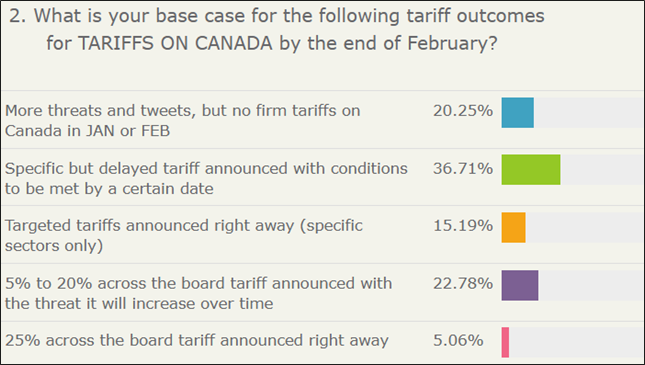
1. USDCAD to 1.4000/50 quick.
2. USDCAD tiny pop then down to 1.41 quick.
3. USDCAD tiny pop then down to 1.41 quick.
4. USDCAD to 1.45 and then trades the news.
5. USDCAD straight to 1.4850 / 1.52 in a few weeks.
Using the percentages from the survey, that’s an expected value of 1.4188 for USDCAD. To get a positive expected value for USDCAD from this exercise, you need around 15% chance of a 25% tariff. Otherwise, one can argue that it’s all fully priced. I feel like these results show remarkable complacency given the relentless anti-Canada trolling from Trump and the recent comments from the premier of Alberta. We’ll find out soon.
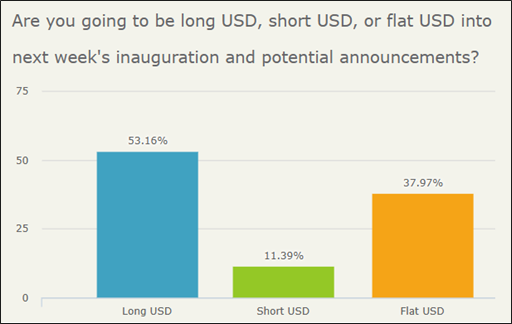
How do we reconcile extreme USD longs with survey complacency on tariffs? Our regular positioning survey, and this survey (see result at right) and every bank survey all show speculators are max long USD. But yet expectations for tariffs are not that aggressive. Here’s why:
1. One cohort of players is massively long USD. Presumably those are the ones expecting big tariffs.
2. Another cohort is long small USD because the asymmetry/tail outcome is a much higher USD.
3. Many USD longs are trend following or FOMO longs.
4. There are other reasons to be long USD besides tariffs (US exceptionalism, US data, Fed on hold, etc.)
5. Nobody is short USD, hardly. So there is no offset at all in the positioning data, whereas usually there is some two-way in positioning, even during strong trends.
Another good question here is whether options are the best tool to express a bullish USD view. If the move higher in USDCAD, for example, is going to be explosive and trending, can’t you just wait for the announcement, and if it’s shock and awe, buy spot USDCAD? Probably.
Then again, there are scenarios where you completely whiff. If you’re sleeping, for example. Or if the first move is so big that you can’t bring yourself to pay that 1.4600 offer. I’m not sure which strategy is best—probably a mix of spot and options. If you’re bearish USD, be aware that most USD-bearish scenarios will also be incredibly bearish for vol.
Anything less than shock and awe will see FX implied vols get bludgeoned. Most scaled or targeted tariff plans will leave the market chopping and flopping and gasping for direction. Have a super CPI.
Author
Brent Donnelly
Spectra Markets
Brent Donnelly is the President of Spectra Markets. He has been trading currencies since 1995 and writing about macro since 2004. Brent is the author of “Alpha Trader” (2021) and “The Art of Currency Trading” (Wiley, 2019).

















