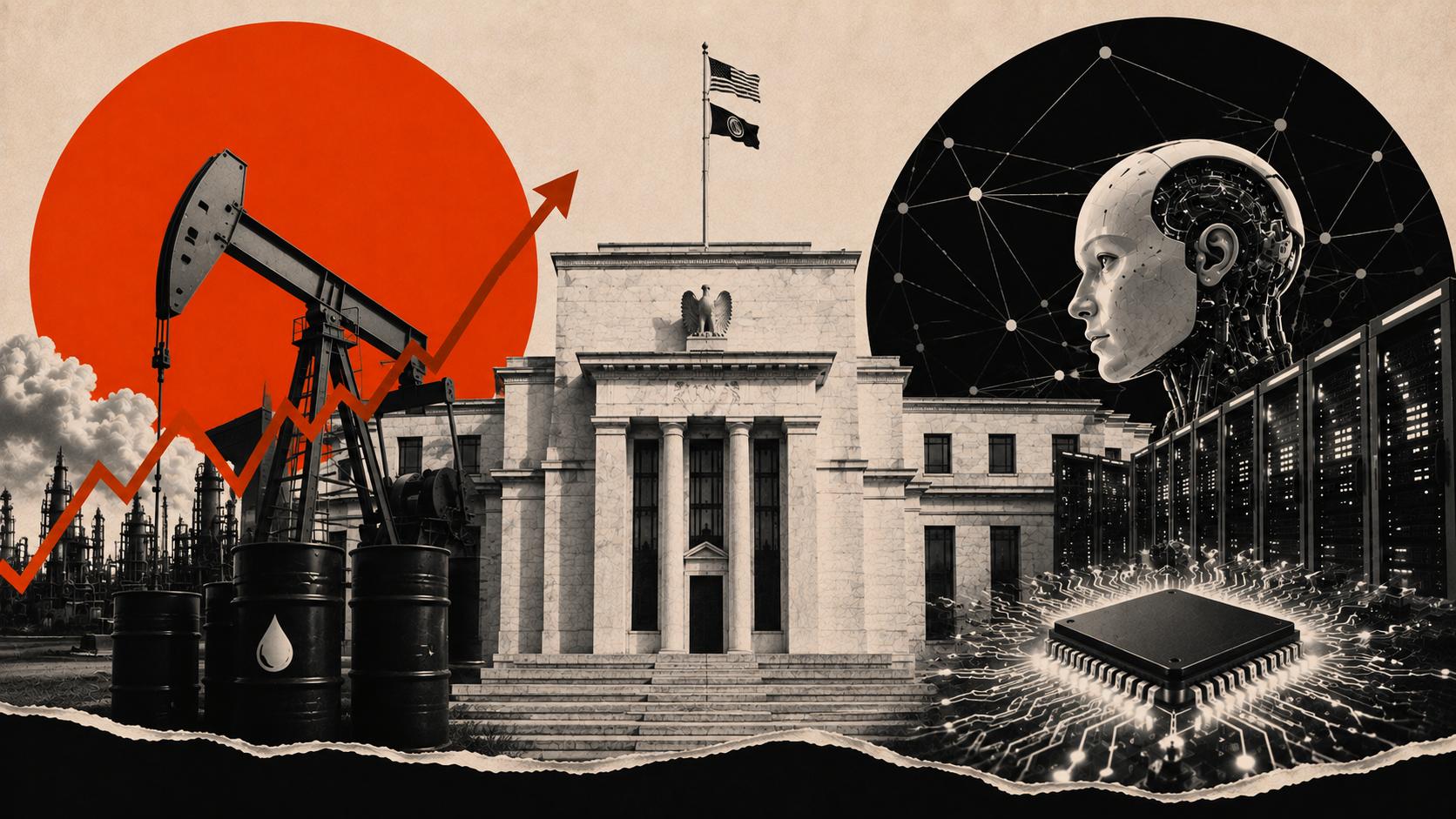
Commodities are undervalued, underowned and the upside potential could be enormous [Video]
![Commodities are undervalued, underowned and the upside potential could be enormous [Video]](https://editorial.fxsstatic.com/images/i/gold-march-05.jpg)
The next major market opportunity may not be hiding in Stocks, Forex or Bonds. It may be sitting in the oldest asset class in the world: Commodities.
Gold, Silver, Copper, Oil and Natural Gas are no longer just cyclical trades. They are becoming the physical foundations of a new global market regime – one defined by inflation risk, energy security, supply shortages, geopolitical instability, central bank diversification and the explosive power demand of artificial intelligence.
For traders, this creates one of the clearest asymmetrical opportunities in years.
“Commodities are still being priced as if the world is calm, stable and fully supplied,” says Lars Hansen, Head of Research at The Gold & Silver Club. “But that is not the world we are living in. The world is short of hard assets, short of energy security and short of strategic metals. That is why the upside potential remains so significant.”
Seasoned traders understand one simple rule: when Commodities go on sale during a powerful macro cycle, you do not wait for the crowd to confirm the opportunity. You act before the repricing becomes obvious.
Unlike shares, Commodities cannot be printed, diluted or created with a keystroke.
Oil fields take years to develop. Copper mines take a decade or more to bring online. Silver supply cannot instantly respond to investment demand. Natural Gas infrastructure requires huge capital, regulation and time. Gold cannot be manufactured by central banks.
That is why pullbacks in Commodities can be so deceptive. They look like weakness in the moment, but in the right macro environment, they can become rare accumulation windows before the next explosive move higher.
“As smart traders know, when Commodities go on sale, you have to snap them up fast,” Hansen says. “In this macro environment, prices don’t stay cheap for long. The demand story has not disappeared – the market is simply giving traders a temporary discount.”
Gold remains the anchor of the hard-asset bull market. It is no longer just a fear trade or a safe haven. It is increasingly becoming a global reserve asset for a world losing confidence in paper promises.
Central banks are buying Gold at record pace because they understand something many traders and investors still underestimate: monetary risk is rising. Debt levels remain extreme. Currency debasement is no longer theoretical. Geopolitical fragmentation is accelerating. The case for holding assets outside the traditional financial system has rarely been stronger.
“Gold is being remonetized in real time,” Hansen says. “Traders who wait for every confirmation signal may find themselves buying much higher prices later.”
Silver may be even more explosive because it combines two powerful forces: monetary demand and industrial demand.
It benefits when traders seek precious metals protection, but it also benefits from solar panels, electronics, electrification, batteries and advanced manufacturing. That dual role gives Silver a unique ability to accelerate when capital rotates into hard assets.
Historically, Silver often lags Gold in the early stages of a precious metals move – then catches up violently. That is why many traders view Silver as the high-beta opportunity of the Commodity complex.
“If Gold is the foundation, Silver is the accelerator,” Hansen says. “The Silver market is much smaller, much tighter and much more sensitive to inflows. When momentum arrives, the moves can be dramatic.”
The artificial intelligence boom is not only a software story. It is a power story. Data centres require electricity, cooling systems, grid upgrades, transformers and vast amounts of Copper.
Copper is also essential for electric vehicles, renewable energy, defence systems, housing, infrastructure and industrial expansion. Yet supply remains structurally constrained. New mines are difficult to permit, expensive to finance and slow to build.
The world wants instant electrification, but Copper supply does not move at the speed of artificial intelligence.
“The market still treats Copper like an old-economy metal,” Hansen says. “That is a major mistake. Copper is one of the most important bottlenecks of the AI and electrification supercycle.”
The idea that Oil and Natural Gas are dead has been one of the most dangerous assumptions in global markets.
The world still runs on Energy. Airlines, shipping, manufacturing, petrochemicals, logistics, agriculture and power generation all depend on reliable energy supply. Meanwhile, Natural Gas is becoming increasingly important as data centres, LNG demand and electricity consumption surge.
Energy transition does not remove the need for Oil and Gas. In many cases, it increases the pressure on Energy systems that are already underinvested and politically fragile.
“Energy is not going away,” Hansen says. “What is changing is that Energy security is once again becoming a national priority. That is extremely bullish for Oil and Natural Gas over the medium term.”
The biggest market moves usually begin when traders are distracted elsewhere.
Right now, capital remains crowded in equities, technology and cash. But Commodities remain under-owned relative to the scale of the opportunity. That is where the potential lies
When capital eventually rotates into Hard Assets, the move can be fast and highly lucrative. By the time mainstream traders fully recognize the opportunity, prices may already have repriced significantly higher.
This is the essence of the Commodities opportunity now: limited supply, rising demand, inflation protection, geopolitical risk, monetary uncertainty and strategic scarcity – all converging at the same time.
For traders and investors alike, the risk is no longer being too early. The bigger risk may be being too late.
Commodities are not simply another asset class. They are the raw materials of economic survival. They power the grid, build infrastructure, fuel transportation, support defence and enable the next technological revolution.
That is why the current setup is so compelling.
Gold protects wealth. Silver amplifies momentum. Copper powers the AI economy. Oil secures global transport and industry. Natural Gas fuels the next wave of electricity demand.
Together, they form one of the most powerful hard-asset opportunities of 2026.
As Hansen puts it: “This is not just a Commodities trade. This is a global repricing of scarcity. Traders who understand that early may be the ones who benefit most.”
The window is open now. But in Commodity markets, these windows rarely stay open for long.
Where are prices heading next? Watch The Commodity Report now, for my latest price forecasts and predictions:
Author

Phil Carr
The Gold & Silver Club
Phil is the co-founder and Head of Trading at The Gold & Silver Club, an international Commodities Trading Firm specializing in Metals, Energies and Soft Commodities.