9-3: Is the Federal Reserve’s vote tally Warsh's new forward guidance?

The rate did not move. Neither did the statement, and that’s the more interesting fact. Set the July 29 Federal Open Market Committee (FOMC) statement beside the one issued on June 17, and the two documents are identical apart from a single verb and a paragraph at the bottom naming three dissenters. Forty-two days containing a war re-escalation, the largest monthly decline in consumer prices since April 2020, a global chip rout and a top-decile move in Treasury yields produced one edit. The Committee reaffirmed its ample-reserves policy in June. In July, the policy continues.
That is not laziness. It is the logical endpoint of a communications regime built to say as little as possible, and it carries a consequence the market spent Wednesday afternoon pricing. When the words stop moving, the only variable left in a Federal Reserve (Fed) statement is the arithmetic of the vote. Kevin Warsh has spent two meetings dismantling forward guidance. He has rebuilt it out of the one number he cannot redact.
The only thing that changed was the arithmetic
The June statement ran 114 words. The July statement runs 115, plus a 35-word paragraph recording that Beth Hammack of Cleveland, Neel Kashkari of Minneapolis and Lorie Logan of Dallas each preferred a quarter-point increase. Close to a quarter of the document is now given over to registering disagreement with it. The accompanying implementation note is word for word what it was in June, down to the $160 billion per-counterparty cap on overnight reverse repurchase operations and the standing instruction to buy Treasury bills as needed to keep reserves ample.
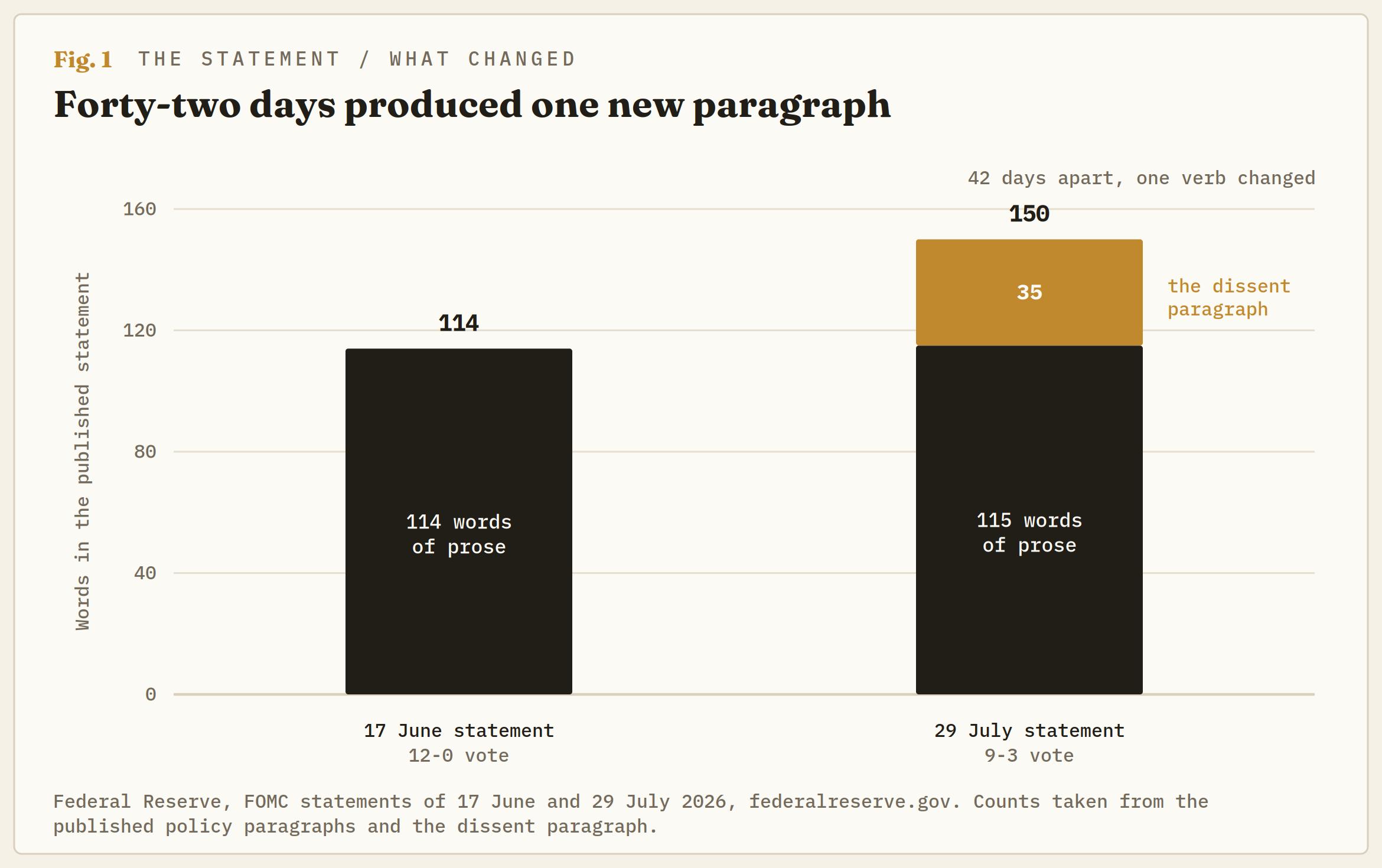
Freezing the prose has an effect the drafters may not have intended. A statement that never changes cannot carry information, so readers go hunting for whatever does change, and this month that was the tally, 12-0 at one meeting and 9-3 at the next. Three officials dissenting in the same direction has not happened since September 2016.
It also means the frozen sentences keep asserting things the tape has already overtaken. The inflation paragraph attributes elevated prices in part to supply shocks including energy, and the growth paragraph nods at uncertainty owing to the Middle East conflict. Both were published into an afternoon on which Iranian forces ended a four-day stand-down with ballistic missiles aimed at US positions and crude rose more than 7%. That is the fifth policy document in four months overtaken by events, and is also the fastest. Earlier cases died between drafting and release. This one died during the meeting.
One surviving sentence deserves a second look: “Job gains have kept pace with the workforce”. That is true, and it’s true because the workforce shrank. Participation fell to 61.5% in June, the lowest since March 2021, on a labour-force exit of roughly 720K against payrolls of 57K. A committee describing a low-hire, low-fire market as balanced has chosen the ratio that flatters it.
The market read three hawkish dissents as dovish
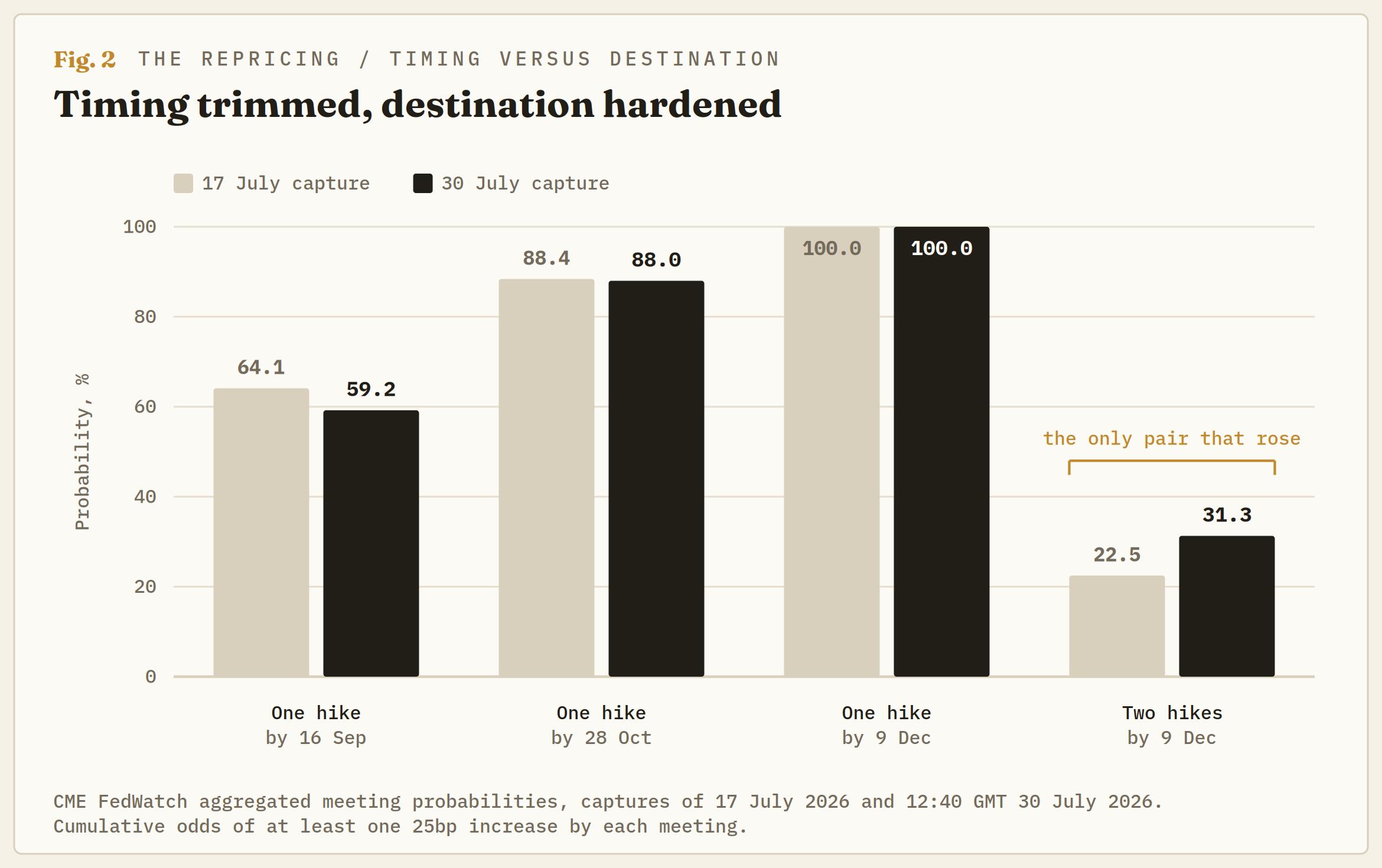
Three officials voted for tighter policy, and the price of tighter policy came down. Cumulative odds of at least one increase by the September 16 meeting sit at 59.2% on the aggregated CME FedWatch table as of 12:40 GMT on Thursday, ahead of the New York open, against 64.1% on the same method on July 17. Odds through October 28 are effectively unchanged at 88.0%, and a first increase remains fully priced by December 9.
Look one cell further out and the picture inverts. The probability of two increases by December has climbed to 31.3% from 22.5% in mid-July. Near-term timing has been trimmed, and the destination has hardened, which is the pattern that has governed the whole cycle. The hike keeps migrating down the calendar, while the terminal creeps up.
The long end was less polite about it, and it has not calmed down since. Thirty-year yields print 5.21% on a 13:08 GMT quote on Thursday, up close to 7 bps on the session and the highest since 2007. Wednesday was not a one-afternoon tantrum in the long bond. It has carried. The Dow shed roughly 2% on Wednesday, and equities have taken the hit and started shopping. The long bond is still selling.
That split is the tell. A front end pulling tightening out while the long end demands more compensation for duration is not a policy trade, it is a credibility trade. It prices less defence of 2% in the near term and a higher fee for whoever holds the consequences.
Why would three hawkish dissents read dovish? Because a dissent is a losing vote. A 9-3 tally does not tell the market the hawks are ascendant, it tells the market they can be outvoted, and that the chair carried every governor plus both reserve bank presidents not named in the dissent, with no defection at the centre. The hawks are loud, and they are three votes short of six.
Hired to cut, delivering the opposite
Warsh was chosen by a president who wanted lower rates and said so continuously. Two meetings in, the record is five consecutive holds, and by the chair's own account from the podium, nominal and real yields are materially higher across the Treasury curve, with some intermeeting increases ranking in the top decile of the past two decades. He offered that as evidence the new regime is working.
Read it again with the appointment in mind. The man installed to make money cheaper has presided over one of the sharpest intermeeting tightenings in market rates in 20 years and called it a change for the better. He’s not resisting the mandate so much as running it backwards.
The White House response was to supply an alibi, and it named the wrong people. Asked on Wednesday whether the decision disappointed him, the President said the Chair would like lower rates but has a board, called that board political, and said it wants rates kept up.
The Board of Governors is the one body that gave Warsh unanimity. It voted without dissent to hold interest on reserve balances (IORB) at 3.65% and the primary credit rate at 3.75%, and not one governor voted against the rate decision. The three votes for higher rates came from reserve bank presidents, who are selected by their own directors rather than nominated from Washington, the furthest thing on this committee from a political appointment.
Then there is the reaction function Warsh finally described under questioning, which is the closest thing to guidance he has offered in either meeting. Any central banker watching underlying inflation move higher with labour markets near equilibrium leans toward tightening, he said, and one watching inflation fall with the other side of the mandate met leans toward loosening. He has repeatedly described the present as the first case. That is a hiking bias stated aloud by a chair hired to cut.
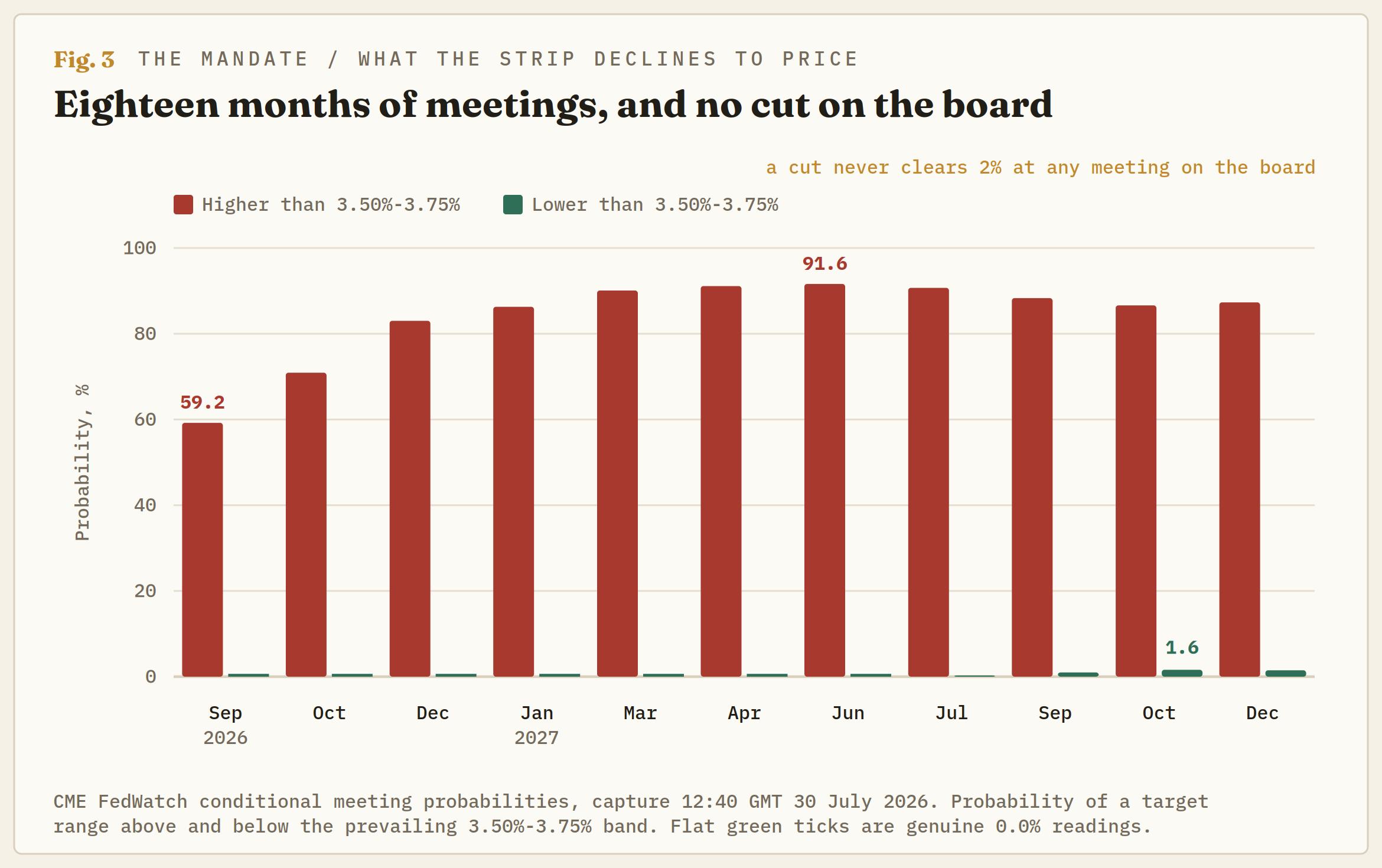
The strip has drawn the obvious conclusion. On the conditional table from the same capture, a lower target range prices at 0.0% for every remaining 2026 meeting. It first turns positive on July 28, 2027, at 0.3%, and peaks at 1.6% in October 2027. Eighteen months of scheduled meetings, and the objective Warsh was appointed to deliver does not clear two percentage points of probability at any of them.
The podium is now load-bearing
At his confirmation hearing, Warsh declined to commit to a press conference after every meeting, and at his June debut he floated speaking only when the Committee had something to say. On Wednesday he committed to press conferences for the remainder of 2026, took questions for roughly 45 minutes, and left the door open to a news-warrants standard.
The reversal is not a change of heart, it is arithmetic. Strip the guidance out of a document that is drafted, negotiated and voted on, and the guidance does not disappear, it relocates to the least controlled venue available. Everything the market learned about the reaction function this week came from one man answering questions live, unvetted by the committee whose vote he had just carried. The statement has never been safer, and the relay has never been more fragile.
The tape has already worked out which document matters. The Dow's afternoon high printed as the statement landed and the press conference opened, and the session low came inside the hour that followed, roughly 700 points beneath that high, while the chair was still at the podium. The words that moved the market on Wednesday were not the ones the Committee voted on.
The concentration produces a problem the chair has not resolved. His account of the intermeeting period credits reduced guidance with pushing market attention onto real data, which he approves of, and he told the room that participants are learning to watch the ball rather than the referee. Asked later whether he worried about surprising a market that prices a September increase, he answered that the Committee will not be constrained by market prices and will not take its cue from them. The market is instructed to lead. The Fed reserves the right not to follow. Someone still has to be the referee.
The same one-way filter runs through his handling of the data. He dismissed June's price decline as a single month of modest decreases against five-plus years above target, the third occasion on which he has declined to let a soft print count. Yet among the four questions he says dominated the meeting, one asks whether the price increases coming out of the capex boom, memory and logic chips and the associated infrastructure, signal a broader inflationary dynamic or merely sit under the brightest streetlight. He is pre-arguing the dismissal of an inflation signal in the week memory pricing became the largest story on the global tape, having spent months calling artificial intelligence net disinflationary while participants at his own table flag the same investment as inflationary.
The only instrument he has not spent
Fourth on Warsh's list of meeting questions was the one worth most to a rates desk. If interest rate policy is the primary instrument, how much accommodation is the Committee getting from the balance sheet? He asked it into an implementation note that changed nothing, still rolling over every Treasury principal payment, still reinvesting agency proceeds into bills, still buying bills as needed to keep reserves ample.
That question is a pressure valve, and it opens both ways. Balance-sheet tightening pays the three dissenters without a rate increase, and it pays them through instruments they have no vote on, since IORB and the discount rate belong to the Board alone. Reserve provision runs the other way, delivering accommodation that never appears as a cut and never requires the word.
Nothing on the calendar forces the question before September, because there is no meeting in August. What there is instead is Jackson Hole, August 27-29 , where the chair says his keynote is a blank page and that he will first sit down with the leaders of the five task forces he created, one of them dedicated to the balance sheet and another to communications.
So the tension to carry into September is not whether this Fed tightens. The 9-3 answered the direction of the argument and the strip has priced the destination. It is whether a chair whose only signal is the vote tally can keep winning it while the long end raises the price of standing still. And it is who he aims the balance sheet at when he finally reaches for it: the hawks, the White House, or both.
Author

Joshua Gibson
FXStreet
Joshua joins the FXStreet team as an Economics and Finance double major from Vancouver Island University with twelve years' experience as an independent trader focusing on technical analysis.