|

Chinese Yuan Looking For Further Weakness Against US Dollar

The Yuan (CNY) is the basic unit of the Renminbi which represents the official currency of the People’s Republic of China.

The ongoing trade war between China and United States is affecting the economy for both country and the recent tension caused by U.S. Tariffs could be the trigger of more weakness in Yuan.
China’s currency had appreciated 30% against the U.S. dollar fro 20 consecutive year ( from 1994 until 2014 ). However in 2015, the People’s Bank of China (PBOC) surprised the markets with three consecutive devaluations of the yuan CNY to boost exports in support of the economy.
Following PBOC intervention, the US dollar gained 15% over the Yuan but failed to break $7 barrier in the recent 2 years which can have significant effect over market prices.

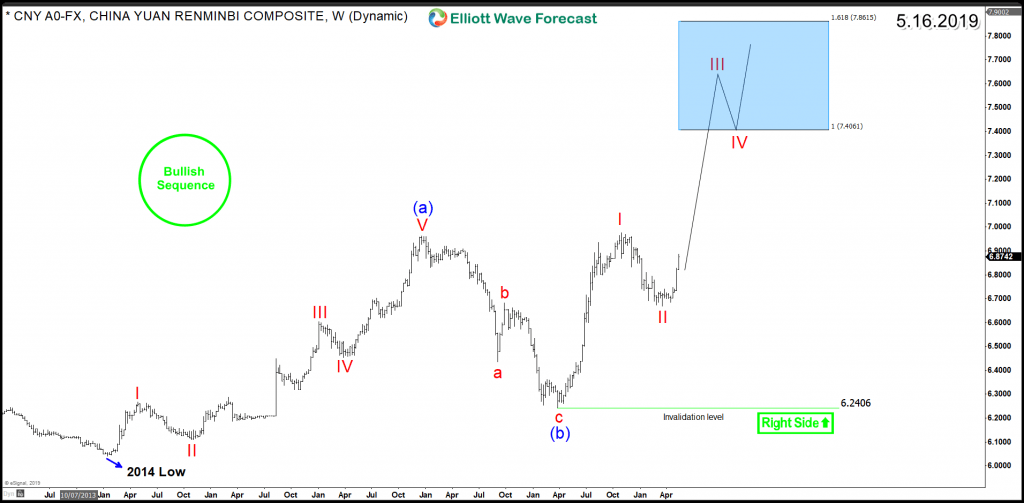
The technical picture for USDCNY will help us to identify the next path for the Yuan. As the pair has ended the downtrend cycle from 1994 then ideally it’s looking for a recovery to correct that decline. Therefore, it’s looking at least for a 3 waves move against the previous trend which is represented on the next chart by a proposed corrective Elliott Wave structure “Zigzag”.

The initial rally from 2014 was in an impulsive 5 waves structure followed by 3 waves pullback then the pair started a new cycle higher taking 2016 peak but still failing around $6.9 area. The break higher created an incomplete bullish sequence suggesting an 5 waves move higher to a minimum target at $7.16 and ideally and it can extend toward the 100% Fibonacci extension $7.4 coming from 2018 low.

Consequently, USDCNY is expected to remain supported above 2018 low at $6.2 and the next step is to take $6.9 peak which will be the key level for short term cycles to allow trades to buy pullbacks in 3 or 7 swings against March 2019 low $6.6.

USDCNY (YUAN) Weekly Chart 5.16.2019
USDCNY

Become a Successful Trader and Master Elliott Wave like a Pro. Start your Free 14 Day Trial at - Elliott Wave Forecast.

Author

Elliott Wave Forecast Team

Elliott Wave Forecast Team

ElliottWave-Forecast.com

More from Elliott Wave Forecast Team
Share:

Editor's Picks

AUD/USD stabilizes near 0.7100 as the post-Fed USD rally pauses

AUD/USD consolidates the previous day's losses near 0.7100 in the Asian session on Thursday as the US Dollar pauses its hawkish Fed-inspired rally to its highest level since late July. However, RBA rate-hike bets and hopes for US-Iran diplomatic efforts lift risk sentiment and support the risk-sensitive Australian Dollar and the major.

USD/JPY reverses a dip below 156.00 as focus shifts to BoJ

USD/JPY is reversing a brief dip below 156.00 in the Asian session on Thursday, looking to snap a three-day winning streak to a nearly two-week top set the previous day. The US Dollar pauses following the post-Fed rally to seven-week highs, while a more hawkish repricing of the BoJ's policy normalization path supports the Japanese Yen. This keeps the pair's upside limited, with the focus now shifting to the BoJ policy decision due on Friday.

Gold bounces but not out of the woods yet

Gold is facing fresh sellers above $4,300 early Thursday, stalling its recovery from six-week lows of $4,235 reached soon after hawkish US Federal Reserve monetary policy announcements.

Bitcoin, crypto market see muted activity following FOMC rate hike

Bitcoin traded above $76,000 on Wednesday as the Federal Reserve raised its benchmark interest rate by 25 basis points, bringing the federal funds target range to 3.75%-4.00%. The unanimous 12-0 decision marked the Fed’s first rate hike since July 2023.

The Fed rate hike: What happens now?
The dust has settled on tonight’s Fed meeting and the market reaction is clear: the Fed’s signal that there could be a series of rate hikes has spooked financial markets. Bonds sold off at the short end of the Treasury curve and US stocks also fell, led by the Dow Jones Industrial Average, which slipped more than 1% on Wednesday night.
How Japan became the World's Banker and why that era may be ending

Japan's ultra-low interest rates helped finance trillions of dollars in global investments for more than a decade, making the Japanese Yen one of the world’s cheapest sources of funding. With the Bank of Japan expected to tighten policy again this week, that advantage may be entering a new phase. While most major economies raised interest rates, Japan remained the world's outlier.