Changing of the guard for Germany, as Euro takes it in its stride


The German election outcome was as expected. The Conservatives won, which means that Frederich Merz will take over from Olaf Scholz as Chancellor of Germany. Merz has said that he would like to form a coalition government in Germany, which is the norm, within 2 months, and that the AfD will not form part of his coalition. The AfD won the second largest share of the vote, and they will now become the biggest opposition party in the German parliament. At this stage, the most likely outcome is a coalition between Merz’s CDU/CSU and the Social Democrats.
The path to economic recovery could be easier after election
This is a pivotal election for Germany, and it comes at a fragile time for the country as it battles economic malaise and domestic friction. A coalition between the two biggest German parties could be the most fruitful from an economic policy standpoint, since it may make it easier for Germany to reboot economic growth after 2 years of economic contraction. The best way to do this is to ease restrictions on government borrowing to help spur the economy back to life. This will be much easier if you have the main parties as part of the coalition.
Germany needs to reclaim European leadership role
The lead candidates of the main German parties will brief the media on Monday morning, and we could get an insight into how fractious it will be for Merz to build a coalition. His 2-month timetable is vital for a number of reasons, not least because the new German government faces some big challenges: how to respond to potential US tariffs on the EU and boosting European defense spending now that the US’s security umbrella is likely to close on Europe under President Trump. Germany is central to these discussions, so a neat solution to a coalition is preferable for financial markets.
What next for the Euro
The euro opened a touch higher on Sunday night, however the move is insignificant so far. This could be due to a few reasons: firstly, the fact that the result was in line with expectations, secondly, the AfD party did not get more than 20% of the vote, which was considered a line in the sand for the far-right party, even though it doubled its vote share. While the AfD may have faltered this time, if a Merz led coalition fails to get immigration under control or boost the economy, then the AfD party will be waiting in the wings. Added to this, there has been a lot of upside in the euro in recent weeks. EUR/USD is higher by more than 1% since the start of February, even though election uncertainty was hanging over the single currency. This pair is now approaching a major resistance level at $1.0537, the 100-day sma, which may be why EUR/USD is experiencing some stickiness ahead of $1.05.
The outlook for stocks
We won’t know two crucial pieces of information until after Easter: 1, who the next coalition will include and 2, what the new economic policies will be. However, we would expect a mini recovery rally for German stocks on the back of the victory for Merz. Firstly, a conservative chancellor could be good for business, especially one who is focused on boosting economic growth. Secondly, the Dax is one of the top performing stock markets in Europe so far this year, yet it declined more than 1% last week, thus investors could see this decline as a buying opportunity. Added to this, the MDAX, Germany’s mid cap index, has underperformed the FTSE 250 and the Russell 2000 in the US so far this year. The change in leadership could help the MDax to stage a mini recovery at the start of this week.
Chart 1: Mdax, FTSE 250 AND Russell 2000, normalized to show how they move together over the last 12 months.
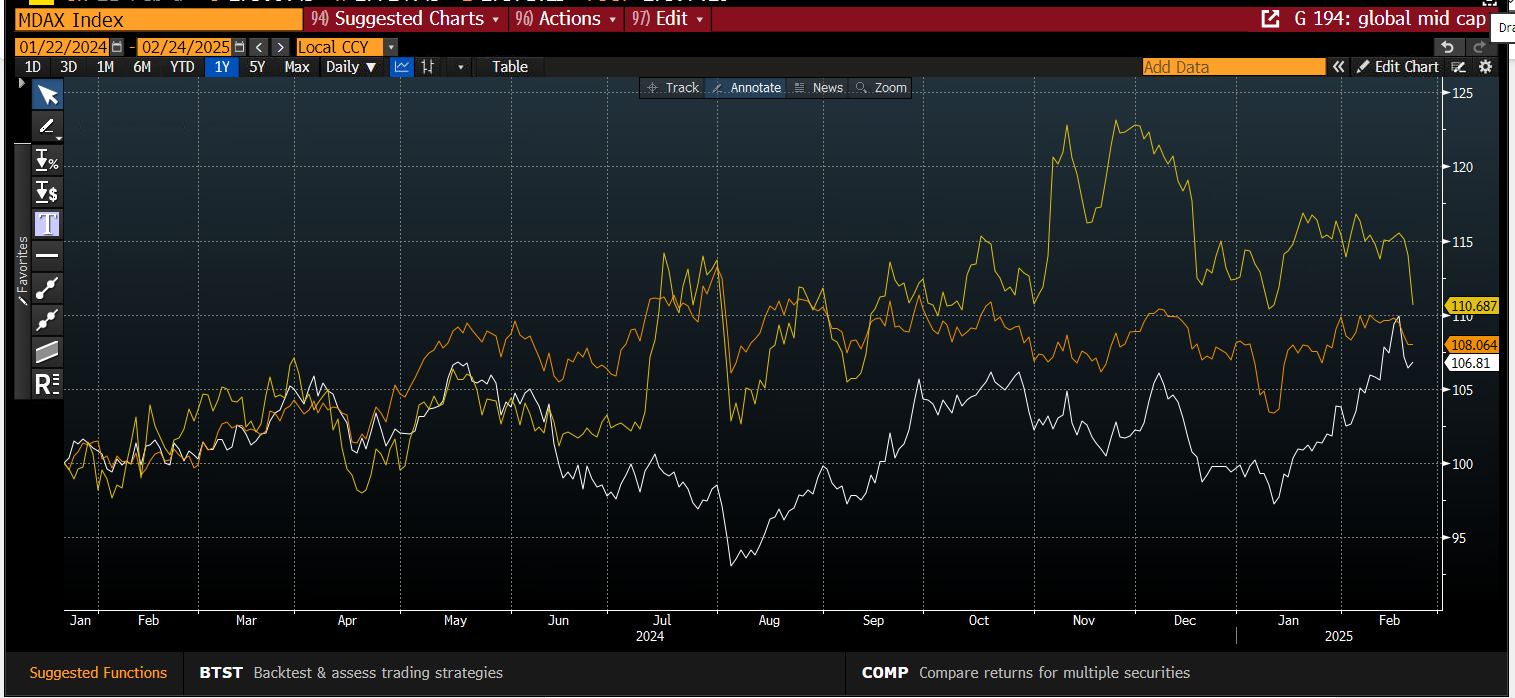
Source: XTB and Bloomberg
Will European relations with the US improve with Merz in charge?
Perhaps the biggest reason to cheer European assets at the start of this week is news that Donald Trump has welcomed Merz’s victory, and a conservative German Chancellor could help to rebuild relations with the US President at a pivotal time for Europe’s relationship with the US. He said that the German people had been tired of the ‘no commonsense agenda’ on energy and immigration, which suggests that Trump expects Germany to change its stance under Merz. The German election winner has been less supportive of Trump this evening, instead condemning Elon Musk’s interference in Germany’s election, and his overt support for the AfD. Even so, if Merz can boost relations with the US, then this could be a big win for the euro, although that is not playing out in the euro at this early stage.
We may need to wait until the European session to get a clearer idea about how the euro will react to the German election news. However, this result could be good news for the economy, and we will need to hear more from the major parties to see if they give anything away regarding their economic policies later on Monday. For now, German stocks could get a short-term boost, and the euro may have a delayed positive reaction to this news. As mentioned, a break above $1.0537 would be a bullish move for this pair.
Author
Kathleen Brooks
XTB UK
Kathleen has nearly 15 years’ experience working with some of the leading retail trading and investment companies in the City of London.