Chairman Powell in Zurich: A good US economy and rate cuts

When Federal Reserve Chairman Jerome answered questions in Zurich, Switzerland today his most attentive audience was 4,000 miles away in the financial district of New York
Markets are looking for clues to the FOMC rate decision on the 18th of this month. The fed funds futures give the chances of a 25 basis point cut at 91.2%. Judging by his remarks today the Fed Chairman is not far behind.
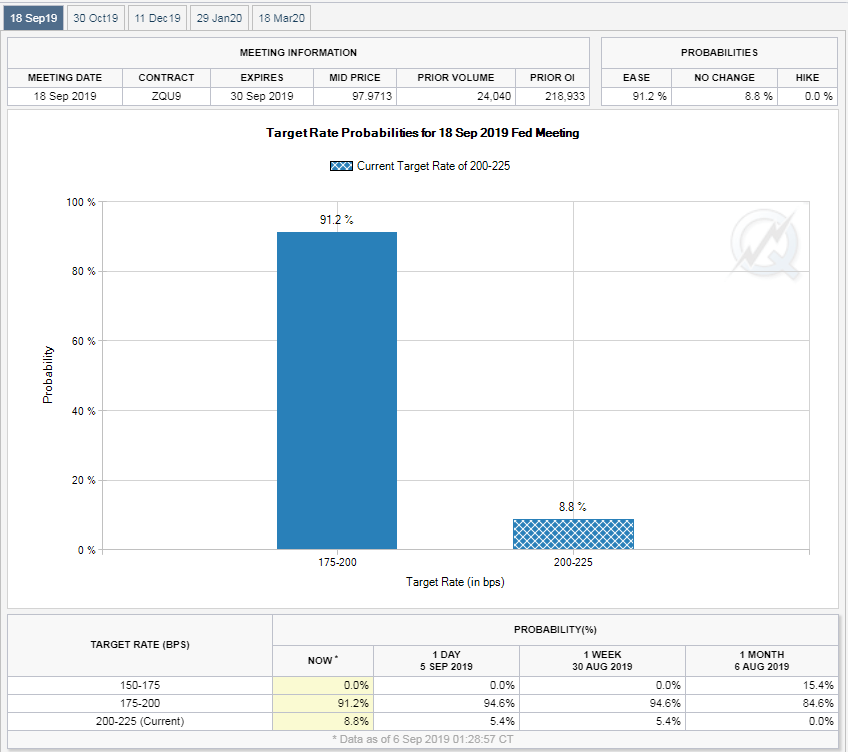
CME Group
“The Fed has through the course of the year seen fit to lower the expected path of interest rates,” he noted. “That has supported the economy. That is one of the reasons why the outlook is still a favorable one.”
Mr. Powell has, over the past eight months, repeatedly cited the threat to the long-running US expansion from the trade conflict with China, Brexit and a global economic slowdown.
“I think it is the case that uncertainty around trade policy is causing some companies to hold back on investment,” he said.
The manufacturing sector has been particularly hard hit with the purchasing managers’ index dropping into contraction in August for the first time in three years after falling steadily for a year from its August 2018 post-recession high of 60.8.
The almost two year old trade conflict with Beijing has played havoc with investment and prompted concerns that the pullback in business spending could spill over into the labor market which remains strong.
The much larger service sector has proved more resilient with its PMI coming in better than expected for August at 56.4.
Credit markets reacted to the Chairman’s seeming assurance of a rate cut with the 2-year Treasury yield losing 5 basis points from its high to 1.52% and the 10-year shedding 2 from its top to 1.54%, (2:10 pm EDT). The Dow was up just over 100 point in mid-afternoon trading.
Mr. Powell’s appearance with Thomas Jordan the head of the Swiss National Bank at the question and answer session was his last public event before the traditional Fed two week news blackout begins on Saturday.
The Chairman’s confidence in the US economy is undiminished. “We’re not forecasting or expecting a recession,” he observed. “The most likely outlook is still moderate growth, a strong labor market and inflation continuing to move back up.” “Our main expectation is not at all that there will be a recession.”
Chairman Powell has repeatedly stressed the need to reinforce the long running US expansion in the face of external threats. He referred to the 25 basis point rate reduction at the July 31st meeting as a form of insurance.
The economy expanded at a 2.55% rate in the first half of the year and is running at 1.5% in the third quarter according to the Atlanta Fed GDPNow model. Relatively good retail sales over the past five months have been supported by rising wages and compensation.
Job creation has slowed from last year. The Labor Department reported that 130,000 new positions were founded in August, less than the 158,000 forecast. While the three month moving average for non-farm payrolls has fallen from 245,000 in January to 156,000 there is still sufficient wage pressures from labor shortages to push wages 0.4% higher in August and 3.2% on the year.
It is an open question how long the service sector can remain independent of a deepening manufacturing contraction and a global economic slowdown.
Despite the market confidence that the Fed will offer more accommodation at this month’s meeting the policy and FOMC background for a reduction is far from standard.
As outlined in the last FOMC minutes several regional Fed presidents have said that the do not see a good economic case for further rate decreases while others noted that low inflation warranted a larger cut. St. Louis Fed President James Bullard has recently supported a 50 basis point rate cut and Eric Rosengren of Boston and Esther George of Kansas City were quoted in the minutes as favoring no change in rates.
“Sometimes it’s easy to get unanimity on things when the path is clear. There will always be questions about how much to do and how fast to move. Sometimes things are relatively clear, other times it’s murky out there,” Mr. Powell said. “I think it’s one of those times.”
Mr. Powell has also faced recurring criticism from US President Donald Trump who has insisted that the Fed cut rates faster and farther. Mr. Powell has deflected saying only that the Fed does not take political consideration into account when deciding policy. The central bank is “committed to nonpolitical decision making on the best analysis we can muster.”
Author

Joseph Trevisani
FXStreet
Joseph Trevisani began his thirty-year career in the financial markets at Credit Suisse in New York and Singapore where he worked for 12 years as an interbank currency trader and trading desk manager.