Chairman Powell before Congress: Praising the economy and rebutting the President

Federal Reserve Chairman Jerome Powell will repeat in Congress the policy message he delivered after the last FOMC meeting, the US economy is in a good place in the 11th year of the country’s longest expansion.
Mr. Powell will present a short statement and answer questions twice this week, on Wednesday before the Joint Economic Committee and on Thursday in front of the House Budget Committee.
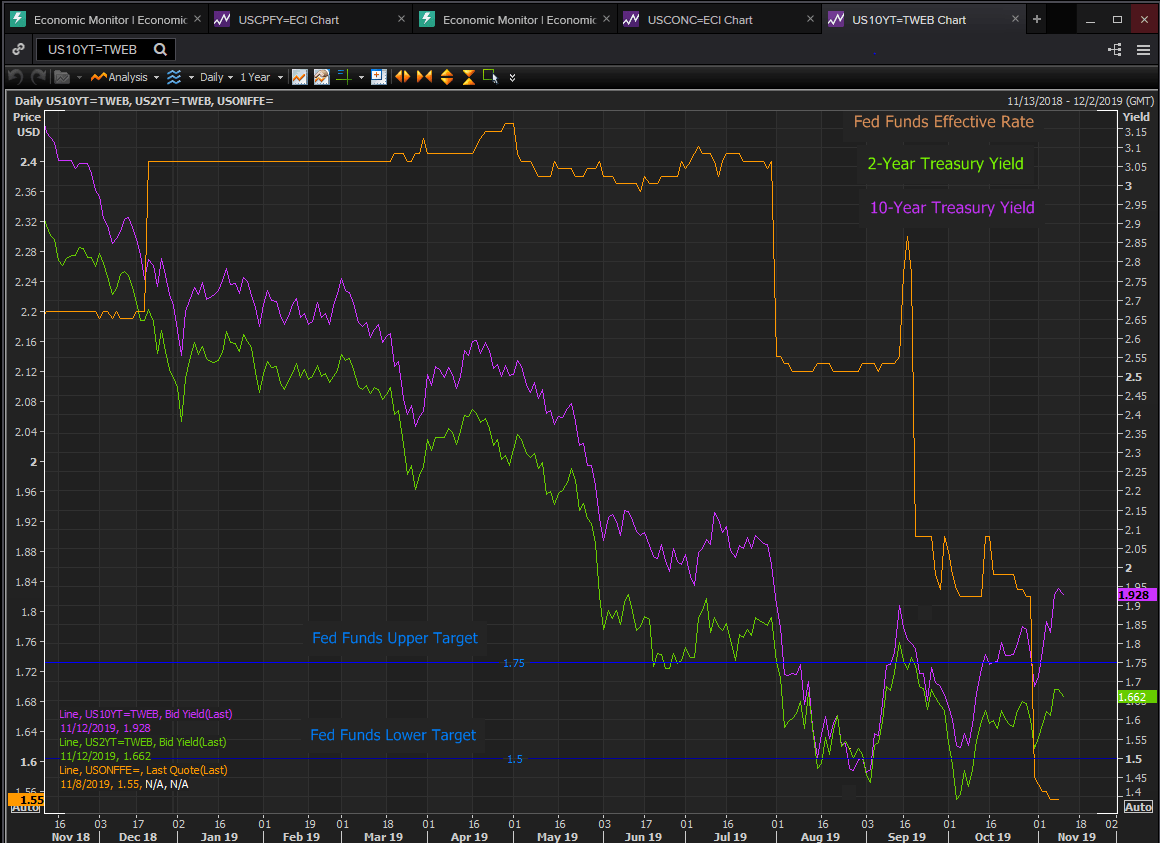
He will reaffirm the policy change to neutral at the October open market committee meeting after the governors lowered the fed funds rate for the third time to a 1.75% upper target.
In his news conference last month Mr. Powell noted that of the three risks facing the US economy which had prompted the Fed “insurance policy,” the slowdown in global growth, China trade and Brexit, two, trade and Brexit, had moved closer to solution.
“The principal risks we have been monitoring have been slowing global growth and trade. We now have a potential trade agreement with China...which could bode well for business activity over time. ..It appears as well, that the risk of a no deal Brexit has...subsided,” he said.
Markets appear to agree with the Fed assessment. In the US the three major equity averages have reached records in the last two weeks. The Treasury yield curve, which inverted briefly at the end of August in a well-documented recession signal, has reversed with the generic 2-10 spread closing at 27 points on Tuesday.
Reuters
October payrolls were another positive economic sign. Companies created 128,000 jobs despite the subtraction of between 40,000 and 70,000 workers due to a strike at GM and layoffs in allied industries during the recording week. Revisions to the August and September totals added another 95,000.
The continuing performance of the labor market has helped to mitigate concerns that the global economic slowdown would begin to affect hiring by US companies. In turn a weaker job market would bring down consumer spending. The 2.0% expansion in the second quarter was fueled largely by consumption. Business investment having been sidelined by the US China trade war.
In the September Fed Projection Materials the governors predicted 2.2% GDP this year, it is currently 2.33% through three quarters, and 2.0% next year. The Fed funds target range of 1.5%-1.75% is below the 1.9% year end estimate. The next set of projections will be issued with the December 11th rate announcement at the final meeting of the year.
Representatives and Senators are sure to bring up one topic that will test Chairman Powell’s diplomacy—the overt criticism of Fed’s policy from President Trump.
In a speech to the Economic Club of New York on Tuesday the President repeatedly attacked the central bank for keeping credit too tight.
“We are actively competing with nations who openly cut interest rates so that now many are actually getting paid when they pay off their loan, known as negative interest,” said the President. “It puts us at a competitive disadvantage.”
In the past when President Trump had criticized the Fed Chairman Powell had barely demurred, saying that the governors had the interests of the American people and the bank's mandates in mind and that politics did not and will not enter into policy considerations.
No doubt Mr. Powell’s restraint will be tested numerous times as the legislators attempt to elicit criticism of the President’s remarks.
Author

Joseph Trevisani
FXStreet
Joseph Trevisani began his thirty-year career in the financial markets at Credit Suisse in New York and Singapore where he worked for 12 years as an interbank currency trader and trading desk manager.

















