|

CFTC Positioning Report: USD longs plummet to yearly lows

These are the highlights of the CFTC Positioning Report for the week ending March 18:

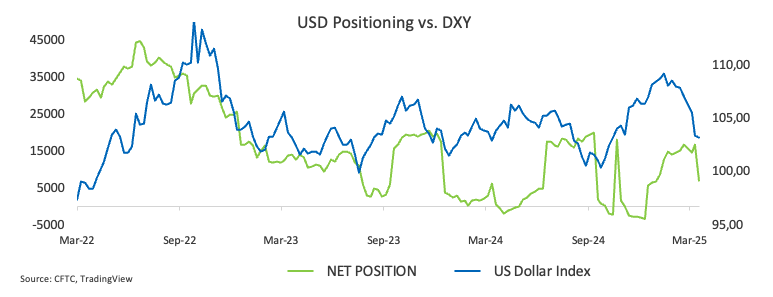
  • Speculators trimmed their net longs in the US Dollar to nearly 7.2K contracts, the lowest level so far this year. The period covered the run up to the Fed's interest rate decision, amid ongoing uncertainty over US tariffs and rising concerns about the US economy. The US Dollar Index (DXY) retreated to levels last seen in mid-October 2024 around 103.20, nearly retracing the so-called "Trump trade" (the rally from October to mid-January).
  • Non-commercial players turned net longs in the CBOE VIX index (aka “the panic index”) for the first time sin late October 2024, with around 6.2K contracts. The index, in the period, receded from yearly peaks past the 29 mark to levels below 22.
  • Speculative net longs in the Euro rose for the second week in a row, this time surging to the vicinity of 60K contracts for the first time since late September 2024. Commercial player (hedge funds) remained net shorts on the single currency for the fourth straight week, although contracts rose to multi-month highs around 92.4K. EUR/USD set aside a knee-jerk to the vicinity of the 1.0800 region to advance to new 2025 peaks past the 1.0950 level.
  • The constructive scenario for gold remained firmly in place, as non-commercial net longs rose to a three-week high of around 258K contracts. The precious metal’s climb above the psychological $3,000 mark for the first time was fuelled by ongoing uncertainty over US trade policy, concerns about a possible US recession, and expectations of further easing by the Federal Reserve. Moreover, this uptick in the yellow metal was accompanied by a rise in open interest.
Author

Pablo Piovano

Born and bred in Argentina, Pablo has been carrying on with his passion for FX markets and trading since his first college years.

More from Pablo Piovano

Share:

Editor's Picks

AUD/USD bulls seem hesitant below 0.7050 ahead of RBA on Tuesday

AUD/USD reverses an Asian session dip on Monday as renewed optimism over Iran diplomacy boosts investor confidence, keeping a lid on the safe-haven US Dollar and supporting the risk-sensitive Aussie. Spot prices, however, remain below the one-month high, touched last Thursday, as bulls wait for the crucial RBA decision before taking fresh positions.


USD/JPY climbs to 158.00 neighborhood as BoJ uncertainty weighs on the JPY

The USD/JPY pair gains some positive traction at the start of a new week, recovering further from Friday's post-Bank of Japan (BoJ) swing low to sub-157.00 levels. The momentum lifts spot prices to the 158.00 neighborhood during the Asian session and seems unaffected by fresh intervention warning from Japan's Finance Minister Satsuki Katayama.

Gold trims intraday gains; trades below $3,900 as Fed hike bets counter weak USD

Gold trims part of its modest intraday gains, trading with a mild positive bias below the $3,900 mark during Monday’s early European session. The US Dollar attracts fresh sellers amid optimism over a potential diplomatic breakthrough to end the US-Iran war and offers some support to the commodity. Meanwhile, US Federal Reserve rate-hike bets remain firmly on the table amid energy-driven inflation concerns, keeping the non-yielding yellow metal near the October 2025 low touched on Friday.

Dogecoin risks deeper slide as whales diverge

Dogecoin hovers around $0.075 on Monday after falling for the fifth consecutive week since the end of September. Santiment data shows diverging whale activity, as large holders reduce their positions while smaller whale wallets accumulate tokens. Meanwhile, weakening on-chain metrics and a deteriorating technical outlook suggest that DOGE could remain vulnerable to further losses.

Middle East War updates: Iran warns of expanded strikes against US despite progress in talks

Here’s a brief recap of the key developments in the Middle East war that occurred over the weekend, which are expected to have a significant impact on markets in the upcoming week.

The 2% inflation target came from a throwaway remark. It now moves trillions
The Federal Reserve's 2% inflation goal grew out of an off-the-cuff remark by a New Zealand politician in 1988. Bond investors still price long-term US debt as if 2% holds, so a change in how the Fed measures inflation would move markets.