Central banks' appetite for Gold hasn't been satisfied


Central banks have been gobbling up gold, and based on responses to the World Gold Council's 2024 Central Bank Gold Reserves Survey, their appetites for the yellow metal aren’t going to be satisfied any time soon.
Last year, central banks added a net 1,037 tons of gold to their reserves, just slightly below the record of 1,082 tons in the previous year.
That pace of buying will likely continue.
Based on a World Gold Council survey that included 70 respondents, 29 percent of central banks plan to add more gold to their reserves in the next 12 months. The WGC said it was the highest level since the survey began in 2018.
Only 3 percent said they had plans to decrease gold reserves.
Eighty-one percent of the respondents said they expect overall global gold reserves to increase in the next 12 months. That was up from 71 percent in the 2023 survey.
Meanwhile, 69 percent of the central bankers surveyed said they think global gold reserves will be higher in five years. That was up from 62 percent in last year’s survey. In 2022, only 46 percent of the respondents thought gold reserves would be higher in five years.
The results would seem to indicate the panic and gold selloff that happened recently when China didn't announce any change to its reserves for the first time in well over a year was probably overblown. Central banks aren't about to stop increasing their gold reserves any time soon.
Why Gold?
Why do central banks hold gold in their reserves?
According to the World Gold Council, “[Gold] purchases are chiefly motivated by a desire to rebalance to a more preferred strategic level of gold holdings, domestic gold production, and financial market concerns including higher crisis risks and rising inflation.”
When asked about specific factors that influence overall reserve decisions, interest rate levels ranked first. Inflation concerns and geopolitical instability were the second and third biggest factors influencing reserve decisions.
A growing number of emerging market central bankers said they were concerned about shifts in global economic power. This likely reflects the growing de-dollarization trend and worries that the U.S. and other Western powers could use the dollar as a foreign policy weapon. In fact, 32 percent of the central bankers surveyed admitted that de-dollarization was a factor in their decisions to hold gold.
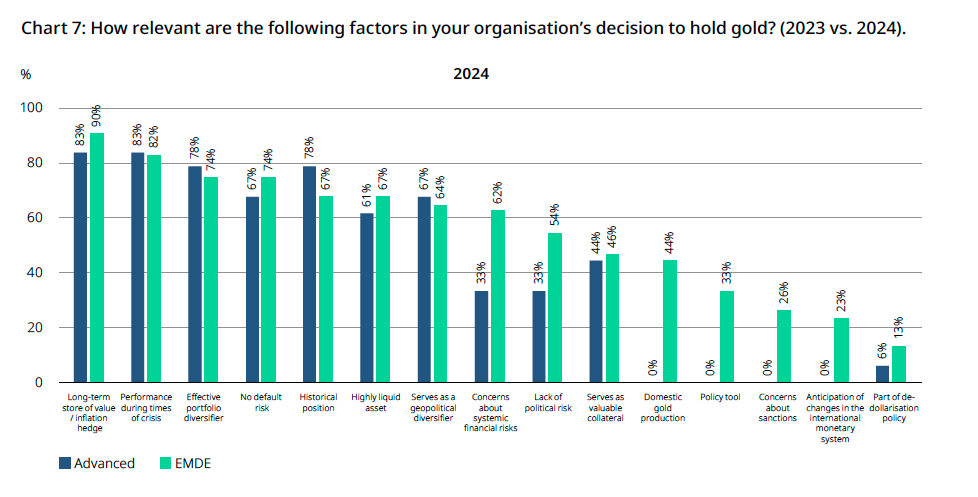
Central banks specifically hold gold for several reasons.
The number one reason is gold serves as a long-term store of value, and it creates a hedge against inflation.
Other key reasons given for holding gold were its performance during times of crisis, its role as a portfolio diversifier, and the fact that there is no default risk.
Emerging and developing market central banks view risks differently than those in developed markets. A higher proportion of EMDE central banks viewed the following factors as more relevant to their decision to hold gold:
-
Concerns about systemic financial risks.
-
Lack of political risk.
-
Concerns about sanctions.
-
Anticipations of changes in the international monetary system.
This likely reflects the ongoing shift of gold from the West to the East. Policymakers in the U.S. and Europe don't seem to grasp the significance of this shift.
To receive free commentary and analysis on the gold and silver markets, click here to be added to the Money Metals news service.
Author
Mike Maharrey
Money Metals Exchange
Mike Maharrey is a journalist and market analyst for MoneyMetals.com with over a decade of experience in precious metals. He holds a BS in accounting from the University of Kentucky and a BA in journalism from the University of South Florida.