Capital Flows Part III: This Time Is Different

The relationship between interest rate expectations and exchange rates has become harder to quantify, largely due to the unique nature of the current economic cycle. This changing dynamic ultimately affects capital flows.
What About Expectations?
As we have discussed in two previous reports,* capital flows respond to relative interest rate and exchange rate dynamics across borders. We now turn to the effect of expectations on our three variables. Expectations have played an increasingly important role in market participants' reactions to global events. For example, recent Italian political developments led the euro to decline against the dollar, while Italian bond yields rose more than 100 bps (top chart). While it is too soon to determine any effect these political tensions could have on capital flows, it is clear that expectations play a role in short-term exchange rate and interest rate dynamics. In the long run, these dynamics affect capital flows.

Expectations of central bank actions have also caused unpredictable swings in foreign exchange rates and interest rates. As previously discussed, our currency strategy team has found additional rate hikes from the Fed to be less supportive of the dollar, while at this stage, tightening on the part of foreign central banks has been more supportive of foreign currencies. Throughout much of 2017, short-term rate expectations moved in favor of the U.S. dollar, but the dollar declined (middle chart). This is likely due in part to the FOMC being further along its tightening path relative to other major central banks, and market participants having already priced in future rate hikes to a large extent. Market-implied probabilities of a rate hike are nearly 100 percent for today's FOMC decision. Market participants likely see the FOMC as only having so many rate hikes left before reaching its terminal rate, and this means the potential for rate hike "surprises" is much lower.
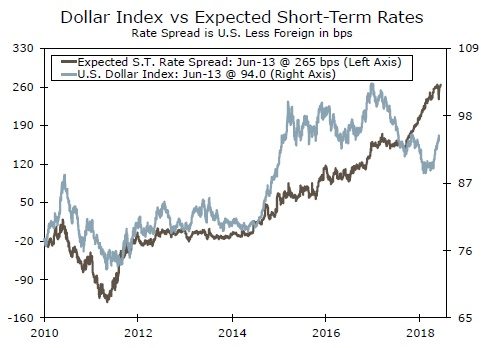
In turn, the effect of interest rate expectations on exchange rates has been harder to quantify. As the Fed began to tighten policy in 2015-2016, one could theoretically identify a more direct relationship between the probability of a Fed rate hike and its effect on the dollar. However, as global central banks have engaged in unconventional monetary policy measures, the focus has turned toward perceived policy stances through actions such as quantitative easing, rather than a pure reaction to actual rate hikes.
Reviewing Past Cycles: All Else Is Not Equal for Capital Flows
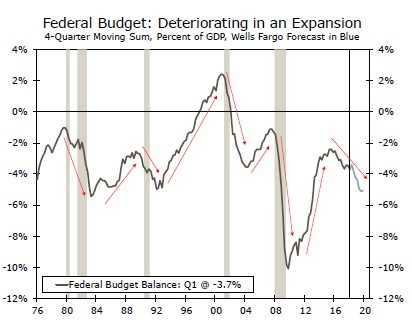
The evolving relationship between interest rate expectations and exchange rates confirms why this cycle is unique. We have found that country-specific characteristics lead to volatility in capital flows, and similarly influence expectations. In the U.S. for example, prior cycles may have had a rising rate environment, but lacked a fiscal stimulus. This difference is compounded by unconventional global monetary policy and a deteriorating fiscal outlook during one of the longest economic expansions in recent history (bottom chart). These differences influence investors' relative allocation of capital, and decision makers would do well to pay attention to the unique outcomes that stem from differing market expectations.
Author
Wells Fargo Research Team
Wells Fargo

















