Canada's 6.4% unemployment rate: Why Friday's jobs print puts the BoC's slack story on trial

The Bank of Canada (BoC) held at 2.25% on Wednesday for a seventh straight meeting and rewrote the one paragraph that still argues against a hike. In July, the BoC’s statement called the labour market soft and pinned the unemployment rate inside a 6.5%-7% range it had held since the end of 2024. July's Labour Force Survey (LFS) then printed 6.4%. On Wednesday, the same paragraph called conditions improved, kept the conclusion that demand for labour is subdued and excess supply persists, and dropped the sentence judging the policy rate appropriate. Friday's August LFS decides whether the number that broke the range was noise.
The Loonie isn't waiting for the verdict. USD/CAD sits just under 1.3800, more than 3% off the July peak just above 1.4200, below both the 50-day and 200-day exponential moving averages (EMA), with the 200-day at 1.3900 having turned back from the late-August bounce. What's left of the BoC's case for patience is a slack story, and the print that tests it lands in the same hour as US Nonfarm Payrolls (NFP).
The floor the data already broke
The July Monetary Policy Report (MPR) put the output gap between -1.5% and -0.5%, described growth in labour demand as subdued and job turnover as low, and reported businesses holding onto staff while declining to add any. That was written with June's 6.5% in hand, sitting on the floor of the range. Three weeks later, July added 75,000 jobs against forecasts near 15,000-20,000, took the rate down for a third straight month from its 6.9% April peak, and brought the gain since April to 181,000, all of it full-time on net, with private-sector and self-employed hiring more than accounting for the total while public payrolls shrank.
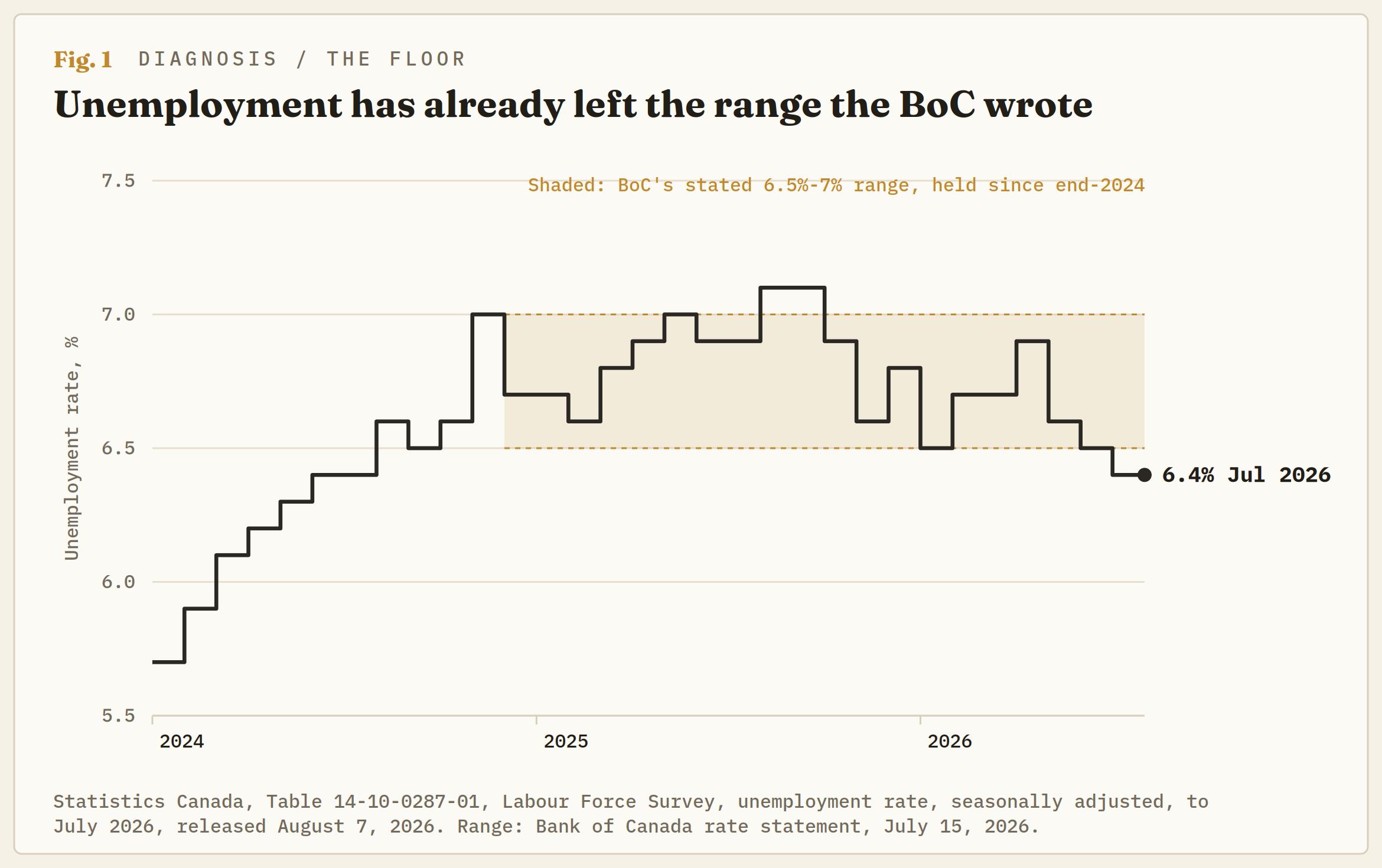
Wednesday's statement absorbed the new number without changing its mind. Conditions have improved, demand remains subdued, excess supply continues: three claims in one paragraph, and the last two are now doing all the work. The evidence changed and the conclusion didn't, which is what a central bank writes when it wants the option to hike without having pre-announced one. Governor Tiff Macklem then told the press conference that policymakers were prepared to raise more than once if inflation stayed too high, and the curve took him at his word. Pricing after Wednesday's decision carried a 43% chance of a quarter-point hike on October 28, an implied 2.48% after the December 9 meeting, which is 23 of the 25 basis points, and 3.15% by September 2027, more than three and a half hikes from here. That path sits above every earlier vintage on the same screen, from one week ago to ten.
Tight for the wrong reason
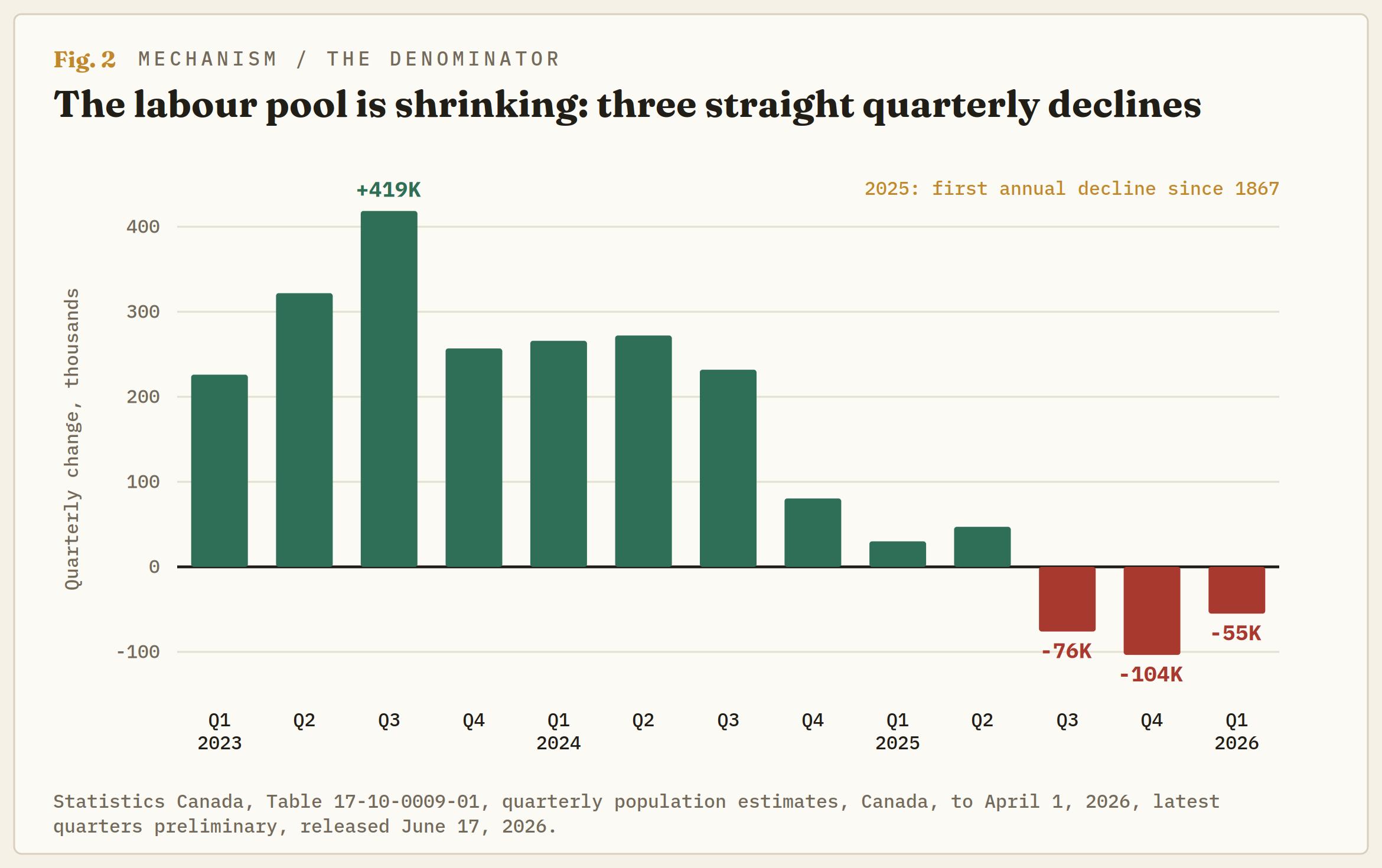
The unemployment rate is falling faster than hiring is rising, and the gap between the two is the whole story. Over the year to July, the unemployment rate fell 0.5 percentage points while the employment rate rose 0.2, from 60.7% to 60.9%. Hold participation where it stood a year ago, at 65.2%, and July's 6.4% rounds to 6.6%, back inside the range the BoC wrote. Part of the improvement is people leaving the labour force rather than finding work, and the country has been losing them: Statistics Canada estimates the population fell in each of the last three quarters it has published, by about 104,000 in the fourth quarter of 2025 and 55,000 in the first quarter of 2026, with non-permanent residents down about 118,000 in the latest quarter alone.
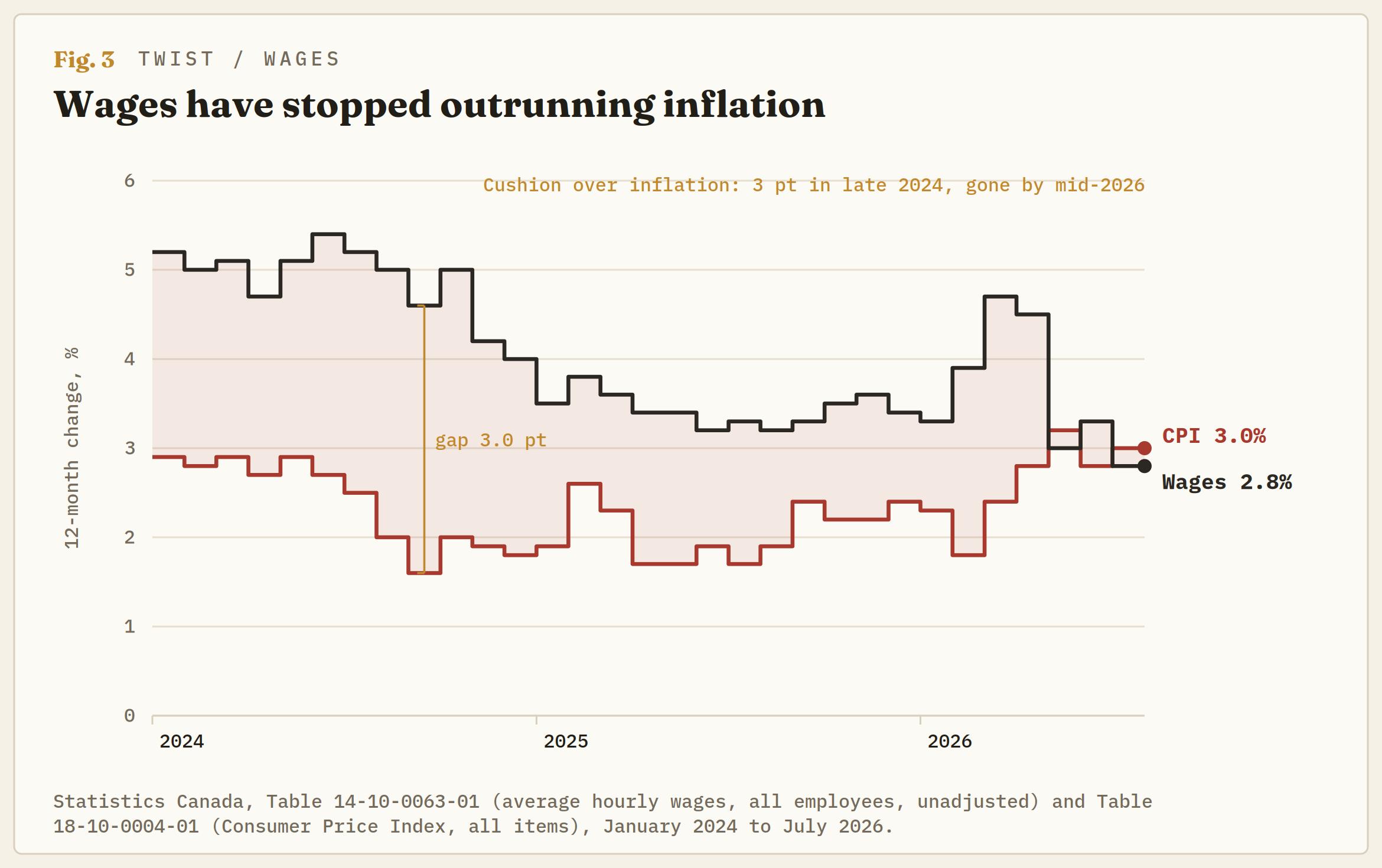
Employers confirm it. The job vacancy rate has sat at 2.7%-2.8% for more than a year, with vacancies stuck near 500,000. The share of the unemployed who found work in the month was 20.8% in July against a pre-pandemic norm of 26.6%, and wage growth slowed to 2.8% from 3.3% in June, with the BoC's own composition-adjusted measure at 2.7%. A labour market this tight on the rate and this loose on the flows is precisely what lets the BoC write improved and subdued in the same breath, and it's why Friday's headline rate is the least useful number in the release.
What matters is whether hiring keeps outrunning a labour force that has stopped growing. Consensus looks for a gain near 15,000 and an unchanged 6.4%, with the low end of forecasts at 5,000. Anything near zero with the rate steady is the supply story continuing on its own. A second month above 50,000 with hours and private payrolls up is demand, and demand is the thing the BoC says isn't there.
The last clean print
August's reference week ran August 9-15. The Section 338 proclamations were signed July 20, the 50% tariffs on about CAD $27.6 billion of Canadian goods took effect August 22, and Canada's matching counter-tariffs land September 8. Friday is therefore the first survey taken under the threat and the last taken before either side's duties reached a payroll. The first survey week that captures both is September's, published in early October, ahead of the October 28 decision and the MPR that comes with it.
That timing cuts both ways. Macklem put the directly affected products at about 5% of exports to the US and named the larger risk as firms outside those sectors deferring hiring and investment. Friday's number becomes the baseline the October MPR measures that deferral against. A strong print raises the bar the tariffs have to clear to justify a hold, which makes it more hawkish than the same number would have been in June. A weak print hands the excess-supply sentence back to the BoC and lets it look through headline inflation near 3% for one more meeting, Oil permitting.
Same hour, two banks leaning to hike
The overshadow is real. US Nonfarm Payrolls (NFP) land in the same hour with forecasts near 50,000-58,000 after July's -23,000, a 4.1% unemployment rate that fell because the labour force shrank, and a benchmark revision on August 28 that marked March payrolls down by 79,000. The Federal Reserve (Fed) meets September 16 with FedWatch pricing at a coin toss, 50% for a quarter-point move off 3.50%-3.75% after Fed Chair Kevin Warsh's Jackson Hole remarks, a first hike fully priced by December 9 and a second all but priced by March 17. Both sides of the pair are pricing tightening, the two banks share decision days on October 28 and December 9, and the Loonie trades the relative surprise rather than the Canadian one.
The pair has traded the expected rate gap rather than the posted one all summer, and the tape says so. In the first week of August, when payrolls printed -23,000 and Canada added 75,000 in the same hour, USD/CAD lost 1.4000 and hasn't been back above it. Friday's combinations write themselves. Strong Canada and weak US is the clean one, and the one the curve is leaning toward. Weak Canada and strong US is the squeeze, and it's the one the tape has spent August not pricing.
The map
Spot near 1.3800 is the middle of the August range and the wrong place to initiate. The lean is short USD/CAD on the rate-gap arc, but the entry is the print, not the level.
Strong LFS, meaning employment well above 50,000, a rate at 6.3% or lower and wages holding near 3%: the slack sentence goes, October's 43% becomes the base case, and the pair loses the late-August low near 1.3700 with the February low near 1.3500 as the next shelf. A soft NFP on top is the cleanest setup of the quarter.
Weak LFS, meaning a negative headline or a rate back at 6.5% or higher: the range is restored, the near-full December hike bleeds back toward a coin toss, and the pair squeezes back through 1.3900 at the 200-day EMA toward 1.3950 at the 50-day. A daily close above 1.3950 puts 1.4000 back in play and invalidates the lean until October's data.
In-line print, near forecasts with the rate at 6.4%: the supply story keeps writing itself, the rate stays flattering and hiring stays subdued, and the pair stays pinned between 1.3700 and 1.3900 while NFP picks the direction. That is the outcome that keeps the BoC's paragraph intact for one more month, and it's the one Wednesday's statement was written to survive.
Author

Joshua Gibson
FXStreet
Joshua joins the FXStreet team as an Economics and Finance double major from Vancouver Island University with twelve years' experience as an independent trader focusing on technical analysis.