Australian Dollar Price Forecast: Initial resistance emerges at 0.7200
- AUD/USD adds to the weekly recovery, retesting the 0.7200 hurdle.
- The pair keeps the trade in the upper end of its range, near four-month tops.
- Australia recorded the second trade surplus in a row in July.
AUD/USD bulls struggle to break free
Base case: while above the 200-day SMA near 0.6980, spot should maintain the constructive stance. Of note is that the pair is navigating close to the overbought zone, which carries the potential to, eventually, trigger a “technical” correction.
Against that, Australia’s relatively solid domestic fundamentals and the RBA’s hawkish stance should discourage aggressive selling, while bouts of fresh demand for the US Dollar (USD) and steady geopolitical uncertainty should keep bulls’ impulse contained for now.
Bullish case: A convincing move beyond 0.7200, ideally supported by firm Australian data, stronger expectations of another RBA rate increase, or an extended period of tighter-for-longer from the central bank, would strengthen this scenario.
That's said, there is a short-term target just above 0.7200 preceding the 2026 ceiling at 0.7277 (May 6).
The sizeable build-up of speculative AUD shorts could add fuel to the move if a confirmed breakout forces bearish traders to unwind their positions.
Bearish case: A sustainable retracement to the sub-0.7100 region, amid a resurgence of USD strength or generalised weakness in market sentiment, would bring sellers back into the market, with subsequent targets emerging at the provisional 100-day and 55-day SMAs near 0.7080 and 0.7020, respectively. South from here lies the more relevant 200-day SMA.
A daily close below this area would damage the wider positive structure and increase the probability of a deeper correction.
Australia’s economy keeps the floor in place
Australia’s domestic backdrop remains relatively healthy, supported by firm demand, positive growth and a somewhat resilient labour market.
August final business surveys reinforced that picture after the Manufacturing PMI held steady at 52.0, and the Services PMI lost some momentum, falling marginally to 53.2 from 53.6. Despite the mixed performance, the domestic business activity remains comfortably in expansionary territory.
The July data from the labour market were, however, discouraging: the Unemployment Rate ticked higher to nearly 5-year highs at 4.5%, while the Employment Change unexpectedly dropped by 15.8K following a revised 80.3K increase in June.
The picture remains, meanwhile, broadly auspicious after Australia recorded an A$1.923 billion trade surplus in July, adding to June’s A$2.341 billion positive results.
In addition, the latest GDP figures showed the economy expanded by 0.4% QoQ (from 0.3%) in the April-June period, while annual growth came in at 2.1% (from 2.5%).
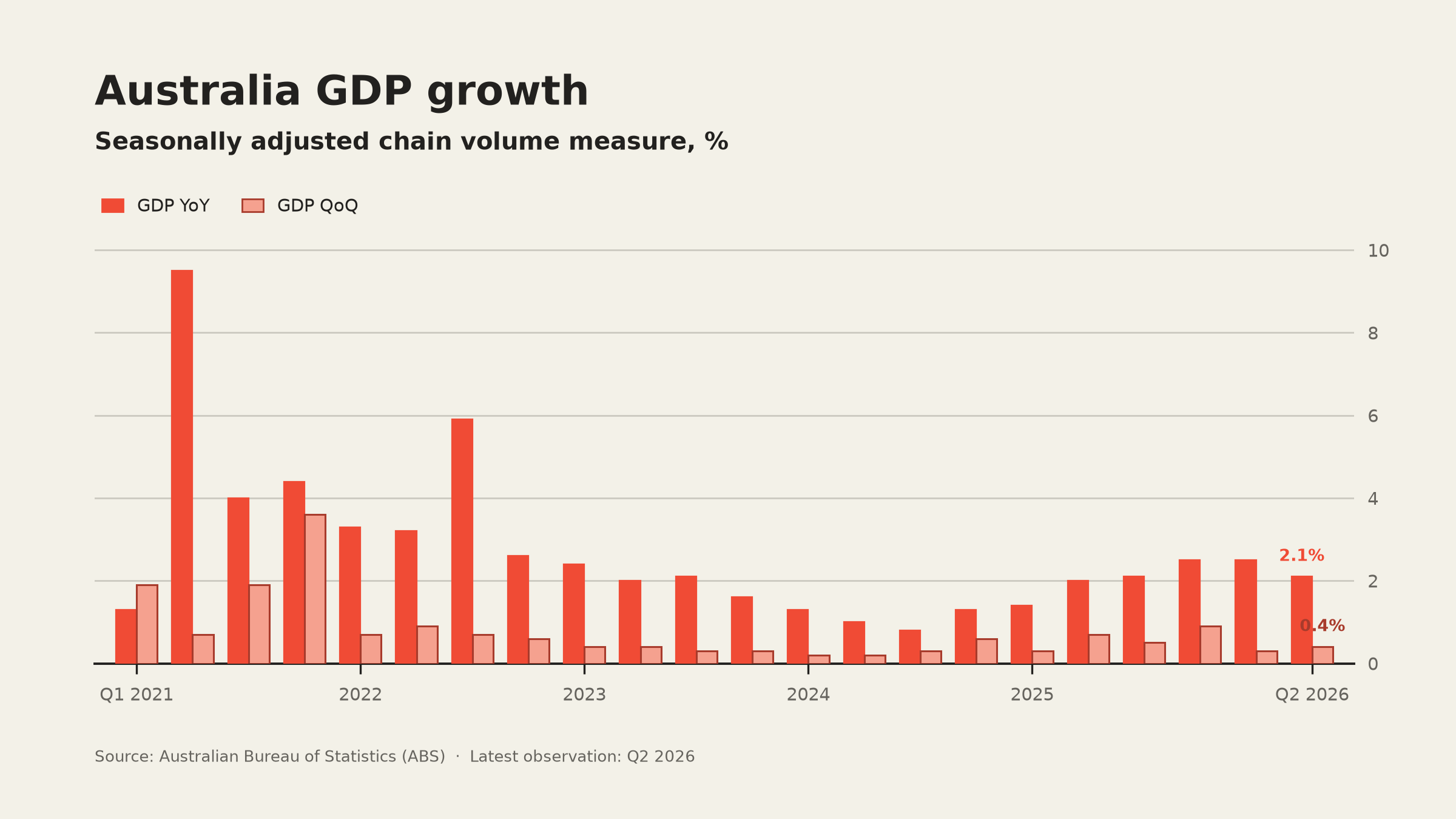
Overall the figures suggest a resilient economy but perhaps not strong enough on its own to trigger a sustained breakout in spot.
Inflation keeps the RBA’s finger on the trigger
Australian headline inflation eased to 3.5% in July (from 3.8%), while underlying price pressures tracked by the Trimmed Mean held steady at 3.6%.
Consumer inflation expectations reinforced the view of sticky prices after they ticked higher to 4.9% in August (from 4.7%), according to the Melbourne Institute. All in all, inflation remains too high for the RBA to declare victory.
Back to the RBA, it left its Official Cash Rate (OCR) unchanged at 4.35% in August, delivering another cautious message. Policymakers warned that further tightening could still be required if inflation proves more persistent than expected.
Later, the RBA Minutes pointed in that direction, retaining a cautious but hawkish bias, with several policymakers warning that upside inflation risks could materialise and leave the Board ready to raise rates. Indeed, risks include higher oil prices, cost pass-through and the data centre boom.
The Board debated a 25-basis-point hike but ultimately judged current policy sufficiently restrictive. With fresh inflation, labour-market and GDP data due before September, policymakers also noted balanced risks, including falling housing prices and the possibility of reducing inflation with less damage to employment.
In the meantime, market participants expect just over 4 basis points of tightening by year-end, while consensus appears slightly tilted toward another 25-basis-point rate hike at its September 29 meeting.
China steadies the ship without filling the sails
China remains an important influence on the Australian currency, although it is currently providing stability rather than a powerful tailwind.
The Chinese economy expanded by 4.3% YoY in the April-June period, while Industrial Production has lost some traction and rose by 4.5% in the year to June, and Retail Sales increased by a modest 0.6% over the last twelve months.
Business surveys indicate divergent activity: the National Bureau of Statistics (NBS) reported Manufacturing PMI at 49.8 in August (from 49.2) and Services at 49.0 (unchanged), while private measures like RatingDog remain in expansionary territory, with Manufacturing at 51.5 (from 50.9) and Services at 51.4 (from 50.4).
China’s trade surplus also widened to $125.62 billion in June from $105.4 billion, supported by stronger imports and exports.
Meanwhile, the People’s Bank of China (PBoC) maintained its Loan Prime Rates (LPR) unchanged at its meeting last month, with the one-year rate at 3.00% and the five-year rate at 3.50%, widely in line with the analysts’ estimates.
China is therefore neither delivering a major boost nor creating a significant drag. Unless the data reveal a clearer acceleration or deterioration, Chinese releases may generate short-term volatility without establishing a lasting direction for the pair.
AUD bears remain in control, but conviction is fading
According to the Commodity Futures Trading Commission (CFTC) data, non-commercial net shorts in AUD increased marginally in the week to August 25, reaching nearly 44.5K contracts and extending the bearish trend that has started in mid-June. The weekly deterioration, however, moderated to roughly -300 contracts from nearly -5K contracts.
Once again, participation was at the centre of the debate after open interest rose for the sixth consecutive week, this time by nearly 334K contracts, the highest level in more than 15 years. The move continued to look more like a new bearish position than just a long liquidation. However, conviction behind the negative bias in the Aussie could be dwindling, as noted by the fourth week in a row of shrinking net shorts.
Furthermore, speculative exposure fell to -13.3%, and the 4-week change improved to around -4.5K contracts from about -6.5K contracts. The Speculative Exposure Percentile remained high at 80.8, meaning bearish exposure is historically high, although the Net Position Percentile at 59.7 indicates positioning is not yet extreme.
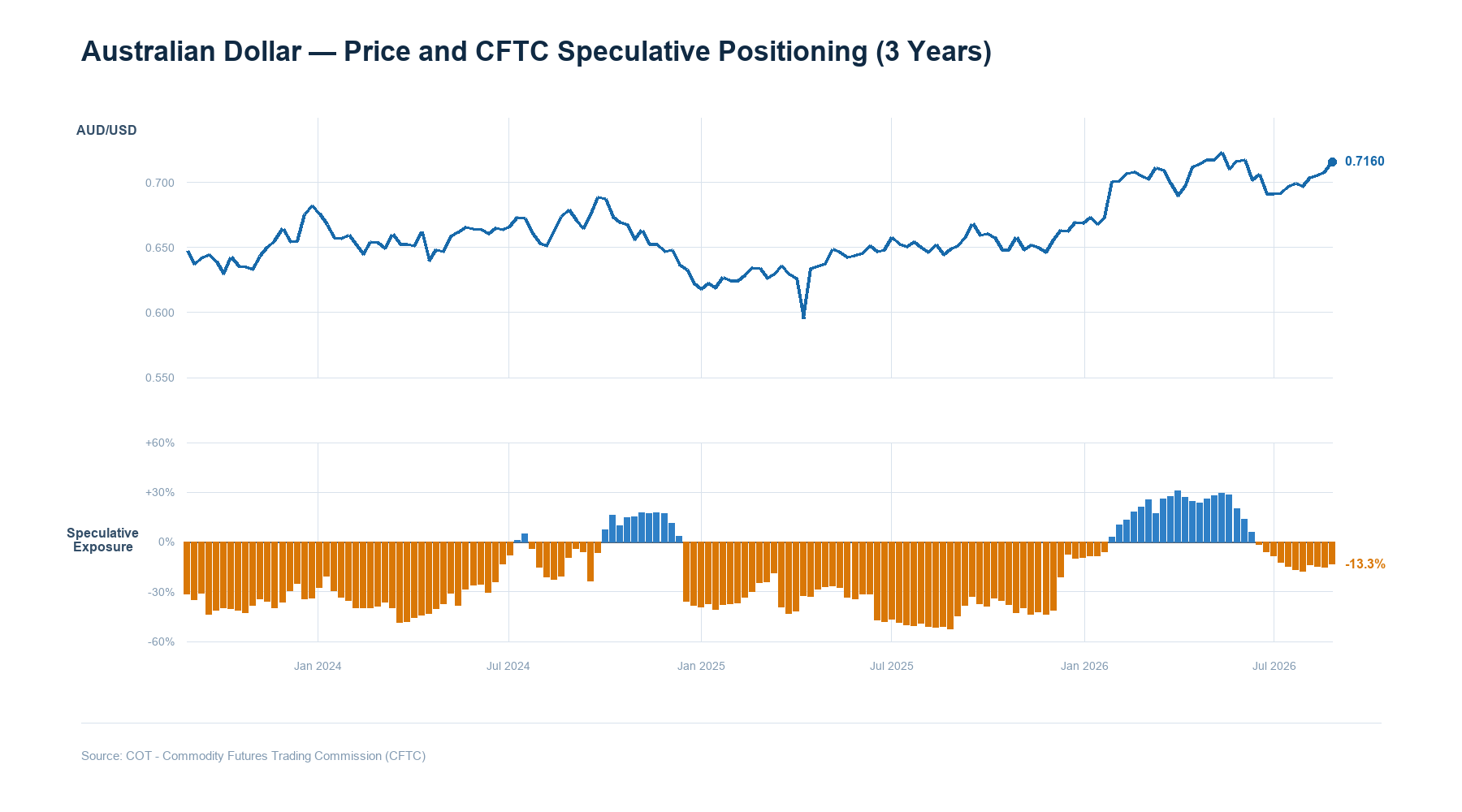
That said, AUD positioning remains bearish, while increasing participation underpins the stance. However, the ongoing improvement in the 4-week trend and moderate net-position percentile suggest that the short bias may be losing traction and is not yet excessively crowded, leaving room for further improvement if shorts continue to decline.
The domestic calendar moves back into focus
Next on tap on the domestic calendar is the publication of Westpac’s Consumer Confidence index, seconded by Building Permits and Private House Approvals.
Technical levels to watch
In the daily chart, AUD/USD trades at 0.7191, maintaining a bullish near-term bias as spot holds above the 55-, 100- and 200-day simple moving averages (SMAs) clustered between roughly 0.70 and 0.71. The Relative Strength Index (14) near 65 suggests firm upside momentum, while a modest Average Directional Index (14) around 22 hints at an improving but not yet explosive trend, leaving the pair well supported but edging toward overbought territory.
On the downside, initial support is at 0.7079, with the 100-day SMA at 0.7078 and the 55- and 200-day SMAs at 0.7024 and 0.6983 providing additional support, followed by a deeper structural floor at 0.6833 and further levels at 0.6660 and 0.6593. On the topside, bulls face initial resistance at 0.7278, closely followed by the nearby barrier at 0.7283, with a more distant hurdle at 0.7661 if the current advance extends.
(The technical analysis of this story was written with the help of an AI tool. Know more.)
AUD/USD needs a breakout to settle the argument
AUD/USD retains a constructive medium-term structure above its 200-day SMA, but the immediate outlook remains uncertain while the pair struggles to secure a foothold well above 0.7200 the figure.
The most attractive setup remains conditional: confirmed acceptance above 0.7200 would favour further gains and could trigger a positioning-driven short squeeze. Another rejection, however, would leave the pair exposed to a breach below 0.7100.
Until one of these boundaries breaks, AUD/USD remains caught between supportive Australian fundamentals and an external backdrop still dominated by the US Dollar, geopolitical uncertainty and only moderate support from China.
Author

Pablo Piovano
FXStreet
Born and bred in Argentina, Pablo has been carrying on with his passion for FX markets and trading since his first college years.
















