|

Cable is breaking out of an ending diagonal
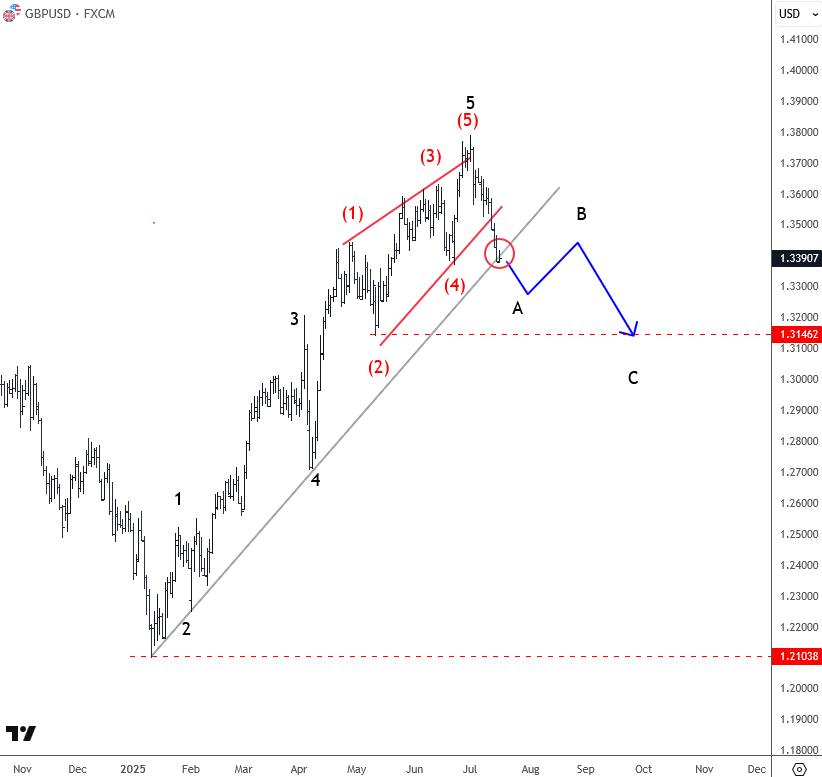
Cable is turning lower and has been one of the weakest currencies over the last week or so, and the main reason for this, of course, were the UK GDP figures reported last week, which showed that the economy has contracted, while at the same time, Bank of England said that they will be looking into more rate cuts in the future. That’s why cable came nicely down towards the 1.3380 area in a relatively short period of time.

Now, what’s really important here is that the market is turning down after an ending diagonal that was positioned in the fifth wave, something we’ve been tracking closely with our members, and already warned about this limited upside back in June. Ending diagonals are known to be slow patterns, but once completed, they usually lead to a sharp reversal — and that’s exactly what we are seeing here.

If we assume that the five-wave rally from the January lows is completed, then we should be looking for a minimum three-wave counter-trend decline. So even if the drop from 1.3780 will turn out to be only corrective, it’s probably just the first leg (wave A) of a larger ABC pullback. In such case, wave C could extend all the way down to 1.3140, if not even lower.

Of course, short-term we may still see some counter-trend bounce, but such rallies could offer opportunities to rejoin the trend, which for now remains bearish, at least from a short- to medium-term perspective.

Grega

Get Full Access To Our Premium Elliott Wave Analysis For 14 Days. Click here.


Get Full Access To Our Premium Elliott Wave Analysis For 14 Days. Click here.

Author

Gregor Horvat

Gregor Horvat

Wavetraders

Experience Grega is based in Slovenia and has been in the Forex market since 2003.

More from Gregor Horvat
Share:

Editor's Picks

AUD/USD hits eight-month lows below 0.6850 amid bullish USD

AUD/USD stays defensive below 0.6850, hitting an eight-month low in the Asian session on Thursday as the possibility of a steeper Fed rate hike in December helps the US Dollar hold near its highest level since April 2025. Geopolitical uncertainty also supports the safe-haven buck, while the RBA’s cautious, on-hold stance limits the Aussie.

USD/JPY eases from near 160.00 amid looming intervention risks, BoJ hike bets

USD/JPY retreats slightly from an over two-month high as the recent surge back to the 160.00 psychological mark prompted verbal warnings from Japanese authorities and sparked fears of direct FX intervention. Moreover, data showed that Japan’s wholesale inflation picked up again in October, strengthening the case for a BoJ hike in December and lifting the Japanese Yen. However, a bullish US Dollar, bolstered by odds of a jumbo Fed rate hike in December, could cap the pair's downside.


Gold remains a sell-on-rise trade amid steeper Fed hike bets

Gold fades its tepid recovery attempts at the $4,000 level early Thursday, as sellers refuse to budge amid rising expectations of a steeper interest rate hike by the US Federal Reserve at its December monetary policy meeting.

XRP consolidates losses, XLM extends recovery
Ripple (XRP) and Stellar (XLM) show mild signs of recovery on Thursday, but bears continue to weigh on both cryptocurrencies. XRP trades near $1.055 while XLM holds modest gains around $0.148. Meanwhile, weakening on-chain activity caps both altcoins’ recovery prospects, despite improving price action. CryptoQuant’s summary data shows a bearish outlook for both altcoins.
UK GDP is set to show that the economy continued growing in Q3

The highlight of the United Kingdom’s economic calendar this week will be the preliminary estimate of third-quarter Gross Domestic Product, which the Office for National Statistics will release on Thursday. The market is bracing for 0.7% growth in the three months to September, following 0.5% growth in the second quarter of 2026, with the annual rate accelerating to 1.9%, from 1.4% in the previous month.

What the US CPI headline doesn’t tell you about inflation

Brent crude has fallen about a third since mid-October on hopes the Iran war is ending, but diesel, freight and fertiliser costs haven't followed. Those costs reach US consumer prices in stages through 2027 and could keep inflation high after gasoline gets cheaper.