Breaking taboo's

S2N spotlight
Let me start this section by saying it is very easy to criticise and pass judgement, especially when you are not the one in the hot seat facing impossible decisions that are a matter of which option is least bad. So I write this from the safety of my cave.
Over the last few weeks the subject of President Trump firing the Chairman of the Federal Reserve has been on the table as a real possibility. In today’s Wall Street Journal there is a headline article about how the Treasury Secretary Scott Besent convinced President Trump not to do it.
I have spent the last 36 hrs (with some sleep) coding, so today I will exercise another side of my brain. I have been wondering about the psychology of putting taboo subjects on the table, making them part of the public discourse.
In today’s Spotlight I am focusing on just one of the subjects that we believed was off-limits. People close to the inner workings of financial markets know the importance of central bank independence and its ability to be above the influence of party politics.
Until last week it looked like Trump was going to fire Powell on trumped-up charges of overspending. You can’t make this stuff up. So what are the drivers and levers controlling this real-life theatre?
Before we get to some modern-day psychological theory, I want to take you back to a story I am sure you have all heard before. Probably the very first taboo.
In the Garden of Eden Adam was told by G-d not to eat from the Tree of Knowledge. My guess is that many of you are not aware of an interpretation that goes like this.
After being instructed by G-d, Adam told Eve that you cannot even touch the Tree of Knowledge; he made that part up as a precaution. The cunning snake devised a plan, bumping Eve into the tree, and guess what? Nothing happened. Suddenly the taboo of not touching had lost its power by becoming part of the discourse in the land of Eden, resulting in the eating from the Tree of Knowledge.
The thought of firing the Fed Chairman because he won't do what you want as the President of the United States was considered taboo; that is, until Trump shattered that taboo. The common wisdom was that kind of activity would collapse financial markets. Yet despite this being carefully leaked to the public, after an initial brief sell-off as the rumours started swirling it was going to happen, the market shrugged it off and continued making new highs.
How?
Two forces are at work: Trump’s inner motive—understood through a Jungian lens—and a step-by-step social-psychological process that comes instinctively to Trump, allowing him to normalise the unthinkable. I have mentioned in previous letters that I like to view the financial markets unconscious behaviour through the Collective Works of Carl Gustav Jung.
Please indulge me. I think my explanation provides a deep psychological explanation of what is happening, and we are part of it.
1. The Jungian motive: Ego inflation meets collective shadow
Jung held that each person pursues psychic wholeness, but the ego often hijacks that quest, demanding grand displays to shore up its fragile sense of worth. Trump’s insistence on low interest rates fills two psychic needs:
Narcissistic inflation (personal shadow avoidance). Low borrowing costs boost stock prices and headline GDP—metrics he treats as mirrors of personal greatness. Achieving them wards off the inner fear of insufficiency that lurks in his shadow. [I am fully aware I am assuming knowledge of important subjects like shadow. The problem is as I write I am penetrating deeper layers of the psyche which all need to be explained but now is not the time or place.]
Trickster-shadow integration (collective level). At a societal level many of us resent the “father figure” of a technocrat telling us what the interest rates that affect us so deeply should be. Trump, in the trickster role, voices this repressed anger: “Fire the Fed guy who’s hurting you.” He becomes the vessel through which the collective shadows, desire for direct control gains expression. Trump, along with the rest of us, is very much under the spell of a father complex. Welcome to the club.
2. How the unthinkable becomes “Meh”: The Eden sequence
Think of public discourse as Edenic: a lush garden of shared taboos that keep the social order intact. The serpent’s first nudge is not a full bite of fruit but a casual bump—“What if you touched the tree?” Each stage lowers resistance.
So the underlying motive is the deep psychological need to assert dominance over limiting forces—symbolic father figures, institutions, or inner authority. The tactic—repeating the unthinkable until it’s thinkable—is not just manipulation; it’s a way to bend reality to the ego’s will by eroding resistance through familiarity.
Trump doesn’t need to win the argument—he just needs to stay on the stage long enough for the crowd to accept the new script. The man is an absolute master of social manipulation that he is doing more on an unconscious level than a cerebral 6-dimensional chess player.
S2N observations
Over the last few days OpenAI launched their new ChatGPT Agent, I watched the official launch video where Sam Altman, sitting on a couch with his ChatGPT Agent team, introduced the new product and the team and got them to demonstrate on a laptop how it works.
Earlier today I watched Anthropic officially launch their Claude Financial Agent. I observed something that struck me as being off. I accept this is an unbaked observation of mine that I have not discussed with others and perhaps carries my own biases.
Everyone in the presentation was so young
I accept brilliance has no age barrier; in fact, most Nobel laureates make their discoveries before the age of 50. But wisdom is not something that comes without lots and lots of experience. Watching these 2 independent presentations by youngsters telling me how to think in the new age felt empty. Reading a book doesn’t give you wisdom; it gives you knowledge. Knowledge in the AI world is now a commodity; we all have access to it. Wisdom remains scarce.
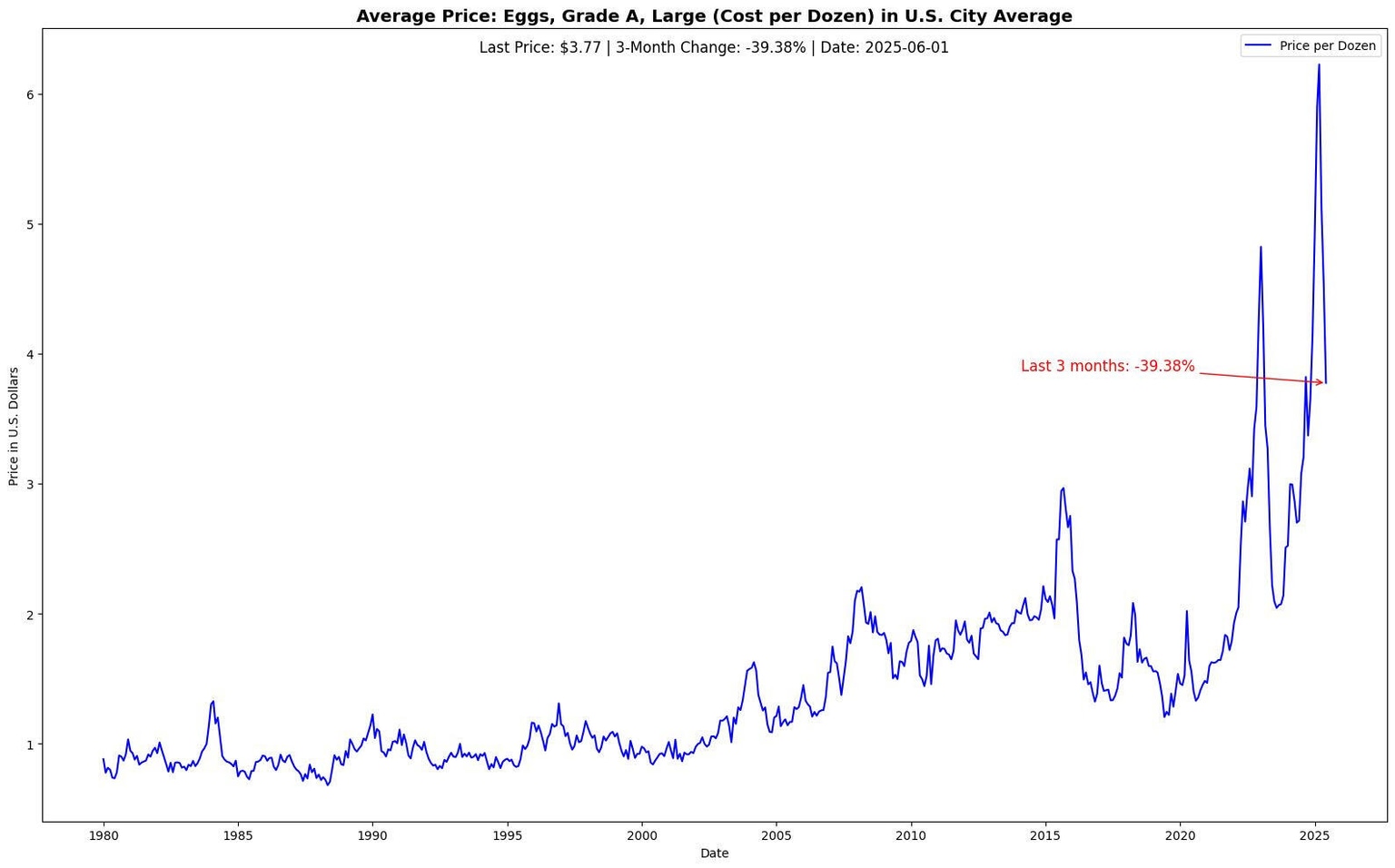
This weekend I was hosting a friend who has modified his diet and eats almost as many eggs a day as I do. Thank G-d prices have come down a bit.
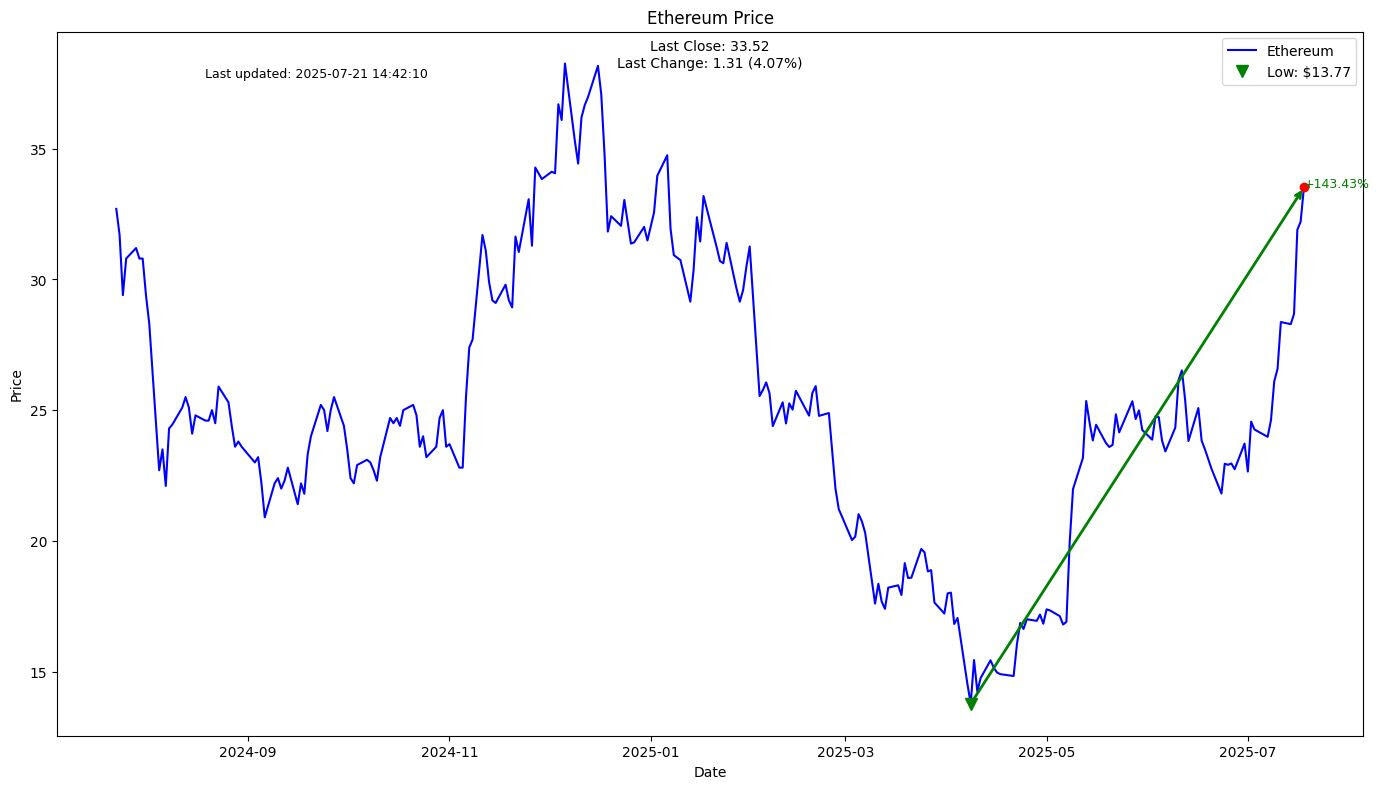
Finally, Ethereum is on a tear. You can see in the table below that ETH is up 50% this month alone but is up a whopping 143% from the low on the 8th of April 2025. [ignore that the price has been divided by 100 by my data provider; the measurement is correct.]
S2N screener alert
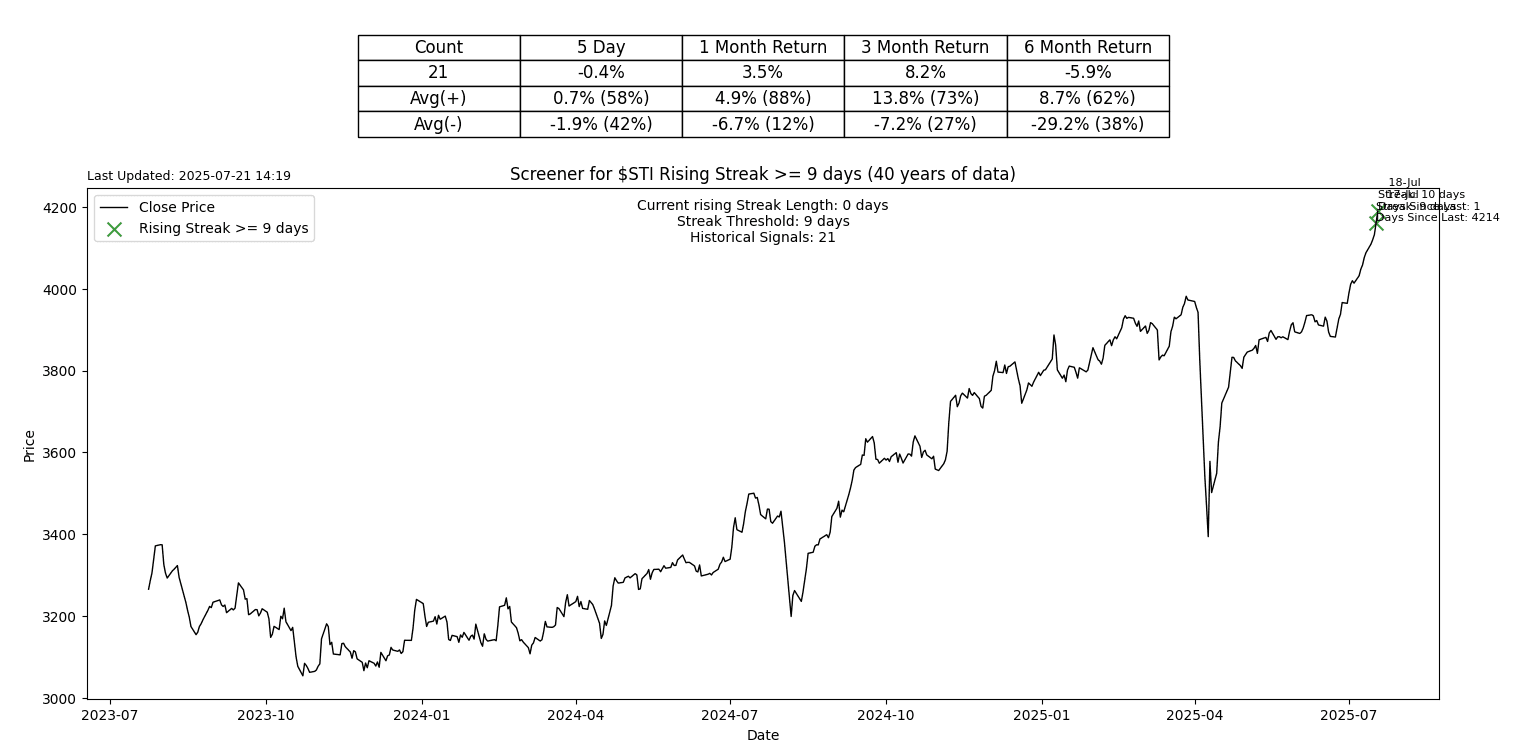
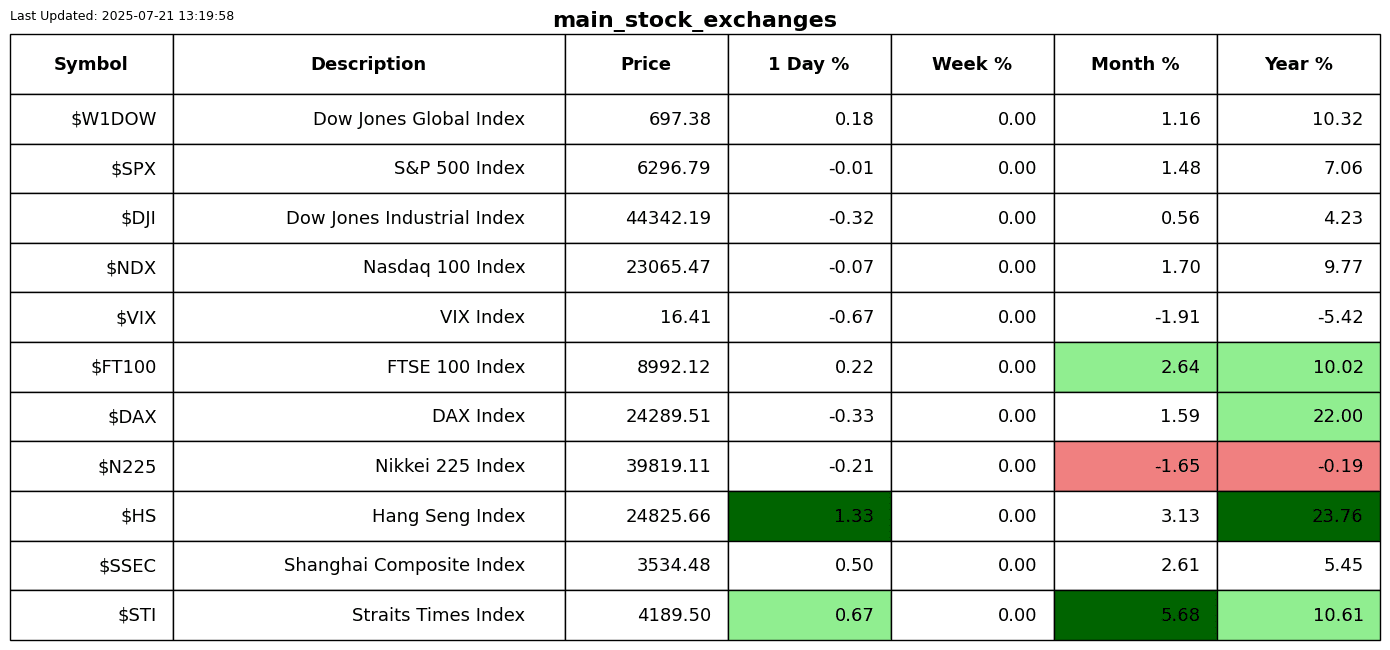
The Singapore Straits Times Index was up 9 days in a row.
S2N performance review


S2N chart gallery
S2N news today

Author
Michael Berman, PhD
Signal2Noise (S2N) News
Michael has decades of experience as a professional trader, hedge fund manager and incubator of emerging traders.

















