Boomer Spending: Bracing for the Slowdown

Most Boomers are now of an age where household spending begins to decline, which has begun to weigh on consumer spending. Healthcare and housing are accounting for a growing share of senior spending.
Consumer Spending: Boomers Shift from Tailwind to Headwind
Spending follows a predictable pattern as consumers age. As earnings rise and families grow, household spending increases through middle-age before falling as the kids move out and the house (ideally) gets paid off. Over the past few decades, falling outlays among older households were masked by the rising earning and spending power of the Boomers as they entered their prime working years. With adults age 65+ expected to rise from 20 percent of the adult population to 25 percent over the next 10 years, there is no offset to the slowdown in senior spending this time around.
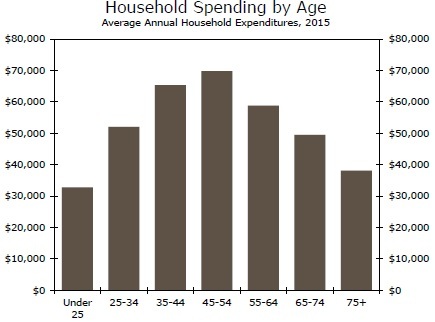
More than three quarters of the Boomers are already over the age of 55, when household spending begins to decline (top chart). With retirementage households spending 25 percent less than younger households, the aging of the Boomers stands to weigh on consumer spending, the powerhouse of the U.S. economy, in the years ahead. Spending could be hampered further in the near term if Boomer households try to shore up their retirement savings by putting more money away now, although this at least would limit the drag on spending further down the road.
What Areas of Spending Will Be Hit Hardest?
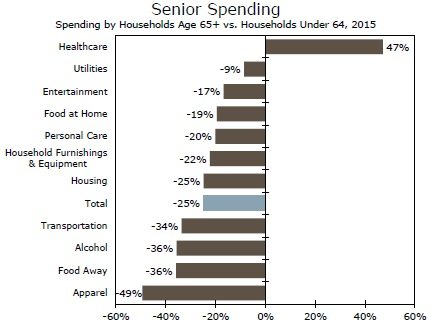
The degree to which businesses will need to brace for the spending slowdown as more Boomers reach retirement age varies by industry. Not surprisingly, one segment where spending rises with age is healthcare (outof- pocket and government). In every other major category, however, spending among households over the age of 65 falls. Apparel, dining out and transportation (vehicles purchases, finance charges and gasoline) see the largest drop off, with average annual expenditures for households 65 and over falling by at least than one-third (middle chart).
Discretionary Spending Pressured by Healthcare and Housing
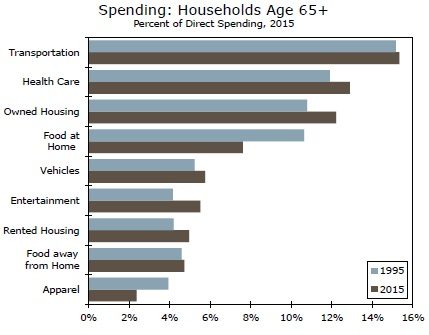
But will Boomers spend the same way as older generations after turning 65? Healthcare looks set to account for a greater share of spending among Boomers than previous generations. Rising insurance premiums have more than offset out-of-pocket savings on prescription drugs due to Medicare Part D. Of course, a substantial share of healthcare spending is paid for by the government, and, with the rising number of beneficiaries, total healthcare spending is likely to remain one of the strongest segments of consumer spending in the years ahead.
Housing is also taking up a higher share of senior spending as more households reach age 65 without having paid off their home or are renting, leaving them exposed to future price increases (bottom chart). In contrast, seniors are saving at grocery and clothing stores, helped by relatively low inflation in these categories the past two decades. This should limit the hit to discretionary spending, but won't change the fact that Boomers will still be spending less overall, generating a drag on consumer spending.
Author
Wells Fargo Research Team
Wells Fargo

















