Bond auctions


S2N spotlight
Let me give some background and explanation with regards to what I am presenting here.
It is well known that the US government is heading towards a fiscal cliff with 32% of US publicly held marketable debt—about $9.2 trillion—maturing and requiring refinancing over the next 12 months.
This means we need to pay careful attention to the fixed income market and the Treasury Department’s auctions. Normally I just rely on the financial media and charts on the bonds to figure this space out. Based on the importance of this to the global economy and financial markets, I have decided to dive a bit deeper.
Fortunately, the treasury department makes most of the data available free of charge via their API endpoints. I will start slow and build this section up and make sure it is updated dynamically on the research portal.
Auctions happen quarterly with the issue of new securities such as the 10-year note; that becomes an “on-the-run” benchmark for that maturity. Intra-quarter Treasury sometimes wants to issue more securities for a particular contract; they call these “re-openings.” The net result is that there are different maturity auctions every month.
What I focus on are 3 main metrics:
Bid-to-Cover Ratio represents the most fundamental measure of auction demand, calculated as the total amount of bids received divided by the amount of securities offered. A ratio of 2.5, for example, indicates that investors submitted $250 billion in bids for $100 billion worth of bonds. Ratios above 2.4 generally signal strong demand, while those below 2.1 suggest weaker investor appetite. This metric directly impacts borrowing costs—stronger demand allows the Treasury to pay lower interest rates, while weak demand forces higher yields to attract sufficient buyers.
Bidder Participation provides insight into the types of investors driving demand across three categories. Indirect bidders, primarily foreign central banks and international monetary authorities, typically represent 60-70% of successful bids and serve as a proxy for global confidence in U.S. fiscal stability. Direct bidders, including domestic pension funds and insurance companies, represent genuine "real money" demand from institutions that intend to hold the securities. Primary dealers, consisting of major Wall Street banks required to bid at every auction, ideally represent the smallest percentage since high dealer participation often indicates insufficient demand from end investors, forcing dealers to warehouse unwanted inventory.
The Tail measures auction competitiveness by comparing the final auction yield (stop-out rate) with the when-issued yield prevailing in secondary markets immediately before the auction. When auctions "stop through" (final yield below market expectations), it indicates strong demand that drove yields lower than anticipated. Conversely, when auctions "tail" (final yield above market expectations), it suggests weak demand that required higher yields to attract sufficient bids. Tight tails (0-1 basis points) indicate competitive bidding, while wide tails (2+ basis points) signal market stress or investor reluctance.
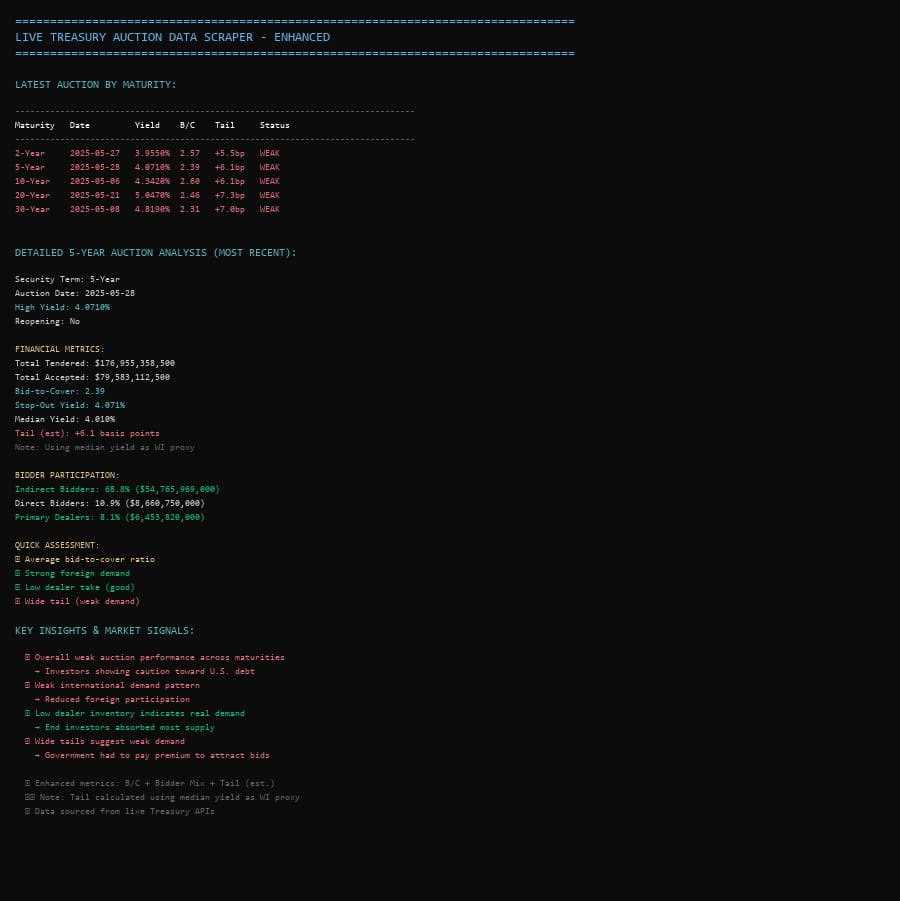
In summary, the table includes a ranking of the last auction for the 2, 5, 10, 20, and 30-year Treasuries as well as a more detailed focus on the last auction, which was the 5-year. It has taken me longer than I hoped to put this together, but it is fully automated now and will be updated regularly. I will also look for more ways to read deeper into the actual numbers and what they mean.
S2N observations
I have been out of circulation for a few days so I don’t want to weigh on the markets as I feel out of touch. I will make one noteworthy observation, which we all knew was coming.
The Trump & Musk bromance is officially over. Trump won’t forgive the “Big Beautiful Bill” being called a “disgusting abomination.”
S2N screener alert
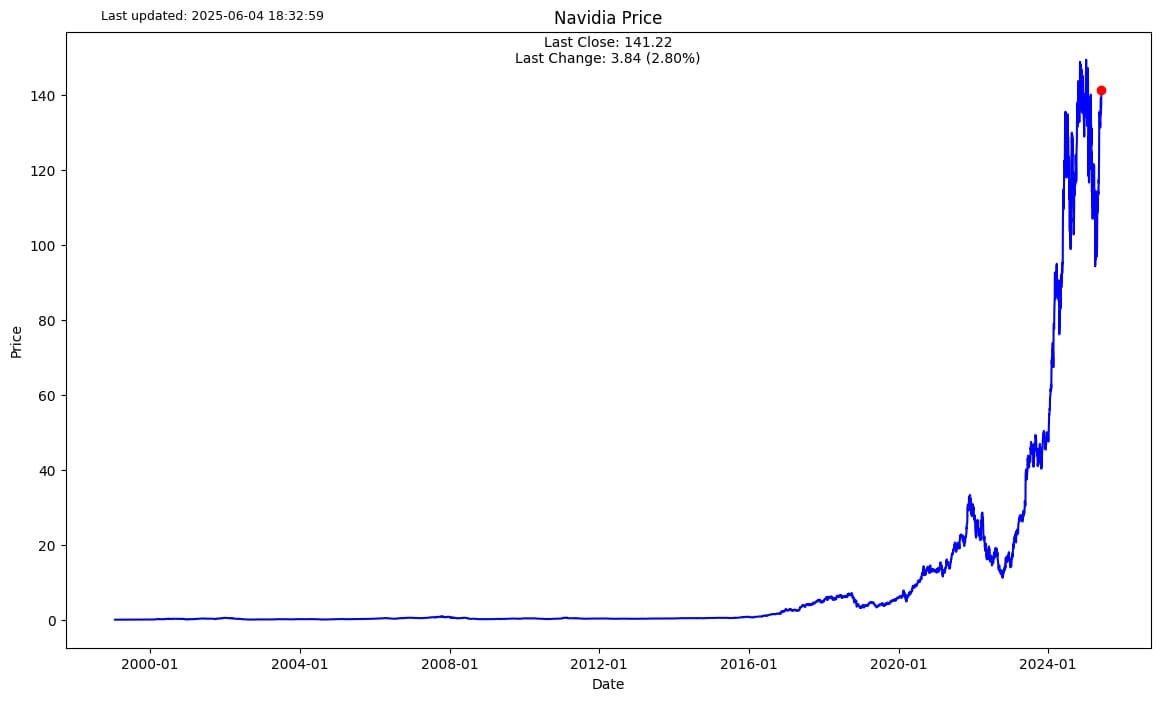
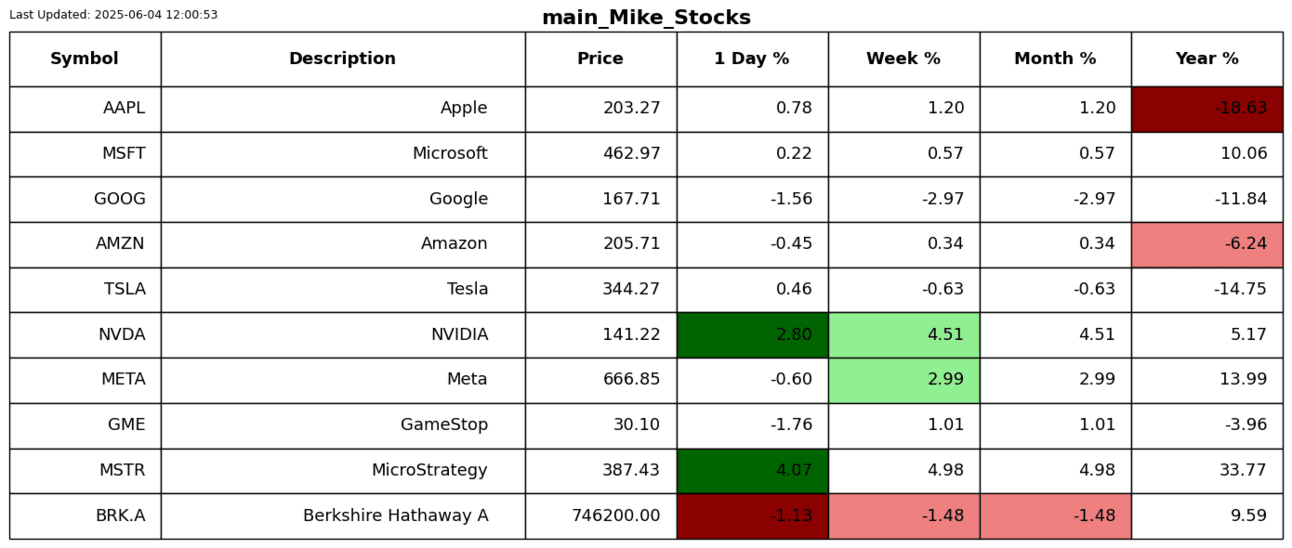
Nvidia toppled Microsoft as the most valuable company in the world with a market cap of $3.45 trillion. Based on my latest views on AI, I think this company will continue to make increasingly larger amounts of profits. The run-up has been enormous, so this might require some pullback along with the broader market. But the future remains bright for AI backbone companies.
S2N performance review



S2N chart gallery
S2N news today
Author
Michael Berman, PhD
Signal2Noise (S2N) News
Michael has decades of experience as a professional trader, hedge fund manager and incubator of emerging traders.

















