|

BoJ hold interest rates at 0.5%, US Retail Sales sink, Yen steady

The Japanese yen is slightly higher on Tuesday. In the European session, USD/JPY is trading quietly at 144.58, down 0.08% on the day. The Bank of Japan held interest rates, while US retails sales were lower than expected at -0.9%.

BoJ holds rates for third straight time

There were no surprises from the Bank of Japan on Tuesday, as the central bank maintained its short-term interest rate unchanged at 0.5%. This leaves the rate at its highest level since 2008.

The BoJ started the year on a hawkish note, hiking rates by 0.25%. However, any hopes for a series of rate increases were dashed as US President Trump unleashed his wide-ranging tariffs which led to significant turmoil in the financial markets. Central banks responded with extreme caution to the geopolitical risks and the BoJ has remained on the sidelines.

Today's decision was unanimous, which underlines the cautious stance that BoJ policymakers are taking. Last week, Governor Ueda said that if the BoJ is convinced that underlying inflation will approach the 2% level, the BOJ will continue to raise rates.

At today's press conference, Ueda said that inflation expectations aren't yet at the 2% level and voiced concern about tariffs affecting future wages. This dovish message reads "caution, caution, caution" and could mean that the Bank won't raise rates before 2026.

BoJ says will slow pace of reduction in JGB purchases

Although the BoJ didn't raise rates at today's meeting, it confirmed plans to reduce Japanese government bond purchases by JPY 400 billion each quarter through Q2 2026. However, the Bank said it would cut in half the pace of reduction after that, to JPY 200 billion every quarter through Q2 2027. This indicates a slower move away from ultra-loose monetary policy, reflecting a more gradual approach in response to the uncertain economic environment.

USD/JPY technical

  • USD/JPY tested support at 144.53 earlier. Below, there is support at 144.16.

  • There is resistance at 144.78 and 145.16.
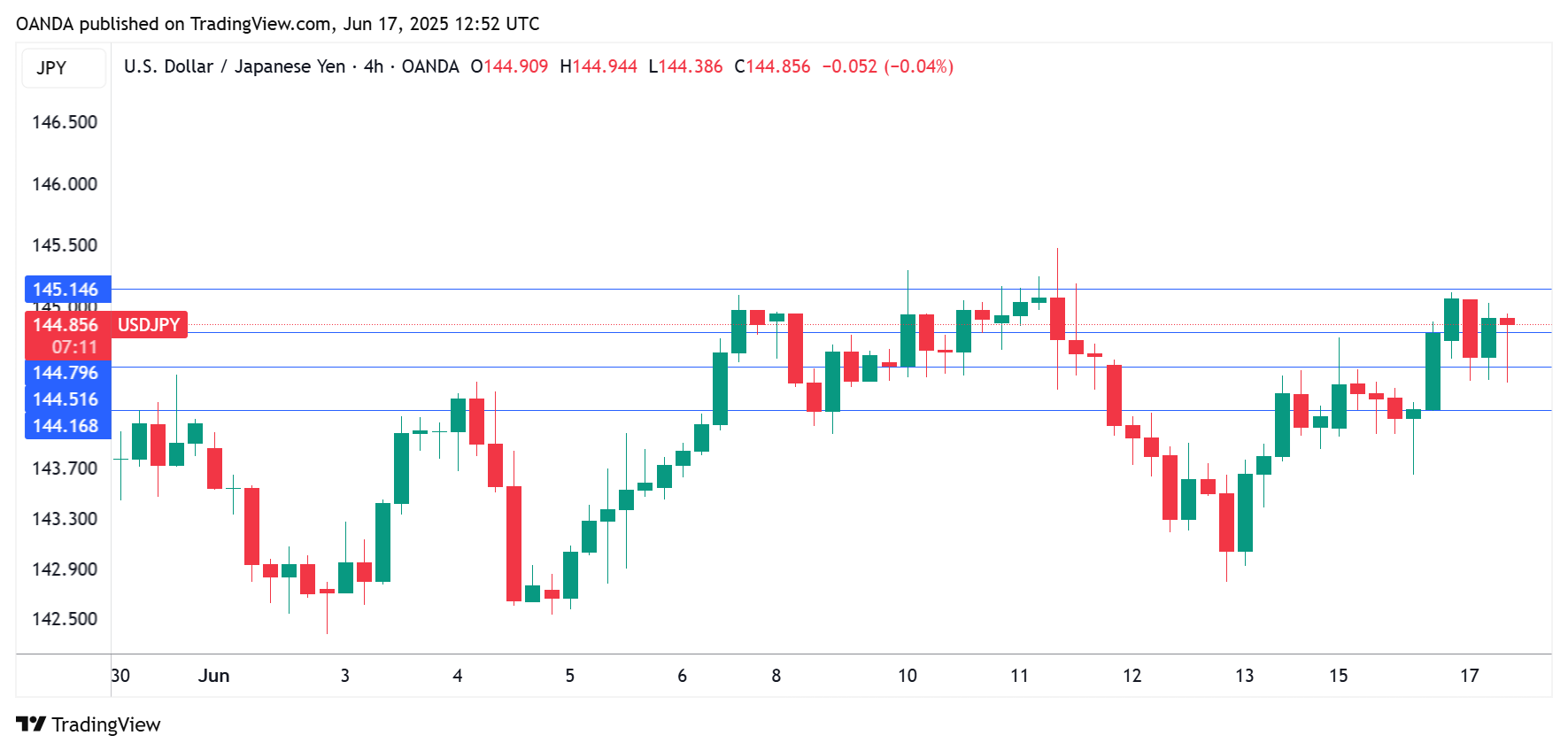
Chart

USDJPY 4-Hour Chart, June 17, 2025

Author

Kenny Fisher

Kenny Fisher

MarketPulse

A highly experienced financial market analyst with a focus on fundamental analysis, Kenneth Fisher’s daily commentary covers a broad range of markets including forex, equities and commodities.


More from Kenny Fisher
Share:

Editor's Picks

British Pound eases to 1.3450 area following downwardly revised Manufacturing PMI data

The British Pound is trimming previous gains against the US Dollar on Monday, returning to the mid-range of the 1.3400s down from fresh seven-week highs, above 1.3500 earlier on the day. Weaker-than-expected UK manufacturing data added pressure on the Pound, which rallied at the Asian session opening, amid news of a halt to the hostilities in Iran.

EUR/USD remains under pressure; looks at 1.1500 on firm US ISM

EUR/USD now accelerates its downtrend and trades in the low 1.1500s on the back of the marginal improvement in the US Dollar, all in the wake of solid US ISM Manufacturing data on Wednesday. The Greenback, in the meantime, remains far from a sustainable rebound in the current context of cooling geopolitical tensions.

Gold remains supported near $4,000

Gold adds to Friday’s pullback, although it remains well underpinned by the key $4,000 threshold per troy ounce on Monday. The US Dollar’s inconclusive price action seems enough to cap the yellow metal’s potential upside, although renewed hopes for a US-Iran peace deal and fading expectations of a Fed rate hike could limit the Greenback’s recovery.

Week ahead: US payrolls report and AI earnings to keep investors on edge

After the Fed decision, NFP report awaited for more rate hike clues. Employment also on the agenda in Canada and New Zealand. Chinese trade and Japanese wage data to be watched too. But Iran and AI headlines to remain in driver’s seat for risk sentiment.

The Bitcoin futures yield collapse: Once over 20%, now less than Treasury notes
Once a goldmine for carry traders, Bitcoin futures have flipped, consistently underperforming plain‑vanilla U.S. Treasuries every month since February. Carry trades consistently yielded 20% or more across regulated and unregulated crypto exchanges during the 2021 bull market. The strategy involved shorting Bitcoin futures while simultaneously buying a spot exchange-traded fund (ETF).
9-3: Is the Federal Reserve’s vote tally Warsh's new forward guidance?
The rate did not move. Neither did the statement, and that’s the more interesting fact. Set the July 29 Federal Open Market Committee (FOMC) statement beside the one issued on June 17, and the two documents are identical apart from a single verb and a paragraph at the bottom naming three dissenters.