Australian Jobs Report Preview: Pattern points to disappointing data, downing the Aussie
- Economists expect Australia to report a modest gain of 15,000 job gains in July.
- Australia's labor figures tend to provide bitter disappointments after two consecutive beats.
- A potentially weak employment report worries about China and fears of the Fed downing AUD/USD.

Two steps forward, one step back – and a big one in the wrong direction. That has been the pattern in recent Australian jobs reports. If recent history repeats itself, there is room for a substantial slide in AUD/USD, which has already been under pressure from various factors.
Here is a preview of Australia's Employment Change release for July, due out on August 17 at 1:30 GMT.
Australian jobs data follows a pattern for a year
The land down under has been benefiting from the post-pandemic recovery and the steaming hot global job market. The Unemployment Rate stood at 3.5% in June, a remarkable achievement, according to the Australian Bureau of Statistics.
A bustling labor market and rising inflation have pushed the Reserve Bank of Australia (RBA) to raise interest rates to 4.10%, but it has been hesitating recently. Apart from tamer price rises, the RBA also watches the labor market – and so do markets. Investors react to new information, not to the overall rosy situation.
Four out of six labor market reports so far in 2023 have outperformed early estimates, yet there is a clear pattern emerging since July 2022 – and patterns mean opportunities for traders.
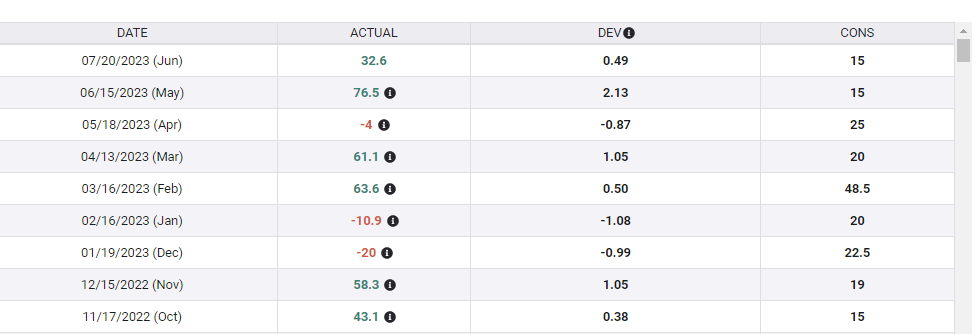
Australian Employment Change. Source: FXStreet
Contrary to America's Nonfarm Payrolls (NFP), Australian jobs numbers tend to jump around. However, after two consecutive beats, there is a bitter disappointment.
Australia reported two consecutive gains of over 60,000 jobs in February and March, only to shed workers in April. The nation averaged 50,000 jobs gained in October and November 2022, before reporting a loss of 20,000 in December. Back in May and June of last year, labor gains were impressive, before July saw a plunge of 40,900 positions.
Will the data for July 2023 repeat this pattern? The Australian labor market expanded by 76,500 in May and 32,600 in June, exceeding modest estimates. For the upcoming report, the economic calendar points to an increase of 15,000 positions.
Potential AUD/USD reaction to Australia's labor figures
If the pattern repeats itself and Australia reports downbeat data, AUD/USD has substantial room to fall. Why?
The Australian Dollar has been under pressure due to ongoing signs of weakness from China, the nation's largest trading partner. Property developers in the Asian giant are struggling to hold up – and that means reduced demand for Australian metal exports.
The Aussie has also suffered from the central bank's reluctance to raise rates, as mentioned earlier. Worries about Australia's housing market and stock market struggles have weighed on the currency. The A$ is a risk currency, which tends to follow the global mood.
On the other side of the Pacific, the US Dollar has been having an excellent August – reversing previous falls despite signs of an economic slowdown. Investors are worried that the Federal Reserve may still raise rates again, blocking the narrow path to a soft landing. Recession fears also benefit the Greenback in its role as a safe haven.
The most recent evidence of AUD/USD's weakness came from the reaction to China's surprising rate cut – no bounce.
If the data defy the pattern and Australia reports a third consecutive beat in job gains, the Australian Dollar is set to rise. Nevertheless, current market conditions favor a decline, turning any rally into a potential selling opportunity.
Final thoughts
Australia's monthly jobs report is a critical mover for the currency and may trigger high volatility. There is a greater chance of a fall than of a rise, given data patterns and market trends.
Author

Yohay Elam
FXStreet
Yohay is in Forex since 2008 when he founded Forex Crunch, a blog crafted in his free time that turned into a fully-fledged currency website later sold to Finixio.