Australian Employment Preview: Significant fall in jobs already priced-in? AUD has room to rise
- Australia’s Unemployment Rate is seen ticking higher to 4.8% in September.
- RBA sees Delta variant-led setback to economic recovery as only temporary.
- The aussie bulls target 0.7420 on hopes of labor market upturn by the year-end.

Australia’s labor market is seen shedding more jobs in September, the latest employment report due to be published by the Australian Bureau of Statistics (ABS) will show this Thursday.
The risks remain skewed to the downside for all the employment indicators, as the Delta covid variant outbreak-induced lockdowns that were imposed around July extended well into September.
Employment data to paint a bleak picture
After terrible August month employment data, the OZ economy is expected to have lost another 120K jobs in September. The Unemployment Rate is expected to climb to 4.8% from 4.5% booked previously. The Participation Rate is seen falling sharply to 64.7% last month when compared to the previous figure of 65.2%. In August, the Australian economy saw a hefty loss in jobs by 146.3K, erasing the prior three months of gains.
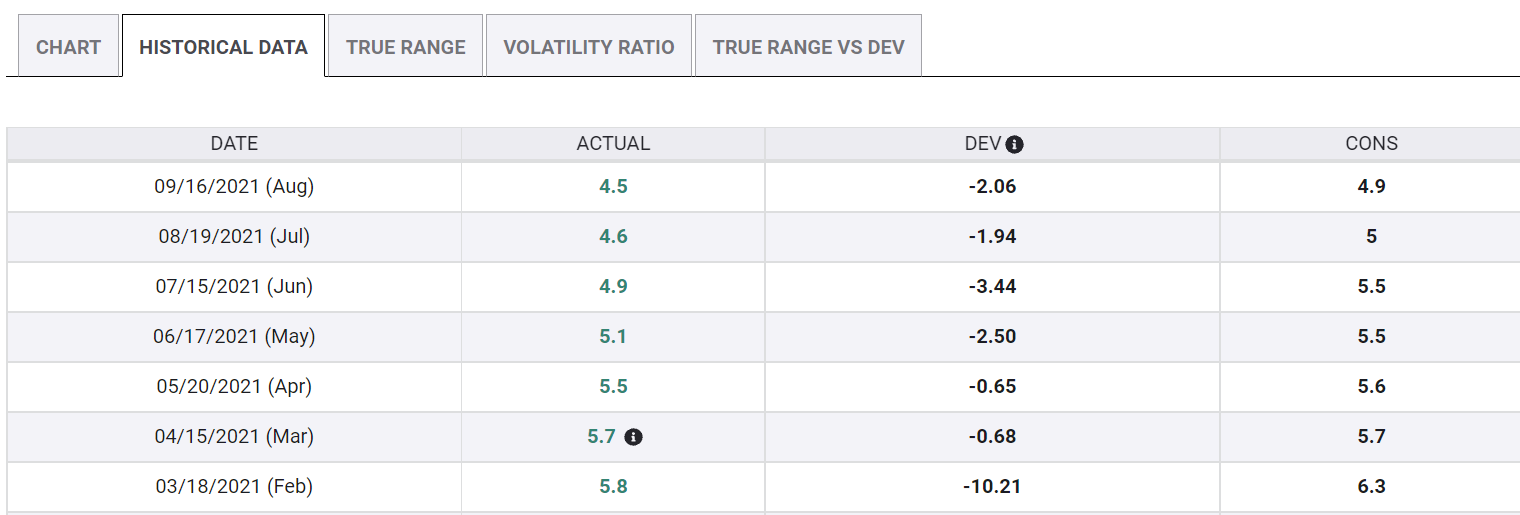
Source: FXStreet
At its October monetary policy decision, the Reserve Bank of Australia (RBA) kept its monetary policy settings unchanged, with the Official Cash Rate (OCR) on hold at a record low of 0.10%.
However, the RBA presented an upbeat outlook on the economy in the final quarter of 2021, citing that the “setback to the economic expansion in Australia is expected to be only temporary.”
“Vaccination rates increase further and restrictions are eased, the economy is expected to bounce back. The economy will be growing again in the December quarter,” the central bank explained in its monetary policy statement.
Meanwhile, the ABS said last week that the payroll jobs fell by 0.7% in the fortnight to September 11, following a larger 1.5% drop in the previous two weeks. The ANZ job advertisements for September saw a third straight monthly decline, suggesting an increase in the unemployment rate in the coming months.
However, the country’s NAB business confidence index jumped sharply in September, as firms remained hopeful as New South Wales (NSW) and Victoria announced plans for reopening.
AUD/USD probable scenarios
The AUD/USD pair has paused its uptrend near 0.7385 ahead of the critical US inflation data and the Australian employment figures. The US data and FOMC minutes will set the tone for the markets in the coming weeks, which will have a significant impact on the broader risk sentiment and eventually on the risk-sensitive currencies such as the aussie dollar.
Therefore, AUD/USD’s reaction to the Australian jobs report could be influenced by the persisting risk tone. Further, markets have already priced in significant job losses for Australia in September, expecting an upturn in the labor market by the year-end. That said, even a slightly upbeat reading could help intensify the bullish undertone in the aussie, triggering a breakthrough out of the nine-week-old symmetrical triangle formation on the daily sticks.
The Relative Strength Index (RSI) is holding firmer, well above the central line, adding credence to a potential move higher. A sustained break above the latter could prompt the buyers to challenge the bearish 100-Daily Moving Average (DMA) at 0.7420.
On the flip side, a big Australian data disappointment combined with the risk-off mood could reverse the recent upswing in the currency pair, with a test of the horizontal 50-DMA at 0.7305 back on the cards. The next relevant support is seen at the mildly bearish 21-DMA at 0.7280.

AUD/USD: Daily chart
Author

Dhwani Mehta
FXStreet
Residing in Mumbai (India), Dhwani is a Senior Analyst and Manager of the Asian session at FXStreet. She has over 10 years of experience in analyzing and covering the global financial markets, with specialization in Forex and commodities markets.