Australian Employment Preview: Can the Aussie handle a slowdown in job creation?
- Australia expected to add 15,000 jobs in May; Unemployment Rate to remain at 3.7%.
- The RBA raised interest rates last week and noted that labor market conditions remain tight.
- AUD/USD is testing the 0.6800 area again; strong job numbers could help to break further above.

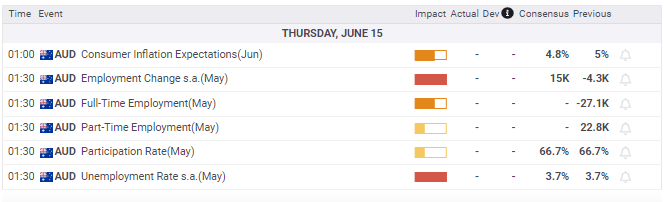
Australia will report May employment data on Thursday, June 15, at 01:30 GMT. After shedding 4,300 jobs in April, the country is expected to have added 15,000 new positions this time. The Unemployment Rate is forecast to remain steady at 3.7%, while the Participation Rate is seen unchanged at 66.7%. Alongside monthly employment figures, Australia will publish the June Consumer Inflation Expectations, foreseen at 4.8%.
RBA hikes and GDP slows
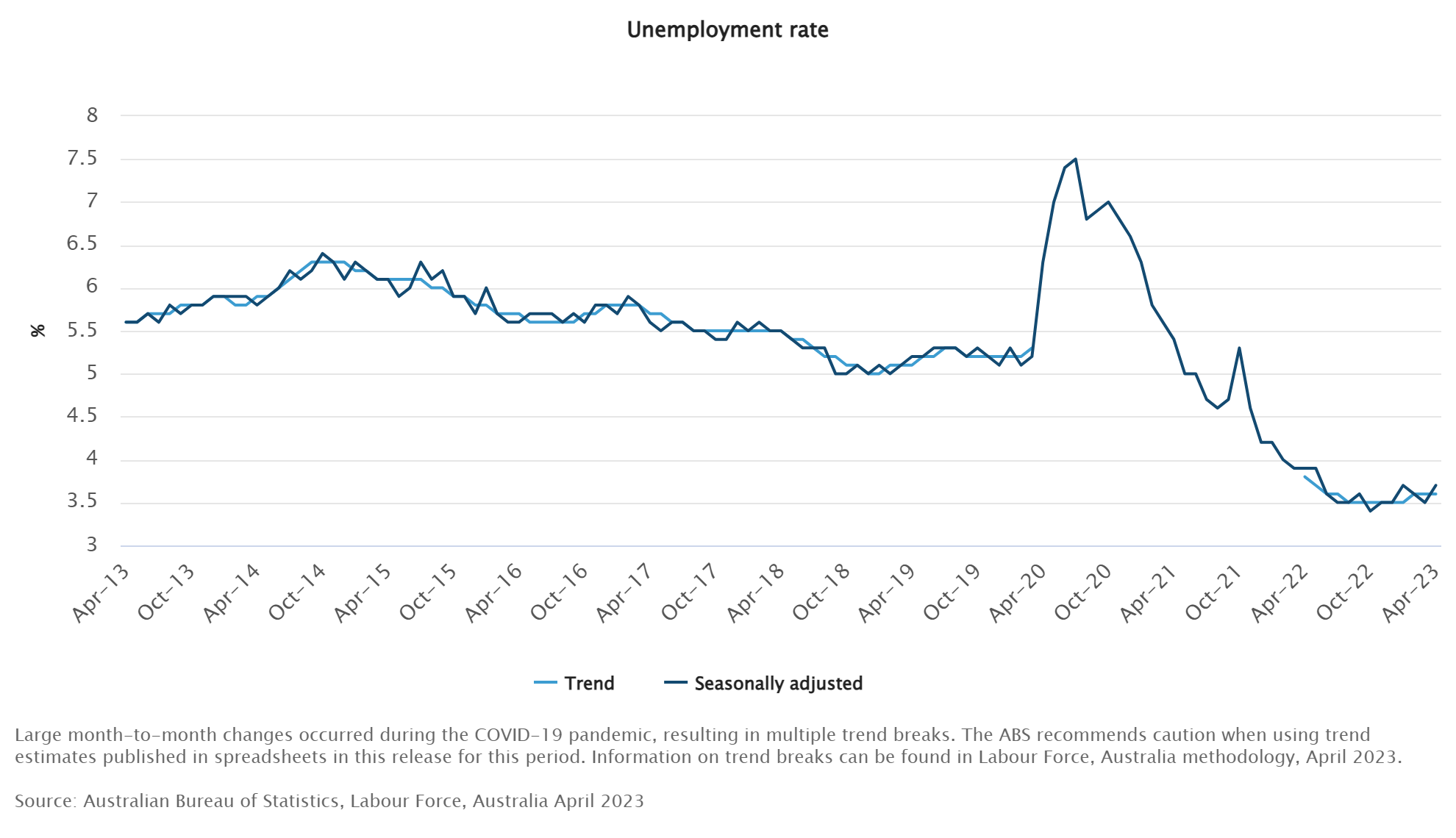
Last week, the Reserve Bank of Australia (RBA) raised its key interest rate by 25 basis points to 4.10%, surprising market participants who expected the central bank to remain on hold. A rebound in inflation in May was a crucial factor. RBA Governor Philip Lowe noted: “Growth in the Australian economy has slowed and conditions in the labor market have eased, although they remain very tight. The unemployment rate increased slightly to 3.7% in April and employment growth has moderated. Firms report that labor shortages have eased, although job vacancies and advertisements are still at very high levels.”
The following day, Lowe added: “We have been prepared to be patient in getting inflation back to target, but our patience has a limit, and the risks are starting to test that limit.” Later that day, data showed that the Australian economy grew 0.2% during the first quarter, the weakest pace since 2021. Annual growth came in at 2.3%, both numbers were below expectations.
The focus of the central bank is clearly on the inflation front, particularly after the latest numbers. A tight labor market is a key factor that allows further rate hikes. Inflation is testing RBA patience, according to Lowe, but a weak job market could also do so. Inflation remains high, and employment figures look firm. One single report will not change that. The unemployment rate will remain near record-low levels.
Market pricing shows expectations for more rate hikes, most likely in August rather than July. The peak rate is seen at 4.50%. The employment numbers could modestly influence these expectations.
AUD/USD at 0.6800
The combination of a weaker US Dollar, RBA rate hikes and positive risk sentiment boosted the AUD/USD to the 0.6800 area. The pair is challenging a crucial resistance level that capped the upside during the last three months. A positive employment report could help the pair to break that mark or to consolidate above. However, the fate of the AUD/USD could depend more on how the Dollar performs after US inflation data and the FOMC meeting, as well as overall risk sentiment, rather than what the Australian labor market numbers show.
Solid employment figures could boost the Aussie, suggesting that the labor market remains tight, easing concerns about the economic outlook. On the contrary, a report showing a large contraction in employment could provide further arguments for analysts warning about a potential recession in Australia, while putting pressure on the RBA to limit its tightening. However, inflation data will have the final say regarding the central bank's policies for the moment. This implies that the impact of a positive or negative jobs report (particularly if it comes out close to expectations) could be limited.
If, after the jobs report, the AUD/USD remains firm above 0.6800, further gains seem likely, with the next resistance level seen around 0.6875/0.6880. On the contrary, if it fails to hold above the critical level, the familiar range between 0.6600-0.6800 will continue to be active.
AUD/USD daily chart
-638223437060289790.png)
Author

Matías Salord
FXStreet
Matías started in financial markets in 2008, after graduating in Economics. He was trained in chart analysis and then became an educator. He also studied Journalism. He started writing analyses for specialized websites before joining FXStreet.















